

 English
 русский
 Español
 عربى
 中文简体
 中文简体
Content
- 1 Positioning of the Model 700 in PVC Pulverising Production
- 2 High-Efficiency Grinding Structure
- 3 Composite Water-Cooling and Air-Cooling System
- 4 Durable Grinding Components and Extended Maintenance Intervals
- 5 Screening, Dust Collection, and Powder Purity
- 6 Applications in PVC Recycling
- 7 Applications in Flooring, Wallboard, and Building Products
- 8 Processing Cable Sheathing, Leather, and Composite PVC Waste
- 9 Support for PVC Compound Modification
- 10 Motor, Drive, and Starting Options
- 11 Manufacturing Strengths and Engineering Capability
- 12 Advantages Over Basic and Oversized Alternatives
- 13 Installation and Operating Considerations
- 14 Maintenance and Safety Practices
- 15 How to Select the Correct Configuration
- 16 Economic Value for Medium-Sized Enterprises
- 17 Q&A: Model 700 PVC Pulverising Equipment
- 17.1 What type of material can the Model 700 process?
- 17.2 What is the expected production capacity?
- 17.3 Why does the product information show more than one capacity range?
- 17.4 What mesh sizes can be produced?
- 17.5 How does the cooling system work?
- 17.6 Is the machine suitable for long operating shifts?
- 17.7 How long can the grinding disc last?
- 17.8 Does the equipment include dust collection?
- 17.9 Can the Model 700 process different PVC formulations?
- 17.10 What starting methods are available?
- 17.11 What should be done before purchasing?
- 17.12 What manufacturing advantages does the supplier offer?
- 18 Conclusion
- 19 References
- 20 Product: Model 700 PVC High-Efficiency Grinding Equipment
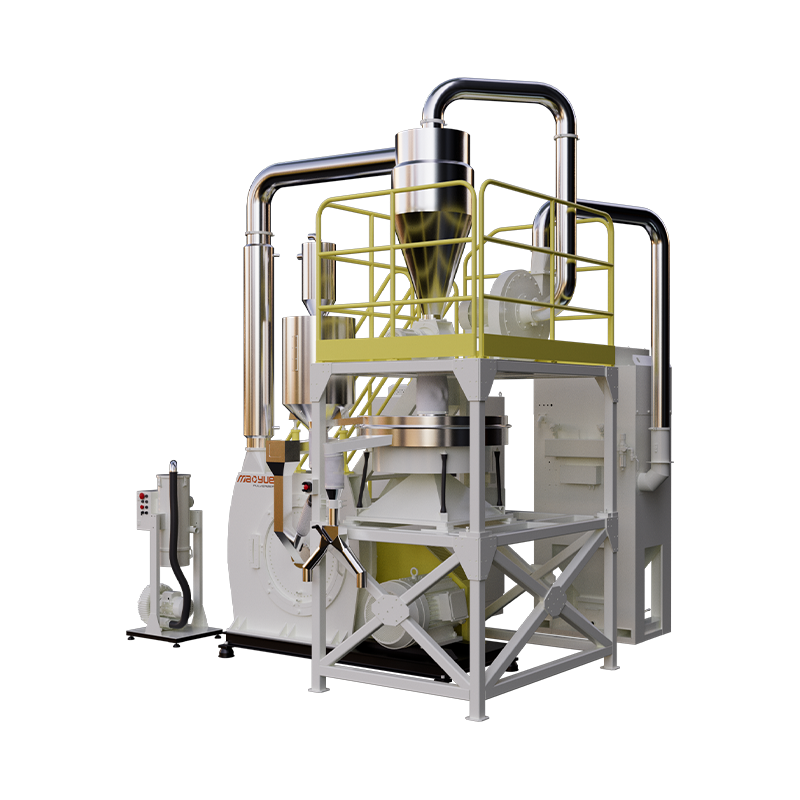
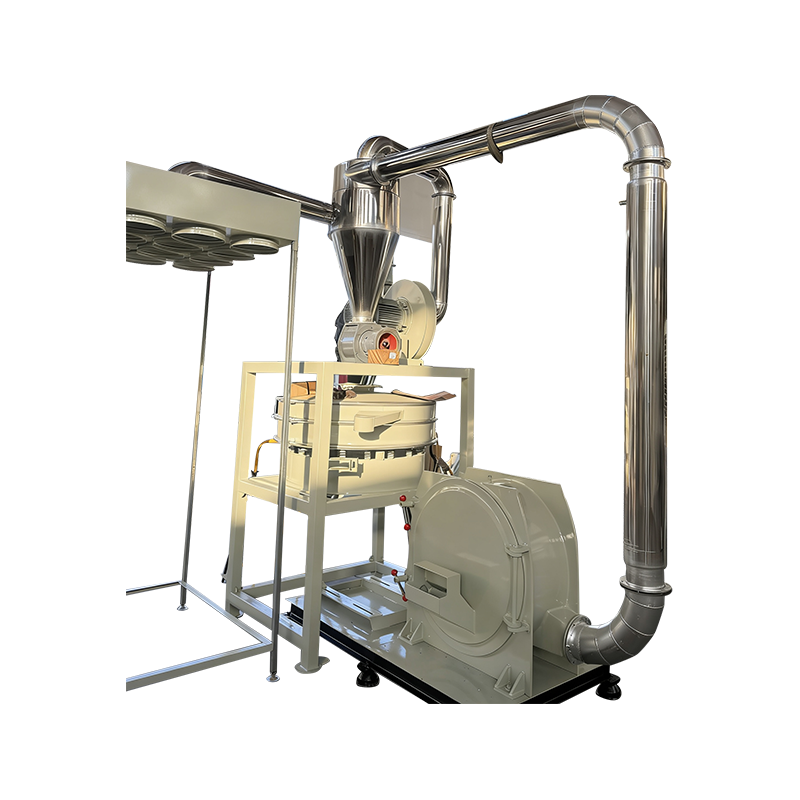
The Model 700 PVC High-Efficiency Grinding Equipment is designed for manufacturers that need dependable, continuous, and flexible pulverising performance without moving to the investment level of a much larger industrial machine. With a grinding disc diameter of approximately 660–700 mm, a main motor range of 55–75 kW, and a practical production range of approximately 300–550 kg/h depending on material and configuration, it occupies an important position between compact PVC pulverisers and high-capacity heavy-duty systems.
The equipment is suitable for PVC recycling, PVC compound production, flooring and wallboard manufacturing, cable material recovery, leather recycling, and other applications that require consistent powder fineness. Its design combines high-speed impact, controlled shearing, friction, air separation, screening, and temperature management in one coordinated production system. As a result, it can produce a stable powder stream while supporting extended operation under medium-to-high production loads.
For many manufacturers, the central challenge is not simply reducing PVC waste to a smaller size. The powder must also have uniform fineness, good flowability, low contamination, and predictable processing behaviour in downstream extrusion, calendering, injection moulding, compounding, or other production stages. The Model 700 addresses these requirements through an upgraded cutting and grinding structure, a composite cooling system, wear-resistant grinding components, and an integrated screening and dust collection arrangement.
Positioning of the Model 700 in PVC Pulverising Production
PVC processing companies often face a difficult equipment-selection decision. A small pulveriser may require too many units to achieve the desired output, while an oversized machine can increase capital expenditure, energy consumption, floor-space requirements, and maintenance complexity. The Model 700 is intended to provide a practical balance between these two extremes.
Compared with the 500 class of pulveriser, the Model 700 offers greater grinding-disc area, higher motor power, more cutting elements, and a larger material-processing capacity. Depending on the specific feedstock, moisture content, formulation, screen setting, and operating conditions, its output may be approximately 80–120% higher than that of a smaller 500 model. This increase allows a medium-sized plant to process more incoming waste without immediately investing in multiple small machines.
Compared with an 800 class system, the Model 700 is generally more economical for businesses whose daily requirements fall within the medium production range. It offers sufficient power for regular PVC recycling and compounding work while avoiding the higher initial investment, larger footprint, and potentially greater operating cost associated with a larger machine. In practical terms, it is designed as a production workhorse for companies that need a balance of capacity, stability, product quality, and manageable investment.
The machine is particularly appropriate for operations with daily processing targets of approximately 8–12 tons when the complete line includes suitable feeding, pre-crushing, conveying, screening, and collection equipment. Actual daily production depends on working hours, feedstock preparation, powder fineness, formulation, and line configuration. The machine should therefore be selected as part of a complete process rather than evaluated only by its nominal motor rating.
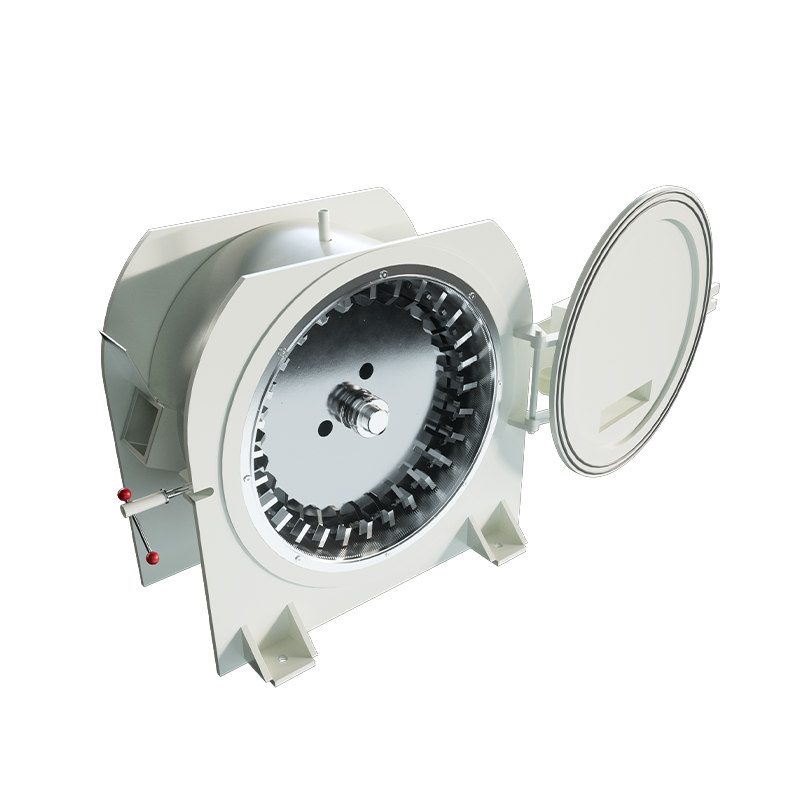
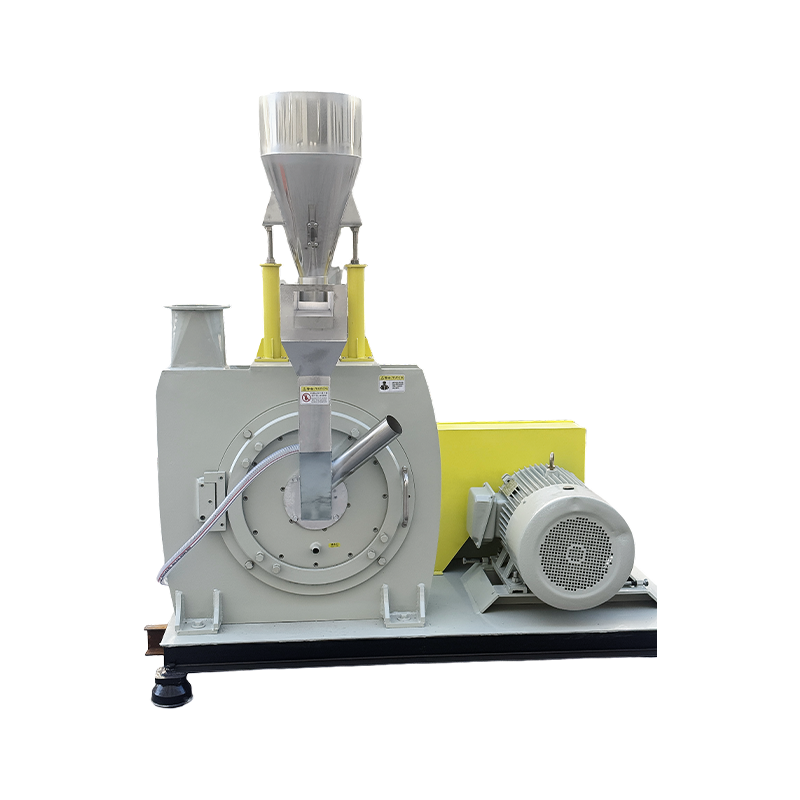
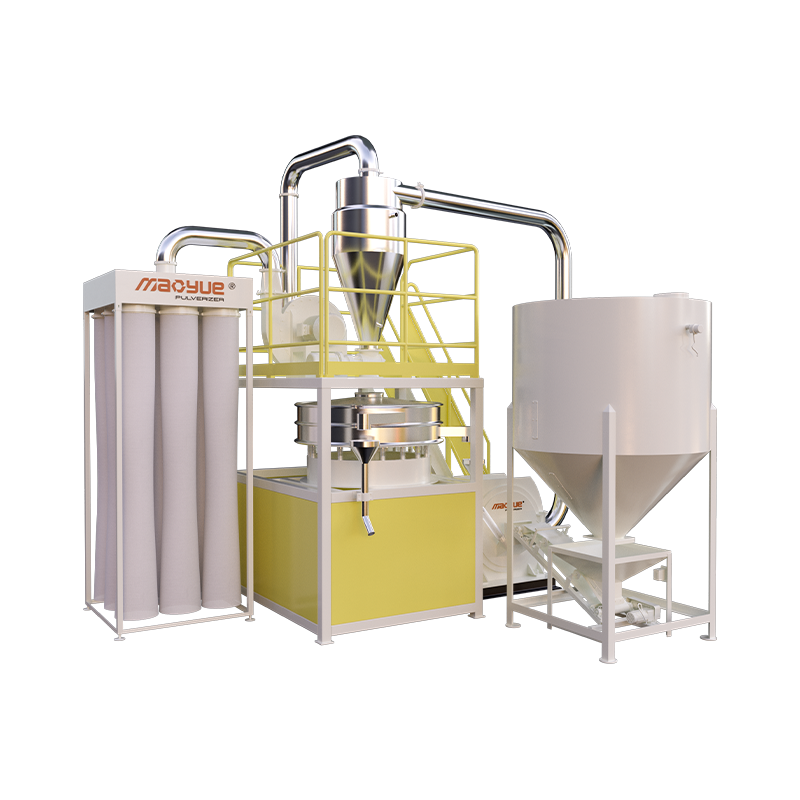
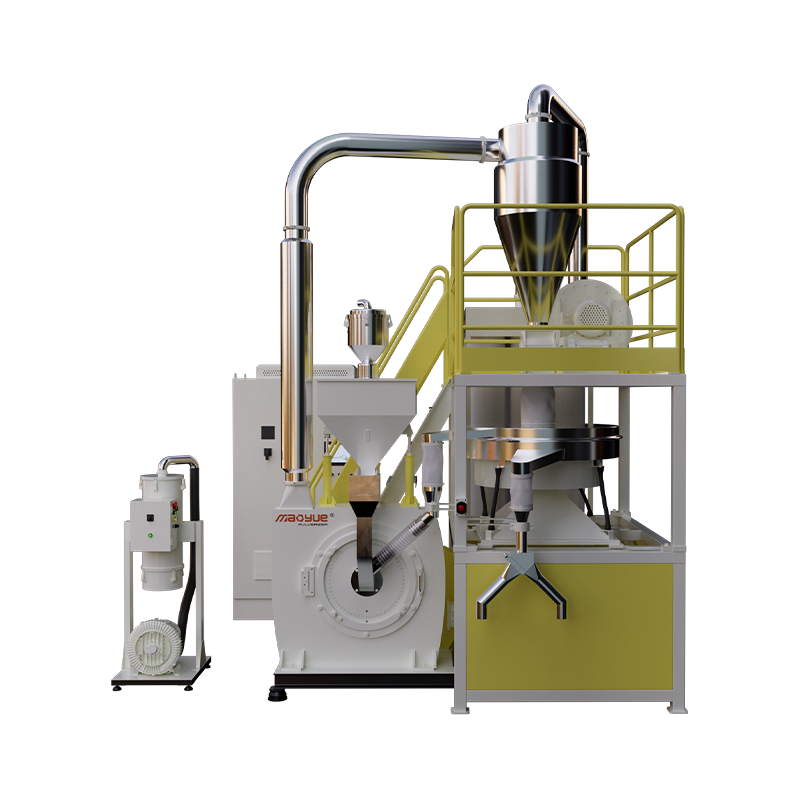
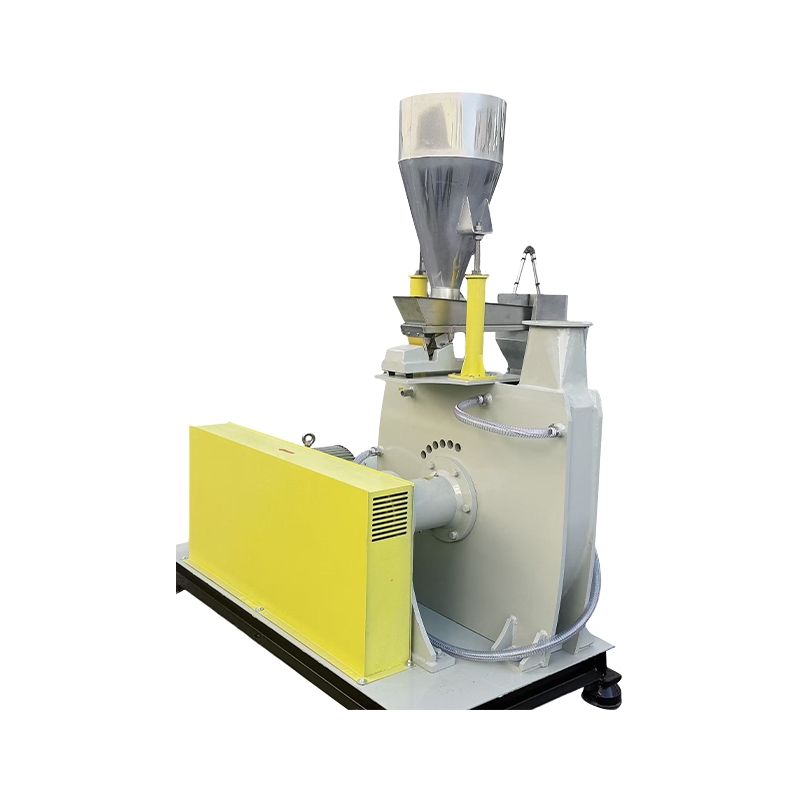
Model 700 PVC High-Efficiency Grinding Equipment
High-Efficiency Grinding Structure
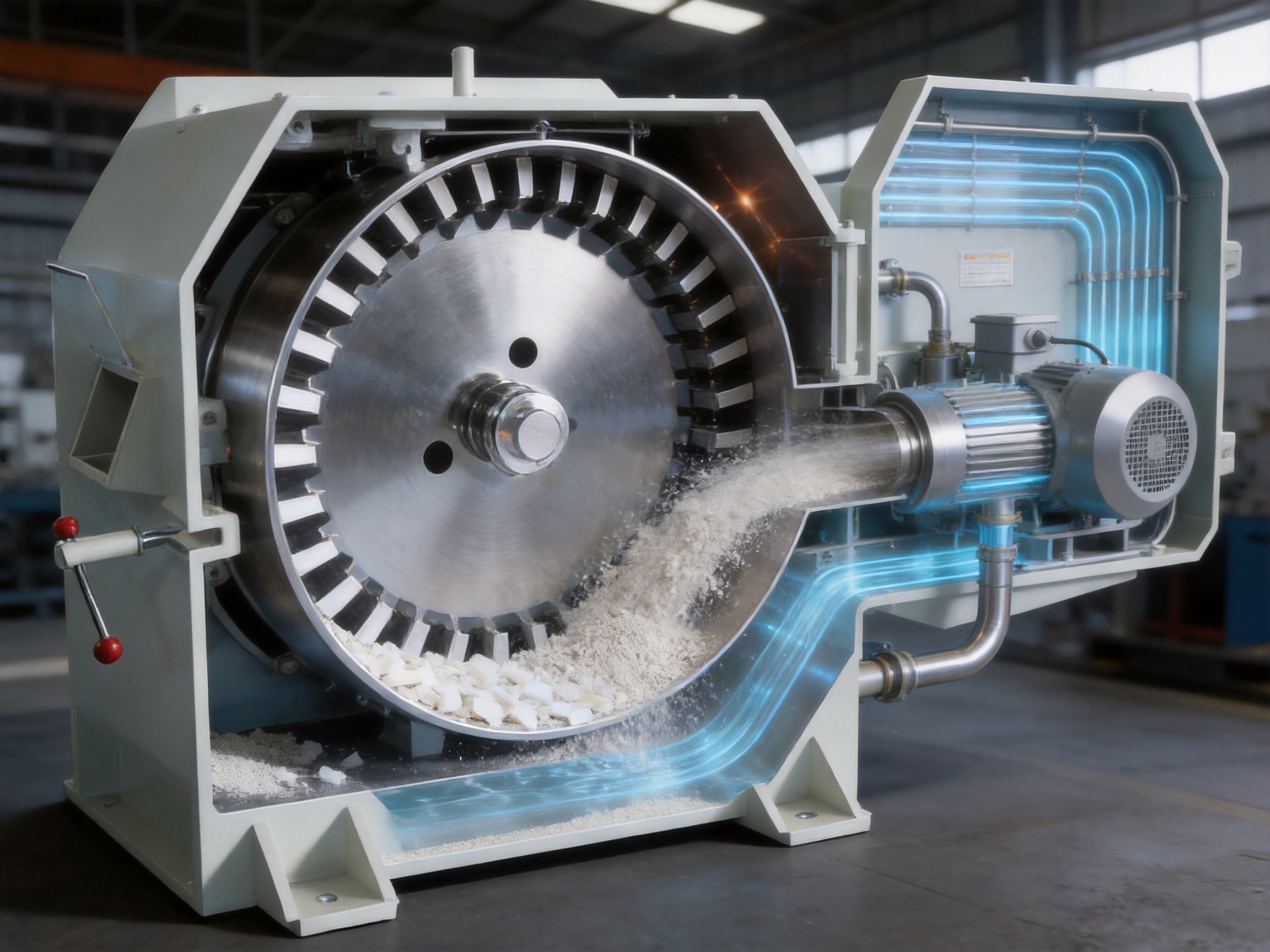
The central grinding assembly is engineered to create repeated contact between the prepared PVC material and the working surfaces. The design uses approximately 32–36 moving blades together with high-density dual-row fixed teeth. This combination creates a dual-action grinding effect. The moving blades generate high-speed shearing and impact, while the fixed teeth help intensify friction and secondary size reduction.
Many basic pulverisers depend primarily on impact. Although impact can reduce material size quickly, it may produce a wider particle distribution or require additional circulation through the grinding chamber. The Model 700 supplements impact with shearing and friction. This helps improve the consistency of the powder and can make the machine more effective when processing rigid profiles, pipe sections, flooring scraps, cable sheathing, and other PVC materials with different physical characteristics.
The arrangement of moving blades and fixed teeth also supports higher throughput at a similar target fineness. Instead of relying only on a larger motor, the grinding chamber uses a more active working geometry to improve the use of installed power. This is important for manufacturers seeking higher productivity while maintaining control over energy consumption per kilogram of finished powder.
The grinding disc has a diameter of approximately 660 mm in the standard specification, while the product range is commonly identified with a 700-class disc design. The larger working surface gives the material more opportunity to pass through the effective grinding zone. It also supports higher feeding rates than smaller machines when the feedstock has been properly pre-sized and the feed system is correctly adjusted.
The blade and tooth arrangement must be matched to the characteristics of the material. Rigid PVC profiles, hard pipes, cable coverings, flooring scraps, and filled formulations may behave differently in the chamber. For this reason, operating parameters such as feeding rate, rotor speed, cooling flow, and screen selection should be adjusted according to the material rather than treated as fixed values for every application.
Shearing and Friction for Uniform Powder
Shearing is particularly useful for materials that need to be cut cleanly rather than simply fractured by impact. Friction then helps reduce remaining coarse particles and contributes to a more uniform final product. The combination can be beneficial for recycled PVC that contains a mixture of different shapes, thicknesses, and hardness levels.
A more uniform powder supports better downstream feeding. In extrusion and compounding, inconsistent particle size can lead to irregular conveying, bridging, uneven melting, and variation in filler distribution. By controlling the grinding action and using a vibrating screen after pulverisation, the Model 700 can help manufacturers produce a more consistent feedstock for subsequent processes.
The system can be configured for a fineness range of approximately 10–100 mesh in the broader product description. The standard technical table identifies a working range of 10–50 mesh. The available range depends on the screen arrangement, material properties, grinding conditions, and process configuration. Buyers should confirm the desired mesh size and required capacity during technical evaluation.
Composite Water-Cooling and Air-Cooling System
Temperature management is one of the most important requirements in PVC pulverising. Friction and repeated impact generate heat, and PVC can be sensitive to excessive temperature. If the powder becomes too hot, it may soften, agglomerate, discolor, or change its flow behaviour. Heat can also affect additives, stabilisers, plasticisers, and other formulation components.
The Model 700 uses an upgraded high-flow water-cooling and air-cooling composite system. The standard water-cooling arrangement uses an inlet and outlet circulation design, allowing cooling water to enter one side and leave through another. The air-cooling function assists material transport and helps remove heat from the working area. Together, these systems are intended to maintain more stable operating conditions than a simple air-only arrangement.
Under appropriate operating conditions, the temperature fluctuation is designed to remain within approximately ±3–4°C. This stated value should be understood as a design performance target that depends on water temperature, water flow, ambient conditions, material feed rate, powder fineness, and machine adjustment. Proper installation and regular inspection of the cooling circuit are essential to achieving stable results.
Stable temperature control provides several production advantages. It helps reduce the risk of partially softened powder sticking to the grinding surfaces, supports more consistent particle formation, and protects heat-sensitive formulations. It can also make it easier for operators to change between different PVC recipes without encountering large changes in powder appearance or flowability.
For plants processing calcium-containing PVC waste, stabilised PVC, or filled formulations, cooling is especially important. Fillers can increase friction and heat generation, while some recycled products may have variable density and composition. A composite cooling system gives operators more control over these changes and helps maintain continuous operation during long production shifts.
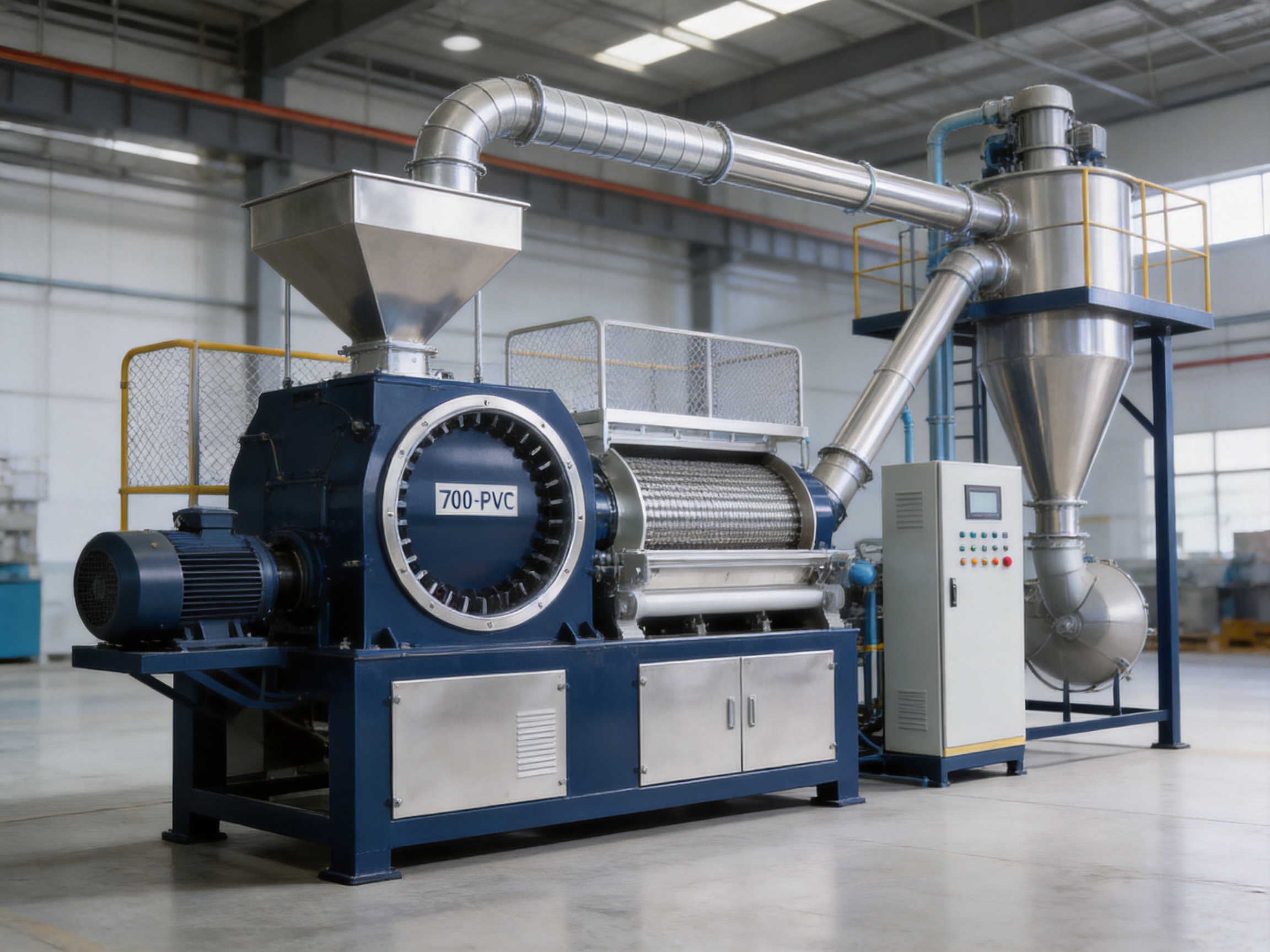
Durable Grinding Components and Extended Maintenance Intervals
PVC recycling can be demanding on grinding components. Construction profiles, pipes, flooring, cable sheathing, and other waste products may contain calcium carbonate, pigments, stabilisers, mineral fillers, metal traces, or embedded contaminants. These materials can accelerate blade and disc wear if the grinding surfaces are not properly selected and maintained.
The Model 700 grinding disc uses carburising and quenching treatment together with a wear-resistant coating. Carburising increases the hardness of the surface layer, while quenching strengthens the treated component. The additional wear-resistant coating provides another protective barrier in areas exposed to repeated friction and impact.
For calcium-containing powders and stabilised PVC materials, the expected service life of the grinding disc may reach approximately 800–1,200 operating hours under suitable conditions. Actual life depends on the type and cleanliness of the material, filler concentration, feed size, operating speed, cooling performance, and maintenance practices. The stated range should therefore be used for planning rather than considered a guaranteed replacement interval.
Longer component life can reduce several types of production cost. The plant may experience fewer planned stoppages, lower spare-parts consumption, and less labour devoted to repeated grinding-disc replacement. More stable working surfaces also help maintain powder quality over a longer period. When wear becomes excessive, the grinding gap and particle distribution can change, leading to higher energy consumption and lower output.
Routine inspection remains important even when wear-resistant components are installed. Operators should examine blade edges, fixed teeth, fasteners, bearing condition, cooling connections, vibration levels, and dust collection performance. Timely adjustment or replacement is safer and more economical than operating with severely worn components that may reduce product quality or damage related parts.
High-Chromium Alloy Blades
The standard specification lists high-chromium alloy as the material for the knives or blades. High-chromium alloys are commonly selected for their hardness, abrasion resistance, and ability to withstand repeated contact with filled plastics. The final performance depends on the alloy composition, heat treatment, blade geometry, installation accuracy, and operating environment.
Blade maintenance should include checking edge condition, balance, fastening security, and clearance from the fixed teeth. Unevenly worn or incorrectly installed blades can cause vibration, reduce grinding efficiency, and place additional stress on bearings and drive components. Correct installation is therefore essential to achieving the intended performance of the grinding chamber.
Screening, Dust Collection, and Powder Purity
Grinding is only one stage of producing usable PVC powder. The final product must also be separated, collected, and protected from contamination. The Model 700 can be equipped with a vibrating screen and pulse dust collector to support powder classification and cleaner handling.
The vibrating screen separates material according to the selected mesh specification. Finer particles can pass through the screen, while oversize material may be returned for additional grinding or directed to a separate collection point, depending on the complete line design. This makes the system more flexible when a customer needs to produce different grades of powder.
The pulse dust collector captures airborne fines generated during pulverising, conveying, and screening. By periodically releasing compressed-air pulses into the filter bags, the collector removes accumulated dust from the filtration surfaces and helps maintain airflow. Effective dust collection improves the working environment, reduces material loss, and supports more reliable operation of the conveying system.
The product information identifies powder impurities below approximately 80 ppm under the specified production arrangement. This performance depends on clean feedstock, effective iron removal, correct equipment cleaning, suitable collection practices, and proper line design. Recycled PVC that contains metal, dirt, fabric, rubber, or other foreign materials must be pre-treated and separated before it enters the pulveriser.
The standard equipment information includes an iron-removal tie feeding method. Removing ferrous contaminants before grinding is important for protecting blades, fixed teeth, the grinding disc, and other machine components. It also helps improve the purity of the final powder and reduces the risk of sparks, abnormal wear, or unexpected equipment damage.
Item | Standard or stated specification | Production significance |
Model | 700 | Medium-to-high capacity PVC pulverising platform |
Grinding disc diameter | Approximately 660 mm | Provides a larger working area than compact models |
Main motor | 55 kW standard; 55–75 kW range described | Supports higher throughput and demanding formulations |
Capacity | Approximately 300–550 kg/h; standard table: 320–500 kg/h | Depends on feedstock, mesh size, and configuration |
Fineness | 10–50 mesh in standard table; flexible range up to approximately 100 mesh | Allows different downstream processing requirements |
Moving blades | Approximately 32–36 | Creates active shearing and impact action |
Blade material | High-chromium alloy | Designed for abrasion resistance |
Blower motor | 7.5 kW | Assists pneumatic conveying and cooling airflow |
Pipe material | Stainless steel | Supports clean material transfer |
Pipe diameter | 159 mm | Suitable for the stated conveying arrangement |
Vibrating screen diameter | 1,200 mm | Supports post-grinding classification |
Vibrating-screen motor | 1.5 kW | Drives the powder separation stage |
Dust-collector bag diameter | 300 mm | Supports filtration and powder recovery |
Speed control | Star-delta, soft start, or inverter | Provides alternative starting and control methods |
Cooling method | Water cooling with inlet and outlet circulation | Helps control grinding temperature |
Applications in PVC Recycling
The Model 700 is well suited to medium-scale recycling lines that process PVC window and door profiles, scrap pipes, vinyl flooring, wall coverings, cable sheathing, production offcuts, and other rigid or semi-rigid PVC waste. These materials are often available in irregular shapes and may include different colours, thicknesses, and formulations. Pre-sorting and pre-crushing are recommended to ensure that the pulveriser receives material within the intended size range.
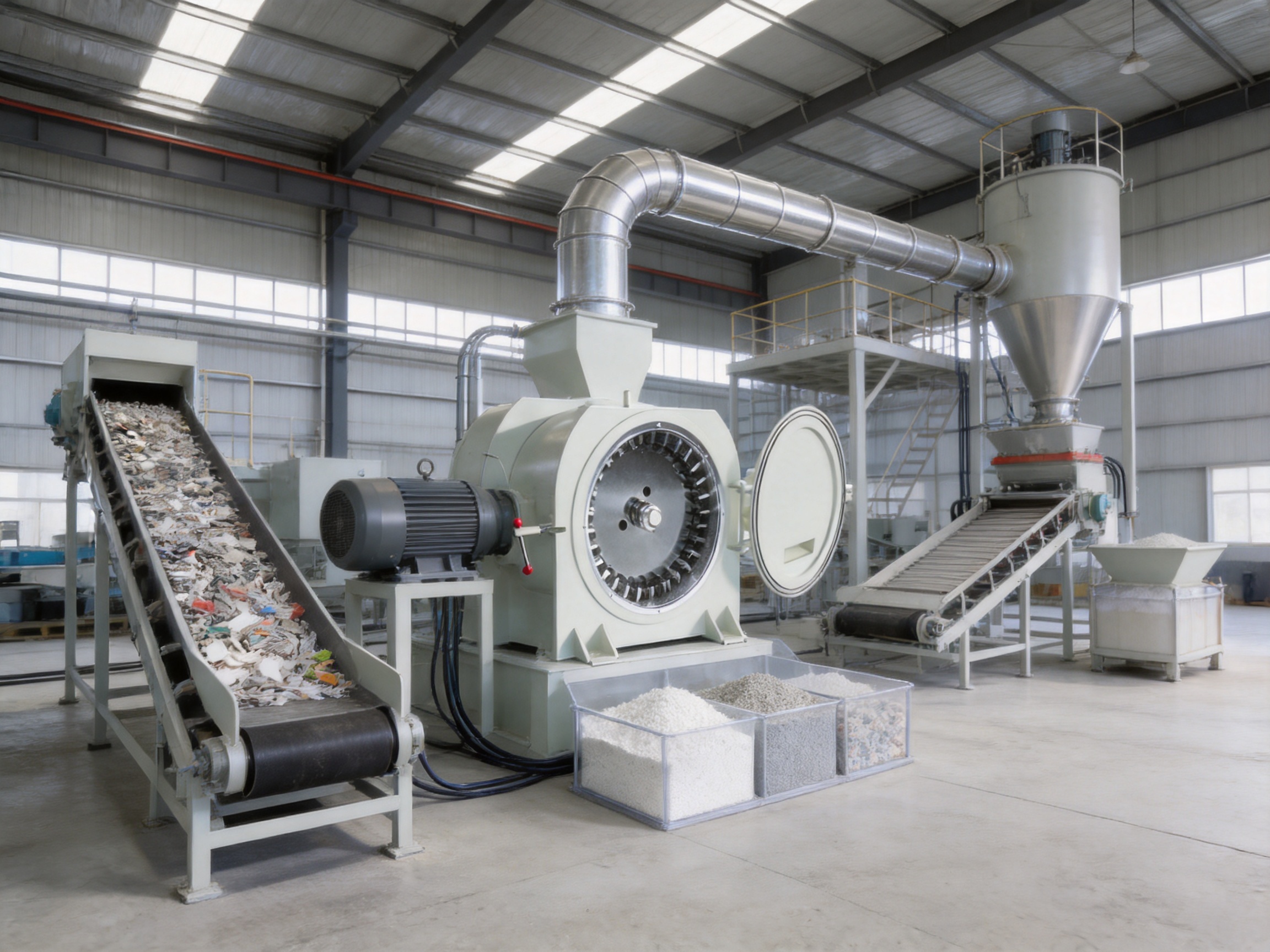
In a typical recycling process, incoming waste is first inspected and separated. Metal components, dirt, rubber, fabric, and non-PVC materials should be removed as far as practical. Large pieces are then reduced by a crusher or granulator. The prepared material is conveyed into the Model 700, where it is exposed to high-speed shearing, impact, and friction. The cooling system controls heat while the blower moves the ground material toward the screening and collection sections.
The final PVC powder can be used as a feedstock for recycled extrusion, profile production, pipe manufacturing, injection moulding, or other processes subject to formulation requirements. The suitability of the powder depends on its composition, contamination level, thermal history, and intended application. Where different waste streams have different additives or colours, separate processing and blending strategies may be necessary.
For a medium-sized recycling plant, the main benefit is the opportunity to create a higher-value intermediate product. Instead of selling mixed or roughly shredded waste, the business can produce a controlled powder that is easier to store, transport, blend, and feed into a downstream production line. This can support more integrated recycling and improve the utilisation of recovered PVC.
Applications in Flooring, Wallboard, and Building Products
PVC flooring, wallboard, ceiling panels, and related building products often require a powder feedstock with stable particle size and good flowability. Irregular or oversized particles can affect feeding, melting, surface quality, thickness uniformity, and the appearance of the finished product.
The Model 700 can function as a powder preparation unit for medium-sized calendering or extrusion lines. Its screen and cooling systems help the operator control the condition of the output before it reaches a mixer or production extruder. With appropriate formulation control, the powder can be blended with stabilisers, plasticisers, fillers, pigments, and other additives according to the product specification.
A uniform powder may contribute to smoother feeding and more even dispersion of additives. In flooring production, this can support consistent surface appearance and thickness. In wallboard and ceiling-panel applications, stable powder quality can help maintain product density and mechanical performance. The equipment does not replace formulation development or quality testing, but it provides a reliable size-reduction stage for those processes.
Processing Cable Sheathing, Leather, and Composite PVC Waste
Cable sheathing and wire-related PVC waste can contain high levels of filler, pigment, plasticiser, or reinforcing material. Some scrap is also produced in composite forms with metal or other polymer components. The Model 700 is suitable for the pulverising stage after effective separation of metal and unsuitable materials.
When cable sheathing is properly prepared, the machine can produce a powder with good dispersion potential for recycled cable compounds. Low contamination is important because metallic particles and foreign polymers may affect electrical performance, mechanical properties, and processing stability. Iron removal and upstream sorting are therefore essential parts of the line.
The same grinding principle can be applied to suitable PVC leather waste and soft or hard composite scraps. The operator may need to adjust feed rate, screen size, cooling intensity, and blade condition according to the material. Softer PVC can generate more heat or have a greater tendency to agglomerate, making temperature control particularly valuable.
For medium-scale cable and leather recycling enterprises, the Model 700 can provide a practical batch-processing solution. It offers more capacity than a small laboratory or entry-level unit while remaining more economical and easier to integrate than a very large industrial pulverising system.
Support for PVC Compound Modification
The equipment is also intended for businesses producing modified PVC compounds or developing new formulations. PVC may be combined with calcium carbonate, stabilisers, plasticisers, flame retardants, pigments, processing aids, and other additives. These formulations often require controlled blending and pulverising in medium batches.
A convenient material-changeover arrangement is useful when a factory frequently switches between grades. Efficient cleaning and accessible working components can reduce the time needed to change from one formulation to another. This is especially valuable for companies that produce several colours, filler levels, hardness grades, or performance specifications.
Temperature control is important during formulation changes because different additives can respond differently to heat and friction. A stable grinding environment helps reduce the risk of unwanted softening or agglomeration. Operators can also use different screen settings to prepare powders for trial production, customer samples, and larger-scale manufacturing.
For a company moving from small-batch development to regular production, the Model 700 can serve as a bridge between testing equipment and a large industrial line. It provides a larger and more repeatable production platform while allowing the manufacturer to maintain flexibility in material selection and formula switching.
Motor, Drive, and Starting Options
The standard technical information lists a 55 kW drive motor, while the broader product description identifies a 55–75 kW main motor range. This allows the equipment to be configured according to the required capacity, material hardness, powder fineness, and production target. A higher-power configuration may be appropriate for difficult, heavily filled, or high-throughput applications, while the standard motor can provide a more economical solution for general PVC recycling.
Several starting and speed-control options are available, including star-delta starting, soft starting, and inverter control. Star-delta starting can provide a straightforward method for reducing starting current compared with direct-on-line starting. Soft starting can reduce mechanical shock during start-up. Inverter control provides greater flexibility for adjusting operating speed when the application requires different material conditions or fineness levels.
The preferred control method should be selected after considering the site electrical system, local regulations, production requirements, and operator practices. An inverter may provide useful process flexibility, but its selection must be compatible with the motor, control cabinet, cooling arrangement, and protection system. Correct electrical installation is essential for safe and reliable operation.
Manufacturing Strengths and Engineering Capability
The equipment is produced by Changzhou Mao Yue Intelligent Equipment Co., Ltd., a source manufacturer with approximately 30 years of experience in plastic crushing and pulverising equipment. The company focuses on disc pulverisers and related size-reduction systems for plastic processing applications, including PVC, PE, polymers, masterbatch, rotational moulding materials, recycling, and powder coating.
A direct manufacturing structure can provide advantages over trading-based equipment supply. It allows closer control of component selection, machining accuracy, assembly standards, testing, and technical communication. Customers can discuss material characteristics and production targets directly with the manufacturer rather than relying only on a general equipment distributor.
The company operates six processing workshops, with each workshop averaging approximately 1,400 square metres. This workshop structure supports the production of machine bodies, grinding components, conveying sections, screening assemblies, dust collection equipment, and related parts. It also provides space for assembly, inspection, testing, and preparation of complete production systems.
The factory uses high-precision grinding machines imported from Taiwan and manufactured to German standards. Precision machining is important for grinding discs, blade seats, shafts, bearing locations, and other components whose alignment affects vibration, wear, and powder quality. Accurate machining helps ensure that rotating assemblies remain stable during high-speed operation.
German dynamic balancing equipment is used to evaluate rotating parts. Dynamic balance is a critical consideration for a pulveriser because the grinding disc and rotor operate at high speed. Poor balance may create vibration, accelerate bearing wear, increase noise, reduce grinding efficiency, and affect the safety of the machine. Proper balancing supports smoother operation and longer service life.
Japanese welding systems are also used in the factory. Consistent welding quality contributes to the strength and dimensional stability of machine frames, housings, hoppers, ducts, and collection structures. Accurate welded assemblies make subsequent installation and alignment more predictable.
Quality Management and Certification
The manufacturer has obtained CE mechanical certification and ISO 9001 quality management system certification. CE certification indicates conformity with applicable European mechanical safety requirements for the relevant equipment scope. ISO 9001 certification reflects the use of a documented quality management approach covering areas such as production control, inspection, corrective action, and process improvement.
Certification does not eliminate the need for correct installation, guarding, electrical protection, operator training, and regular maintenance. However, it provides an important reference for customers evaluating machine safety and manufacturing quality. It can also support companies that need equipment documentation for internal approval, international procurement, or regulatory review.
The company states that its components are manufactured according to European quality standards and that its technical team regularly studies advanced machine technologies from Germany and other industrial markets. This focus on process development helps the manufacturer improve grinding structures, cooling systems, component durability, and overall line integration.
Advantages Over Basic and Oversized Alternatives
The Model 700 has several practical advantages over basic pulverisers. Its combination of moving blades and dual-row fixed teeth provides a more active grinding process than a simple impact-only chamber. The larger disc and higher motor range support increased output, while the vibrating screen and pulse dust collector improve product handling after grinding.
The composite cooling design is another important distinction. Basic air-cooled machines may struggle when processing high-filler PVC, soft PVC, or material requiring a fine mesh. Water cooling adds a further method of removing heat and can help the machine remain stable during extended production periods.
The wear-resistant disc treatment and high-chromium alloy blades are intended to reduce the frequency of maintenance compared with less durable working components. This is especially valuable when the incoming PVC contains calcium carbonate or other abrasive ingredients.
At the other end of the scale, the Model 700 may be more economical than an oversized pulveriser for medium-sized factories. A larger machine may offer greater peak capacity, but its cost and energy requirements may not be justified if the actual production target is within the Model 700 range. Selecting a correctly sized machine can improve asset utilisation and reduce the risk of paying for unused capacity.
The machine also offers more flexibility than a dedicated single-formula system. Its adjustable fineness, speed-control alternatives, material-changeover design, and temperature-management features allow it to serve recycling, compound production, and product-manufacturing applications within the same factory.
Installation and Operating Considerations
Successful performance depends on the complete production line. The foundation should be level and strong enough to support the machine and absorb normal operating vibration. Adequate space is required around the grinding chamber, motor, screen, dust collector, electrical cabinet, inspection points, and maintenance access areas.
The electrical supply must match the selected motor, control method, voltage, frequency, and protection devices. Cooling-water connections should be installed with suitable valves, filtration, flow control, drainage, and monitoring. Water quality and circulation stability should be checked regularly to prevent blockage or reduced heat-transfer performance.
Feedstock preparation is equally important. Large pieces should be pre-crushed to a suitable size. Metal and foreign materials should be removed before the material enters the pulveriser. Feed should be as consistent as possible in composition and moisture. Overfeeding can increase temperature, reduce fineness, overload the motor, and accelerate wear.
Operators should start the cooling and auxiliary systems according to the operating procedure before introducing material. The machine should reach a stable running condition before the feed rate is increased. During production, operators should monitor motor current, temperature, vibration, airflow, water flow, powder appearance, and screen performance.
When changing formulations or waste streams, the grinding chamber and conveying system should be cleaned as required. This reduces cross-contamination and helps maintain powder purity. Particularly sensitive products may require a defined cleaning procedure and the collection of a small transition batch before full production resumes.
Maintenance and Safety Practices
Maintenance should include regular checks of blades, fixed teeth, grinding-disc surfaces, bearings, belts, pulleys, fasteners, screens, blower components, dust-collector bags, and cooling lines. Imported NSK bearings are listed in the standard specification for the belt pulley assembly. Even high-quality bearings require correct lubrication, alignment, sealing, and protection from dust.
The screen should be inspected for blocking, tearing, or deformation. A damaged screen can allow oversize particles into the finished powder or reduce the capacity of the separation stage. Dust-collector bags should be cleaned or replaced according to pressure loss and condition rather than only according to a fixed calendar.
Before opening the grinding chamber, the machine must be stopped, isolated from the power supply, and protected against unexpected start-up. All rotating parts must come to a complete stop. Operators should use appropriate personal protective equipment and follow site-specific lockout and tagout procedures.
Dust control is also important because fine plastic powder can become airborne. The pulse dust collector should operate effectively, duct connections should be sealed, and the work area should be cleaned using methods appropriate for fine powder. Compressed air should not be used indiscriminately to blow dust into the workplace.
Safety guards must remain installed during operation. Blades, grinding discs, belts, shafts, and other moving parts can cause serious injury if accessed while the machine is running. Only trained personnel should adjust the machine, replace wear parts, inspect electrical components, or modify the control system.
How to Select the Correct Configuration
Customers should provide the manufacturer with detailed information before confirming a Model 700 configuration. Important data includes the type of PVC, bulk density, moisture content, filler concentration, incoming particle size, desired mesh size, expected hourly capacity, daily operating hours, and required powder purity.
It is also useful to provide representative samples of the intended material. A sample test can help determine the practical capacity, temperature behaviour, screen selection, blade arrangement, motor size, and dust-collection requirements. Recycled PVC can vary greatly, so test data is more reliable than selecting a machine based only on the name of the material.
Customers should distinguish between nominal capacity and guaranteed production. A capacity of 300–550 kg/h describes a broad operating range. The lower or higher end may apply under different fineness, feedstock, and configuration conditions. The standard table lists 320–500 kg/h, which provides a more specific reference for the standard arrangement.
The desired fineness should also be defined clearly. Producing a coarser powder generally allows higher throughput, while finer powder may require lower feed rates, more grinding energy, additional circulation, and stronger cooling. If several mesh sizes are required, the screening and changeover arrangement should be discussed before installation.
Economic Value for Medium-Sized Enterprises
The financial value of the Model 700 comes from the relationship between output, stability, maintenance, and investment. Higher throughput can reduce the number of machines required for a given production target. Better temperature management can reduce quality losses and interruptions. Wear-resistant components can help control maintenance expenditure. Screening and dust collection can improve recovery and reduce material loss.
Energy consumption should be evaluated on a per-kilogram basis rather than only by motor size. A larger motor consumes more power when operating at full load, but it may also produce more powder per hour. The appropriate comparison is the total energy required to produce the required quantity at the specified fineness and quality.
Labour costs may also be affected. A stable automated line can reduce manual handling, improve material transfer, and allow operators to supervise more than one stage of production. The vibrating screen and pulse dust collector help limit the need for manual separation and powder recovery.
For recycling enterprises, the most important economic benefit may be the increase in material value. Clean, uniform PVC powder can be more useful to downstream manufacturers than mixed flakes or irregular shredded waste. This creates the possibility of more integrated production, although the final commercial value will depend on formulation, market requirements, and quality control.
Q&A: Model 700 PVC Pulverising Equipment
What type of material can the Model 700 process?
The equipment is intended primarily for PVC, including rigid profiles, pipes, vinyl flooring, production offcuts, cable sheathing, soft and hard PVC leather, and suitable filled or stabilised formulations. Feedstock should be pre-sorted, pre-crushed when necessary, and cleared of metal and other foreign materials.
What is the expected production capacity?
The broader product description gives an approximate capacity of 300–550 kg/h, while the standard technical table lists 320–500 kg/h. Actual output depends on material type, feed size, moisture, filler content, selected mesh size, motor configuration, and operating conditions.
Why does the product information show more than one capacity range?
The ranges represent different configurations and operating conditions. A standard 55 kW configuration may operate within the table range, while a higher-power or specially configured machine may approach the upper range. A technical assessment should be completed for each application.
What mesh sizes can be produced?
The standard table identifies 10–50 mesh, while the broader description indicates flexible fineness control from approximately 10–100 mesh. The practical range depends on the screen, feedstock, grinding settings, and required capacity. Customers should confirm the target powder specification before ordering.
How does the cooling system work?
The system combines water cooling and air cooling. Water enters through one connection and leaves through another, while airflow assists material movement and heat removal. The combined arrangement is designed to control temperature fluctuations during continuous production.
Is the machine suitable for long operating shifts?
It is designed for continuous operation under medium-to-high loads and is described as stable for approximately 8–12 hours. Actual operating time depends on correct feeding, cooling, maintenance, material cleanliness, and compliance with the recommended operating procedure.
How long can the grinding disc last?
For calcium-containing powders and stabilised PVC, the expected service life is approximately 800–1,200 hours under suitable conditions. Abrasive contamination, high filler content, incorrect operation, poor cooling, and excessive feed rate can reduce service life.
Does the equipment include dust collection?
The system can be equipped with a pulse dust collector and vibrating screen. The standard information lists a 300 mm dust-collector bag diameter and a 1,200 mm vibrating-screen diameter. The final configuration should be confirmed according to the line layout and local dust-control requirements.
Can the Model 700 process different PVC formulations?
Yes. It is intended to support multiple PVC formulations, including materials containing calcium carbonate, stabilisers, plasticisers, flame retardants, and other additives. Proper cleaning and parameter adjustment are necessary when switching between formulations.
What starting methods are available?
The standard specification lists star-delta starting, soft starting, and inverter control. The appropriate option depends on the plant electrical system, desired speed flexibility, motor configuration, and local technical requirements.
What should be done before purchasing?
Customers should provide material samples or detailed material information, desired capacity, target mesh size, daily operating hours, filler content, moisture level, and downstream application. Testing and technical consultation can help confirm the most suitable motor, screen, cooling, feeding, and collection configuration.
What manufacturing advantages does the supplier offer?
The supplier has approximately 30 years of experience, six processing workshops, high-precision grinding equipment from Taiwan, German dynamic balancing equipment, Japanese welding systems, CE mechanical certification, and ISO 9001 quality management certification. These capabilities support controlled machining, balanced rotating assemblies, reliable welding, and consistent production procedures.
Conclusion
The Model 700 PVC High-Efficiency Grinding Equipment is designed for manufacturers that need more capacity and flexibility than a compact pulveriser can provide, but do not require the cost and scale of a very large industrial system. Its 660–700 mm class grinding disc, 55–75 kW motor range, 32–36 moving blades, dual-row fixed teeth, composite cooling, wear-resistant components, vibrating screening, and pulse dust collection form a coordinated solution for medium-scale PVC powder production.
Its strongest advantages are the combination of shearing and friction, stable temperature control, durable grinding surfaces, flexible fineness, and suitability for continuous operation. These features make it applicable to PVC recycling, flooring and wallboard production, cable and leather recycling, and compound modification.
The machine’s performance is supported by the manufacturer’s direct production capability, precision machining resources, dynamic balancing equipment, welding systems, technical experience, and quality certifications. For customers evaluating equipment on total production value rather than motor power alone, the Model 700 offers a balanced option that connects capacity, powder quality, operating stability, maintenance control, and investment efficiency.
References
1. Product technical specification for Model 700 PVC High-Efficiency Grinding Equipment, including capacity, motor, disc, screen, cooling, and dust-collection data.
2. Manufacturer-provided information on PVC recycling, compound modification, flooring production, cable-sheathing recovery, and powder-processing applications.
3. Manufacturer-provided company profile covering production workshops, machining equipment, dynamic balancing, welding systems, certifications, and technical experience.
4. General engineering principles for plastic pulverising, particle-size classification, temperature control, dust collection, and wear-resistant component maintenance.
5. General industrial guidance for the safe operation, isolation, inspection, and maintenance of high-speed plastic size-reduction machinery.