

 English
 русский
 Español
 عربى
عربى 中文简体
中文简体
 中文简体
中文简体
Content
- 1 Product Overview
- 2 Why the Rotor Matters in PVC Pulverizing
- 3 Key Structural Features
- 4 Performance Advantages Over Conventional Rotors
- 5 Manufacturing Processes That Support Rotor Quality
- 6 Material Engineering and Heat Treatment
- 7 Precision, Balance, and High-Speed Stability
- 8 Powder Quality and Particle Size Control
- 9 Cooling Compatibility and Temperature Control
- 10 Applications in PVC Recycling and Regeneration
- 11 Applications in PVC Powder Products and Building Materials
- 12 Applications in Polymer Modification and Chemical Processing
- 13 Compatibility and Customization
- 14 Cost-Performance and Total Ownership Value
- 15 Quality Assurance and Certifications
- 16 Installation and Maintenance Considerations
- 17 Operational Benefits for 24-Hour Production
- 18 Competitive Position in the Pulverizer Parts Market
- 19 Contribution to Green Manufacturing and Circular Economy Goals
- 20 Q&A Section
- 20.1 Q1: What is the main function of the large disc-shaped rotor in a PVC pulverizer?
- 20.2 Q2: Why is a modular blade design better than a traditional one-piece disc?
- 20.3 Q3: What powder fineness can this rotor help achieve?
- 20.4 Q4: Is the rotor suitable for recycled PVC containing fillers?
- 20.5 Q5: How does the rotor reduce production downtime?
- 20.6 Q6: How does the rotor improve output?
- 20.7 Q7: Why is cooling important when pulverizing PVC?
- 20.8 Q8: Can the rotor be customized?
- 20.9 Q9: What manufacturing processes support rotor reliability?
- 20.10 Q10: What industries can benefit from this rotor?
- 21 Conclusion
- 22 References
- 23 Product: PVC Pulverizer Large disc-shaped Rotor
In modern PVC recycling, compounding, profile manufacturing, flooring production, cable material recovery, and plastic powder processing, the pulverizer rotor is not simply a replaceable component. It is the core working element that determines output capacity, powder fineness, operating stability, energy efficiency, service life, maintenance cost, and the long-term competitiveness of the entire production line. A large disc-shaped rotor designed specifically for PVC pulverizing provides a powerful solution for processors that require stable fine powder, high throughput, low downtime, and reliable operation under continuous industrial conditions.
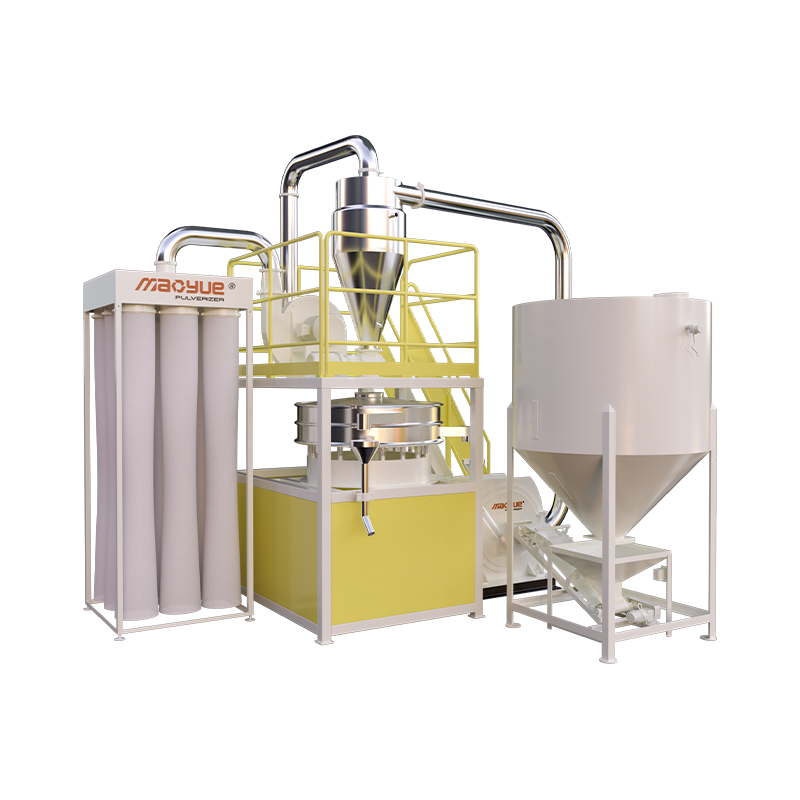
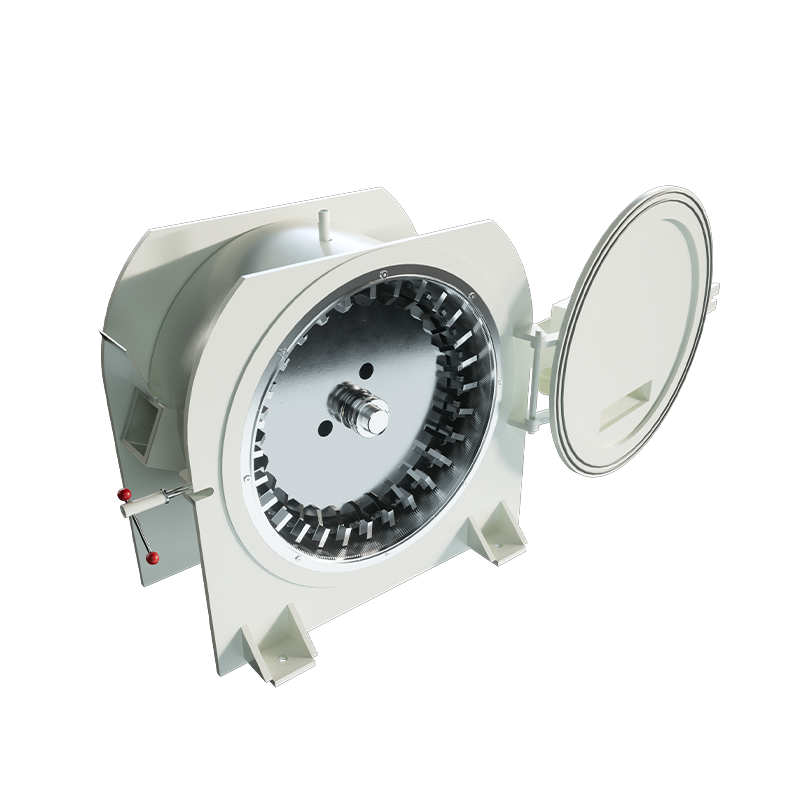
The PVC pulverizer large disc-shaped rotor described in this article is engineered for disc-type PVC grinding mills and demanding plastic size-reduction systems. It uses a large circular disc structure with multiple independently replaceable cutting blocks arranged evenly around the disc periphery. Each cutting block is fixed by high-strength bolts, while the rotor body includes a precision central shaft hole for accurate, stable, high-speed connection with the main spindle. The rotor is manufactured through CNC precision machining, heat treatment, carburizing and quenching, and multiple tempering processes, creating a wear-resistant working surface and a durable structure suitable for long operating cycles.
Compared with traditional monolithic grinding discs or low-tooth-count rotor designs, this modular multi-blade rotor brings major improvements in maintenance convenience, production efficiency, powder uniformity, and cost control. Instead of replacing an entire disc when only some cutting edges are worn, operators can replace only the individual worn cutting blocks. This modular approach can sharply reduce maintenance downtime, lower spare part consumption, and extend the usable life of the rotor assembly. For plants running continuous PVC pulverizing operations, the reduction in lost production time can be one of the most important advantages.
PVC Pulverizer Large disc-shaped Rotor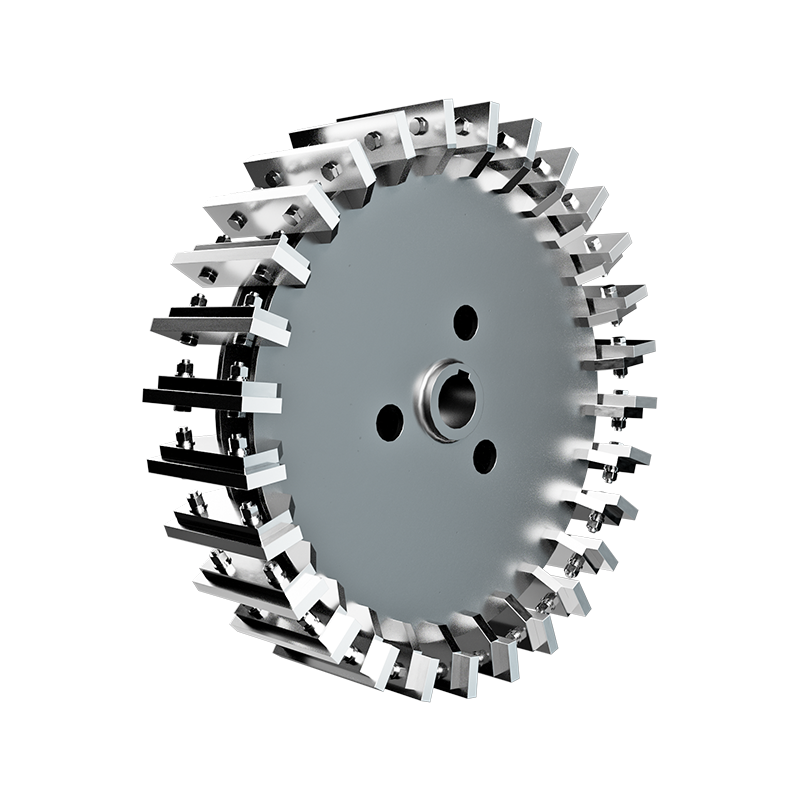
Product Overview
The large disc-shaped rotor is designed for PVC pulverizer applications requiring strong shearing, frictional grinding, and stable heat control. Its main body is a heavy-duty circular disc, precision machined to maintain dimensional accuracy, concentricity, and dynamic balance. Around the outer circumference, multiple blade block groups are positioned in optimized radial or interlaced arrangements. This geometry allows the rotor to engage PVC material at multiple points during high-speed rotation, improving grinding intensity and increasing the probability of repeated cutting and impact before particles exit the grinding chamber.
The cutting blocks are engineered as independent wear components. They can be removed, inspected, rotated, replaced, or customized according to operating requirements. This design is especially valuable for PVC materials containing calcium carbonate, stabilizers, pigments, recycled impurities, or other fillers that accelerate wear. In such working conditions, a conventional one-piece disc may gradually lose cutting sharpness across the entire edge, forcing full replacement or complex regrinding. A modular rotor reduces this burden by separating the expensive rotor base from the consumable blade elements.
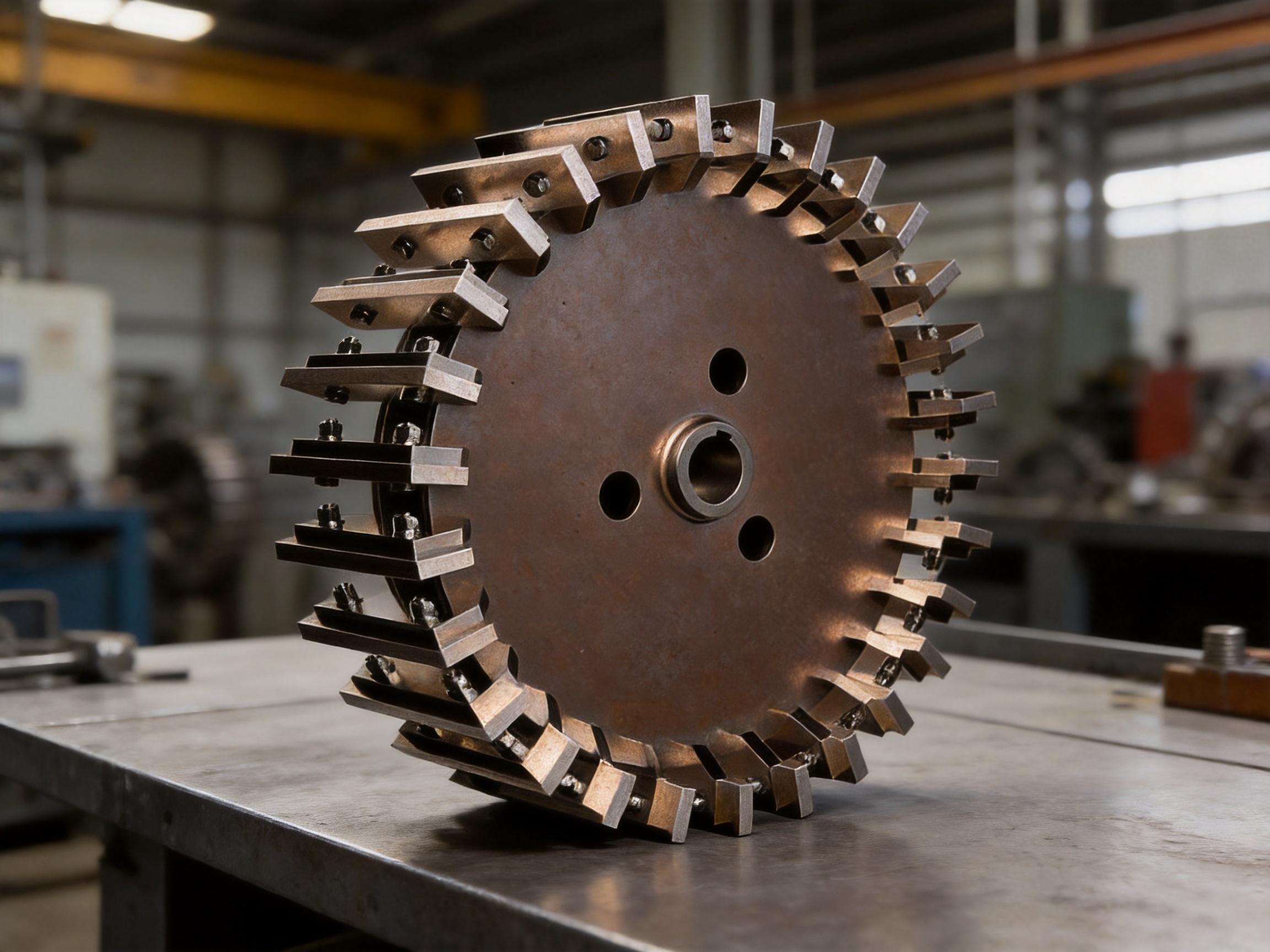
The surface of the rotor typically appears deep brown or rust-brown due to oxidation, heat treatment, or wear-resistant coating processes. The appearance is not merely decorative. It reflects the industrial hardening and surface treatment approach used to improve resistance against abrasion, edge fatigue, chipping, and impact. Stable hardness in the approximate range of HRC 58–62 is targeted for the cutting sections, balancing wear resistance with sufficient toughness for the repeated stress cycles of PVC pulverizing.
For powder quality, the rotor is designed to help produce PVC powder in the 20–100 mesh range, depending on material type, machine configuration, screen or classifier setup, cooling efficiency, and operating parameters. The intended powder characteristics include narrow particle size distribution, reduced coarse particle content, strong uniformity, clean appearance, and minimized scorching or thermal discoloration. These properties are critical for downstream extrusion, calendering, injection molding, regranulation, compounding, and building material production.
Why the Rotor Matters in PVC Pulverizing
PVC is a unique plastic in size reduction. It is not processed in exactly the same way as polyethylene, polypropylene, polystyrene, or engineering plastics. PVC can be rigid or flexible, virgin or recycled, filled or unfilled, plasticized or unplasticized, pigmented, stabilized, compounded, laminated, or contaminated by previous service conditions. During pulverizing, friction heat can soften or degrade the material, causing sticking, plate adhesion, yellowing, agglomeration, or loss of powder flowability. Therefore, the cutting rotor must be sharp, strong, balanced, thermally stable, and compatible with an effective cooling system.
The rotor is the component that transfers motor power into cutting action. If the rotor geometry is poor, energy is wasted as heat and vibration. If the rotor balance is poor, bearings and spindle systems experience stress. If the blades wear too quickly, particle size becomes unstable. If the cutting edges chip, contamination and safety risks increase. If the disc is difficult to service, downtime grows. In industrial production, all of these factors become direct costs. The rotor therefore influences not only powder quality but also maintenance planning, labor intensity, spare part inventory, and total cost per kilogram of pulverized PVC.
A large disc-shaped modular rotor addresses these challenges by combining high cutting density, replaceable blade groups, precise machining, strong fastening, and heat-treated cutting surfaces. The design supports stable high-speed operation, efficient material engagement, and easier long-term maintenance. For plants that must process large volumes of PVC regrind, pipe scrap, profile waste, window and door trimming, flooring offcuts, cable sheath material, rigid sheet scrap, injection molding runners, bottle cap material, or mixed PVC recycling streams, the rotor becomes a practical productivity upgrade.
Key Structural Features
Large Circular Disc Body
The rotor body uses a large circular disc shape to provide rotational stability, mechanical strength, and sufficient mounting area for multiple blade blocks. A disc rotor is well suited for fine grinding because it can create a controlled grinding zone between the moving disc and the corresponding fixed grinding elements. The disc geometry also helps distribute forces evenly around the spindle, provided that machining and balance control are properly performed.
The precision central shaft hole is one of the most important structural details. This hole must match the spindle accurately to avoid eccentric rotation, vibration, irregular wear, and bearing overload. CNC machining enables tight control over diameter, roundness, flatness, and coaxiality. The result is a rotor that can operate at high speed with reduced runout and improved stability.
Modular Replaceable Cutting Blocks
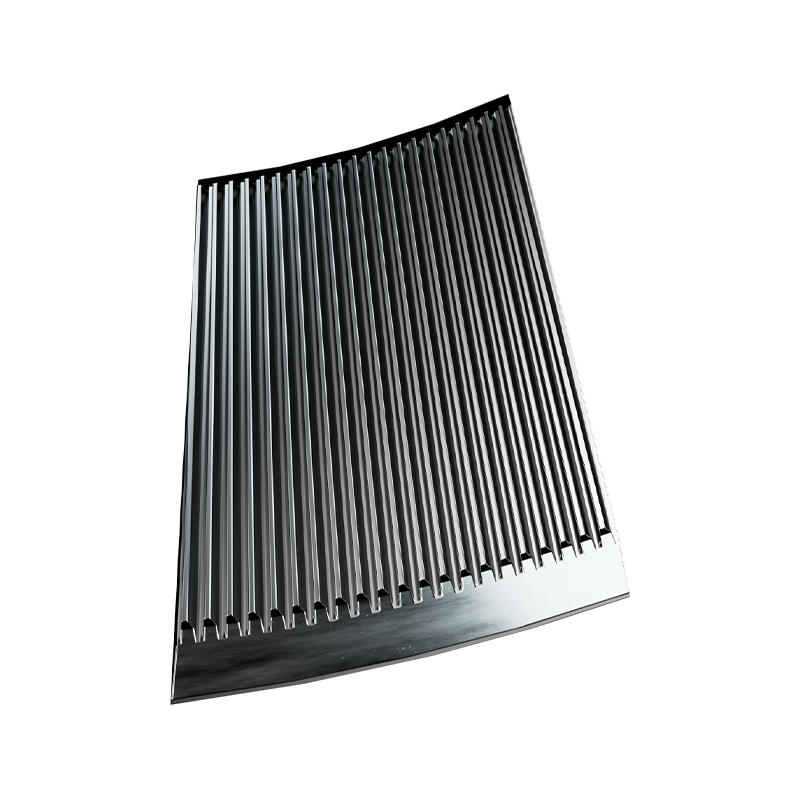
The most distinctive feature is the modular blade block system. Multiple sets of cutting blocks are installed around the rotor circumference and fixed with high-strength bolts. Each block functions as an individual cutting element. When wear occurs, the maintenance team can replace the affected block rather than scrapping or remanufacturing the entire rotor. This creates a major advantage over conventional one-piece discs, especially in abrasive PVC applications.
The modular arrangement also improves adaptability. Different blade quantities, cutting edge angles, surface coatings, or carbide insert configurations can be selected according to processing goals. A plant producing fine PVC powder for flooring may prefer one blade geometry, while a recycler processing heavily filled pipe scrap may require enhanced wear resistance or a different cutting angle. Modular construction gives the machine owner a way to tune the rotor to the application.
High-Strength Bolt Fixing
Because the cutting blocks operate under high centrifugal force, repeated impact, and frictional loads, secure fastening is essential. High-strength bolts hold each blade block in position and help maintain cutting consistency during long operating cycles. Proper bolt quality, thread accuracy, tightening torque, and maintenance procedures all contribute to safe performance. A well-designed bolted modular rotor must prevent loosening while still allowing practical removal during maintenance.
Optimized Interlaced and Radial Blade Arrangement
The blade arrangement is designed to create multi-point shearing and friction. Instead of relying on a small number of cutting teeth, the rotor exposes the PVC material to numerous cutting edges across the grinding path. Interlaced or radial configurations can increase grinding frequency, reduce oversized particles, and improve powder uniformity. This structure also helps reduce bottlenecks that appear in older low-tooth-count designs.
Heat-Treated Wear-Resistant Surface
The cutting blocks use optimized high-wear-resistant alloy steel and undergo carburizing, quenching, and multiple tempering processes. Carburizing increases surface carbon content, quenching develops high hardness, and tempering improves toughness and reduces brittleness. Together, these processes help achieve a cutting edge that is hard enough to resist abrasion yet tough enough to withstand impact. This is particularly important for PVC with fillers or recycled impurities.
Performance Advantages Over Conventional Rotors
Traditional monolithic pulverizer discs often require full disc replacement or professional regrinding when cutting performance declines. This creates long stoppages, higher maintenance labor, and higher inventory costs. Low-tooth-count rotors may also struggle to maintain fine particle distribution at high output. In contrast, the large disc-shaped modular rotor is designed to reduce service complexity and increase grinding efficiency.
One of the strongest advantages is maintenance efficiency. Only worn cutting blocks need replacement. If wear is uneven because of material feed patterns or operating conditions, the maintenance team can target specific zones. This can reduce downtime significantly, in some cases by more than 80 percent compared with full-disc servicing procedures. For a production line operating 24 hours per day, the financial value of reduced downtime may exceed the cost of the rotor itself over time.
Another advantage is production output. The optimized multi-blade layout provides more contact points between the rotor and PVC material. This increases cutting events per revolution and improves material breakdown. At equivalent power, output can increase by approximately 30–50 percent or more compared with less efficient traditional discs, depending on machine condition, material type, cooling capacity, and fineness requirements. This is especially useful for factories facing capacity limitations but not ready to install a completely new production line.
Powder consistency is also improved. A rotor with sharp, durable, evenly distributed cutting blocks can maintain a more stable particle size profile over long operating periods. This helps produce powder with fewer coarse particles, fewer fiber-like residues, and better flowability. Stable powder is easier to feed into extrusion, calendering, molding, or compounding processes. It also improves final product appearance by reducing surface defects, pores, unmelted particles, and color variation.
Thermal control is another important advantage. Efficient cutting reduces unnecessary friction heat. When paired with a dual cooling system using air and water, as well as intelligent temperature control, the rotor helps prevent PVC softening, sticking, degradation, and yellowing. This is a critical requirement because PVC is sensitive to excessive heat. A high-performance rotor should improve productivity without creating thermal damage.
| Evaluation Item | Large Disc-Shaped Modular Rotor | Conventional Monolithic or Low-Tooth Disc |
|---|---|---|
| Maintenance method | Replace individual worn cutting blocks | Replace or regrind the entire disc |
| Downtime | Significantly reduced; targeted servicing possible | Often longer due to full-disc handling |
| Output potential | High, supported by multi-point shearing | Limited by fewer cutting points or worn edges |
| Powder uniformity | Stable 20–100 mesh range with narrow distribution when properly configured | More likely to produce coarse particles as wear increases |
| Wear management | Modular blade replacement lowers consumable cost | Higher replacement cost for complete discs |
| Customization | Blade quantity, angle, coating, and insert options available | Usually less flexible |
| Thermal control | Efficient cutting supports lower heat generation and better cooling performance | Higher friction heat may occur as edges become dull |
| Long-term value | Lower total cost through efficiency and serviceability | Higher operating cost in abrasive applications |
Manufacturing Processes That Support Rotor Quality
A rotor for high-speed PVC pulverizing cannot rely on design alone. Manufacturing precision determines whether the design works reliably in real production. Changzhou Mao Yue Intelligent Equipment Co., Ltd. manufactures plastic crushing and pulverizing equipment as a source manufacturer with more than 30 years of experience. The company has developed its technical foundation through long-term work in disc pulverizers, plastic size reduction, recycling systems, masterbatch processing, polymer powder production, PVC grinding, PE pulverizing, rotational molding powder preparation, and powder coating applications.
The company operates six processing workshops, each averaging about 1,400 square meters. This production scale supports in-house machining, assembly, inspection, and customization. A manufacturer with substantial workshop capacity can better control production schedules, component quality, and after-sales spare part availability. For industrial customers, stable spare part support is as important as the initial machine purchase because pulverizing equipment is often expected to run continuously for years.
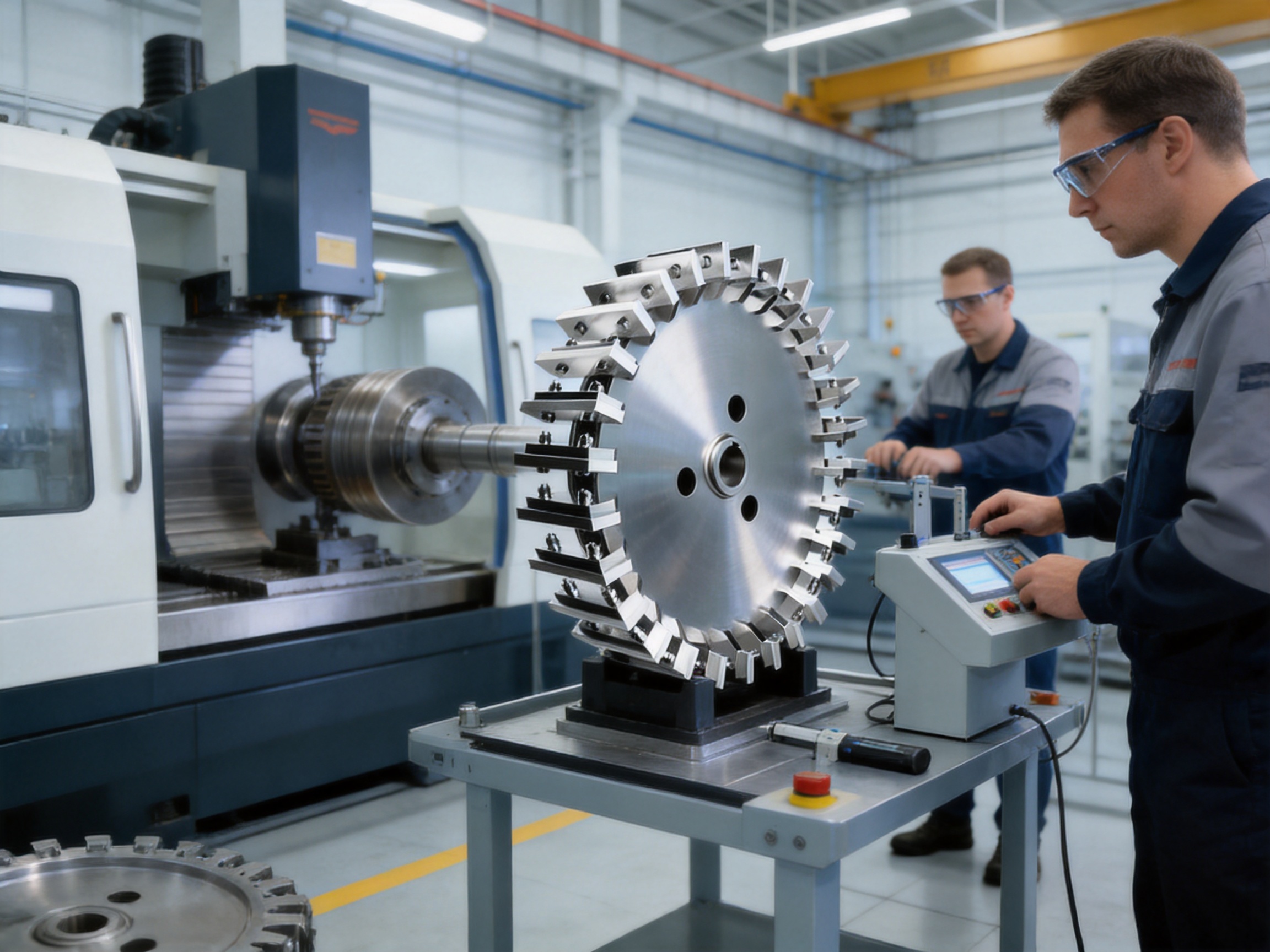
Precision CNC machining is used to form the rotor body, central shaft hole, blade mounting faces, bolt holes, and overall disc geometry. CNC processing reduces dimensional deviations and improves repeatability from one rotor to another. For a rotating component, small geometric errors can cause vibration, uneven grinding, and accelerated wear. Precision machining ensures that the cutting blocks sit correctly, the disc rotates concentrically, and the assembly maintains stable working clearance.
Heat treatment is another defining process. The rotor and cutting components undergo carburizing and quenching to achieve high surface hardness and wear resistance. Multiple tempering steps are used to stabilize the internal structure and improve toughness. Without correct heat treatment, a blade may be hard but brittle, or tough but too soft to resist abrasion. The correct balance is essential for PVC pulverizing because the rotor faces both continuous friction and occasional impact from irregular recycled feedstock.
Dynamic balancing is performed with advanced balancing equipment. High-speed disc rotors must be balanced to reduce vibration, noise, spindle stress, bearing load, and fatigue failure risk. Poor balance can damage an otherwise well-designed machine. By using German dynamic balancing equipment and advanced manufacturing standards, the company improves the reliability of the rotor during sustained industrial operation.
The factory is also equipped with Taiwan-imported high-precision grinding machines built to German standards and Japanese welding systems. These resources reflect the company’s emphasis on accurate machining, stable components, and reliable machine performance. Although the rotor itself is mainly a machined and heat-treated component, the quality culture behind the complete equipment line affects every part: material selection, surface finishing, assembly fit, inspection routines, and final customer support.
Material Engineering and Heat Treatment
The cutting blocks are made from a proprietary optimized high-wear-resistant alloy steel substrate. In abrasive PVC applications, ordinary steel would lose sharpness quickly, leading to reduced output and larger particle sizes. Wear-resistant alloy steel improves the ability of the edge to maintain its cutting profile. The selected material must support both hardness and toughness. It must resist abrasion from fillers and mineral content while avoiding chipping when harder contaminants appear in recycled material.
Carburizing is used to enrich the surface layer of the cutting components. A hard surface layer improves wear resistance while the core can retain toughness. Quenching transforms the microstructure to achieve high hardness. Tempering then reduces internal stress and improves resistance to brittle failure. Multiple tempering processes can further stabilize hardness, reduce deformation risk, and improve edge durability.
The target hardness of HRC 58–62 is suitable for cutting and wear surfaces in demanding pulverizer applications. A hardness level in this range helps maintain sharpness and resist abrasion. However, hardness alone is not enough. If a blade is excessively brittle, it may chip. If it is too soft, it may wear quickly. The product’s advantage comes from the combination of alloy selection, surface treatment, heat treatment depth, tempering control, and precision finishing.
The deep brown or rust-brown finish visible on the rotor is associated with oxidation or special coating processes after heat treatment. This surface appearance reflects an industrial protective finish and reinforces the product’s heavy-duty character. Optional surface wear-resistant coatings or carbide inserts can be selected for extremely abrasive working conditions. These options help customers extend service life in plants processing filled PVC, high-mineral recycled PVC, or feedstock with unavoidable impurities.
Precision, Balance, and High-Speed Stability
High-speed operation magnifies every manufacturing error. A slight mass imbalance at low speed can become a serious vibration source at pulverizer speed. A slight shaft hole deviation can create eccentric rotation. A small mounting surface error can cause uneven blade exposure. For this reason, precision and balance are fundamental to rotor performance.
The large disc-shaped rotor is machined to ensure accurate geometry and proper blade seating. During assembly, the cutting blocks must be distributed uniformly. Bolt fastening must be secure and consistent. After assembly, dynamic balancing helps ensure that the rotor runs smoothly with minimal vibration. Lower vibration protects bearings, reduces noise, improves powder consistency, and lowers the risk of unexpected shutdowns.
Good balance also contributes to operator comfort and plant safety. A pulverizer with excessive vibration is harder to maintain and may create secondary problems in the foundation, motor, coupling, belts, guards, and feed system. A well-balanced rotor supports quiet, stable, predictable operation. This is especially important for factories using several pulverizers in parallel, where cumulative noise and vibration can affect the whole production environment.
Precise balance is also linked to energy efficiency. Vibration wastes energy that should be used for cutting and grinding. By minimizing vibration, more motor power is converted into productive particle reduction. Over thousands of operating hours, even small efficiency gains can produce meaningful savings.
Powder Quality and Particle Size Control
The purpose of a PVC pulverizer is not only to reduce size but to produce powder suitable for downstream processing. Powder quality includes particle size, distribution width, flowability, cleanliness, thermal history, color stability, and absence of oversized particles. A high-performance rotor contributes to all of these characteristics.
With sharp modular cutting blocks and optimized blade arrangement, the rotor can produce PVC powder in a stable 20–100 mesh range when paired with proper machine configuration. Fine powder in this range is commonly used for recycling, extrusion, calendering, compounding, and construction material production. The exact target depends on customer requirements. For example, PVC flooring compounds may require consistent fine powder for smooth fusion and surface appearance, while regranulation may tolerate a broader range but still benefits from uniformity.
Narrow particle distribution improves process stability. If powder contains too many coarse particles, downstream equipment may experience incomplete melting, poor dispersion, visible surface defects, or mechanical property variation. If powder contains too many ultra-fine particles, dust handling and flowability may become problems. The rotor’s multi-point cutting action supports controlled pulverizing so that material is reduced efficiently without unnecessary overgrinding.
Clean powder appearance is also important. PVC can discolor when exposed to excessive heat. Yellowing, scorching, or decomposition odor indicates thermal damage and can reduce product value. Efficient cutting, sharp edges, proper cooling, and intelligent temperature control help prevent these defects. The rotor therefore supports both mechanical size reduction and thermal protection.
Cooling Compatibility and Temperature Control
PVC pulverizing generates heat through friction and impact. If heat is not controlled, the material can soften, adhere to the grinding surfaces, block the machine, or degrade. The large disc-shaped rotor is designed to work with a dual cooling system that combines air and water cooling. Air helps remove heat and transport powder, while water cooling helps stabilize equipment temperature. Intelligent temperature control can adjust operating conditions to prevent overheating.
The rotor contributes to temperature control by cutting efficiently. Dull or poorly arranged blades rub material rather than cutting it, generating unnecessary heat. Sharp, wear-resistant cutting blocks reduce frictional waste and maintain effective shearing. This means the cooling system does not have to compensate for inefficient grinding. The combined effect is stable 24-hour production with reduced risk of PVC softening, plate adhesion, degradation, or powder yellowing.
Temperature stability is especially important in recycling. Recycled PVC may contain mixed stabilizer systems, plasticizers, pigments, fillers, and residues. Some batches are more heat-sensitive than others. A rotor and cooling system that maintain stable conditions provide a wider processing window and reduce scrap. This helps recycling plants deliver more consistent powder to downstream users.
Applications in PVC Recycling and Regeneration
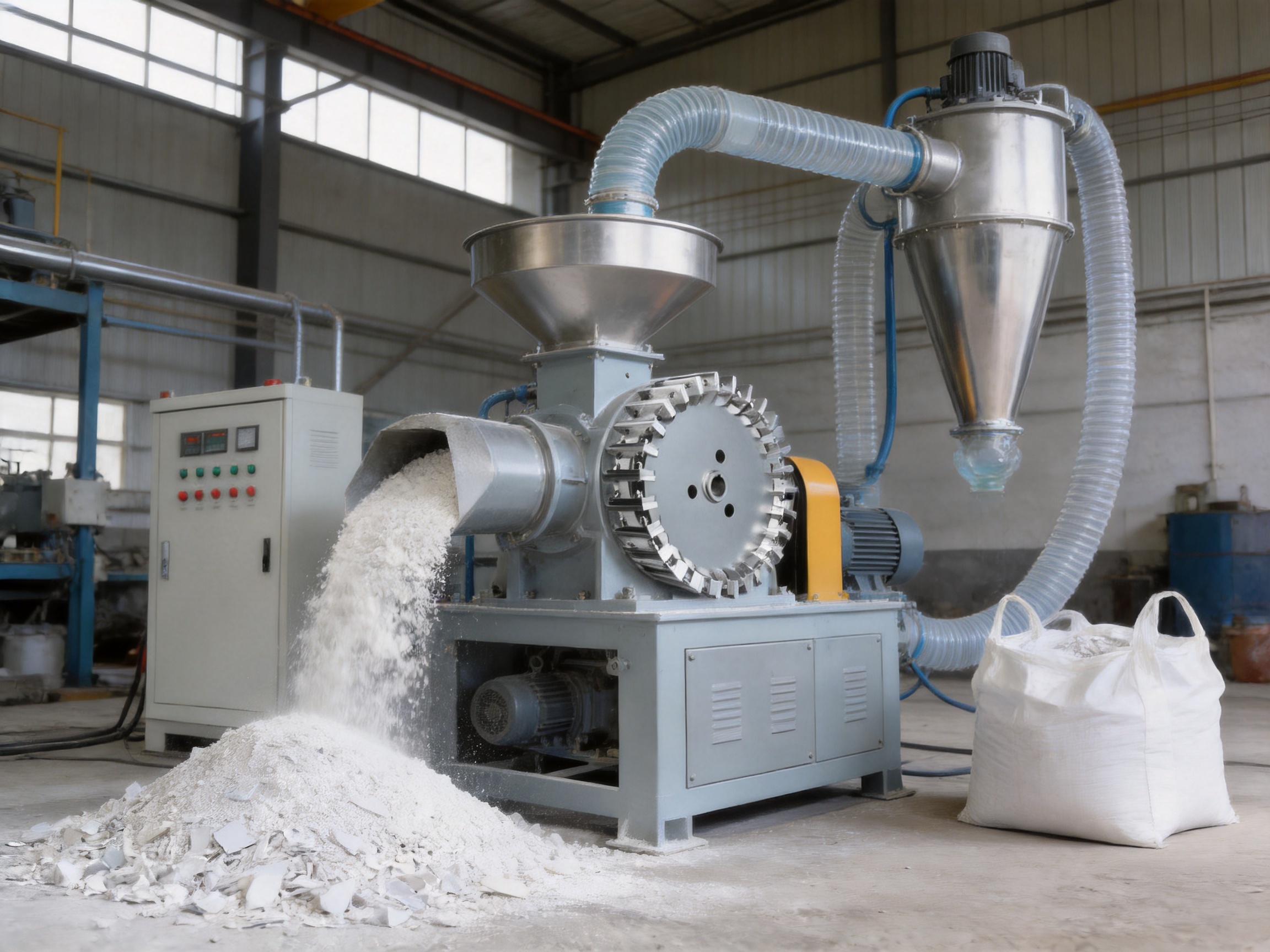
One of the most important uses of the rotor is the fine grinding of waste PVC materials. Common feedstocks include PVC pipes, profiles, window and door trimmings, vinyl flooring, cable sheathing, rigid sheets, injection molding scraps, bottle caps, and production offcuts. These materials are often first crushed into smaller pieces, then fed into a pulverizing system to produce powder suitable for reuse.
Fine PVC powder can be used for regranulation, extrusion profiling, injection molding, calendering, and compounding. Compared with coarse regrind, powder can melt and disperse more uniformly. This improves the value of recycled PVC and supports closed-loop recycling systems. For manufacturers aiming to reduce waste, lower raw material cost, and support circular economy targets, a reliable pulverizing rotor is a practical investment.
The rotor is particularly helpful for recycling plants processing filled rigid PVC. Fillers increase abrasion and can rapidly wear ordinary cutting surfaces. The wear-resistant alloy blade blocks and modular replacement system reduce the economic impact of abrasive wear. Instead of replacing a large expensive disc, the operator replaces only the worn blade blocks. This makes recycling more commercially viable, especially when feedstock quality varies.
Applications in PVC Powder Products and Building Materials
High-quality PVC micropowder is widely used in construction and building material manufacturing. Applications include PVC flooring, wall panels, pipes, profiles, foam boards, cable compounds, leather products, decorative sheets, and other extruded or calendered materials. In these applications, powder uniformity affects melting behavior, surface quality, dimensional stability, and color consistency.
For PVC flooring, uniform powder helps achieve smooth surfaces and stable wear-layer performance. For pipes and profiles, consistent powder supports stable extrusion pressure and product dimensions. For foam boards, particle size uniformity can influence cell structure and surface finish. For cable compounds, powder quality affects mixing uniformity and insulation or sheathing performance. In each case, the rotor plays a hidden but crucial role in preparing the material before final processing.
Factories in building material industries often face production bottlenecks when demand increases. Installing more machines is one option, but improving the efficiency of existing pulverizers can be more cost-effective. A high-output rotor that increases capacity at equivalent power can help producers expand production without a complete redesign of the plant. Lower maintenance downtime further improves effective capacity.
Applications in Polymer Modification and Chemical Processing
Beyond standard PVC recycling and construction materials, the rotor is useful in polymer modification and chemical applications. PVC blends containing fillers, additives, stabilizers, pigments, lubricants, or functional modifiers may need fine pulverization before compounding. Uniform powder improves dispersion and helps produce modified masterbatches or specialty PVC compounds with more stable properties.
Fine grinding can also support laboratory sample preparation, small-batch material testing, chemical carrier powder preparation, and environmentally responsible processing of PVC components from electronic waste. These applications may be sensitive to particle size distribution and purity. A rotor that produces uniform powder without thermal degradation is valuable for research, quality control, and specialty production.
Compatibility and Customization
The large disc-shaped rotor is designed for high compatibility with disc-diameter models in the Mao Yue PVC pulverizer series and may also be partially compatible with other brands of disc-type grinders, depending on dimensions and machine structure. Compatibility considerations include disc diameter, shaft hole size, mounting pattern, rotation direction, working clearance, blade height, housing design, and cooling system configuration. Before installation in non-original equipment, technical confirmation is recommended.
Customization options increase the rotor’s practical value. Customers may select blade block quantity, cutting edge angle, surface wear-resistant coating, carbide inserts, or other structural details according to material and output requirements. A plant processing clean production scrap may prioritize output and powder fineness. A recycler processing mineral-filled waste may prioritize abrasion resistance. A laboratory may require smaller batches and precise particle control. Customization allows the same rotor concept to serve different operating conditions.
This adaptability is one of the main advantages over imported counterparts or standardized commodity rotors. Imported rotors may offer good quality but can involve higher cost, longer delivery, limited customization, and slower spare part response. A source manufacturer with machining and heat treatment capability can provide tailored solutions, faster technical communication, and more practical after-sales support.
Cost-Performance and Total Ownership Value
The purchase price of a rotor is only one part of its economic value. Total ownership cost includes output per hour, energy consumption, downtime, labor, spare parts, powder quality, rejected material, bearing life, machine stability, and service support. A rotor that costs slightly more initially may be cheaper in real operation if it increases output, reduces maintenance, and extends service intervals.
The modular blade system directly lowers spare part cost because worn blocks can be replaced individually. The high wear resistance extends the interval between replacements. Improved output reduces production cost per kilogram. Stable powder quality reduces downstream defects and waste. Lower vibration protects the machine. Faster maintenance improves operating availability. Together, these factors create strong cost-performance compared with conventional discs and many imported alternatives.
For a factory operating continuously, even a few hours of downtime can represent substantial lost production. If modular maintenance reduces downtime by more than 80 percent in relevant service scenarios, the financial return can be rapid. Similarly, if output increases by 30–50 percent at equivalent power, the rotor can help delay or avoid investment in additional equipment. These practical benefits are often more persuasive than specifications alone.
Quality Assurance and Certifications
Changzhou Mao Yue Intelligent Equipment Co., Ltd. has obtained CE mechanical certification and ISO 9001 quality management system certification. These certifications indicate attention to safety, manufacturing control, and quality management. For international customers, certification helps simplify supplier evaluation and supports confidence in machine and component reliability.
The company’s long-term partnerships with more than 5,000 enterprises in domestic and international markets demonstrate practical market acceptance. Export experience of more than 20 years also matters because overseas customers require stable packaging, documentation, communication, spare part support, and adaptation to different operating standards. A product such as a pulverizer rotor must be supported not only by technical design but also by the supplier’s ability to deliver consistent service.
The company emphasizes quality, service, innovation, and customized solutions. Its professional technical team regularly studies advanced machine technologies from countries such as Germany. By combining international manufacturing concepts with in-house production capability, the company aims to provide stable, high-quality pulverizing solutions for customers worldwide.
Installation and Maintenance Considerations
Correct installation is essential for rotor performance. Before installation, operators should inspect the shaft, keyway or locking structure, mounting surfaces, bolts, blade blocks, and working chamber. The rotor should be installed according to the machine manual, and all fastening elements should be tightened to the specified torque. After installation, the operator should check rotation direction, clearance, cooling function, and vibration level before full-load operation.
During operation, feed should be controlled to avoid overload. PVC should be pre-crushed to the correct size before pulverizing. Foreign metals, stones, and hard contaminants should be removed by screening or magnetic separation where possible. Although the blade blocks are wear-resistant and impact-resistant, preventing contamination improves safety and extends service life.
Maintenance should include regular inspection of blade sharpness, bolt tightness, bearing condition, vibration, noise, powder fineness, and temperature. If powder becomes coarse or output decreases, blade wear may be occurring. Modular blocks can then be replaced or adjusted. Operators should replace worn blocks in balanced sets when necessary to maintain rotor balance. After major blade replacement, dynamic balance verification may be recommended, especially for high-speed operation.
Cooling systems should also be maintained. Air passages, water channels, temperature sensors, and control settings must remain functional. A high-performance rotor cannot deliver full benefits if cooling is blocked or temperature control is ignored. PVC powder handling systems should be kept clean to avoid dust accumulation and ensure stable airflow.
Operational Benefits for 24-Hour Production
Many PVC pulverizing plants operate around the clock. Continuous operation places special demands on the rotor. The cutting edges must remain sharp for long periods, the disc must remain balanced, bolts must stay secure, and heat generation must remain controlled. The large disc-shaped modular rotor is designed with these demands in mind.
Continuous production benefits from predictable maintenance intervals. With modular cutting blocks, maintenance can be planned around scheduled shutdowns rather than emergency failures. Spare blade blocks are easier to stock than complete rotor discs. Replacement work is faster, and production can resume sooner. This creates a more stable production rhythm and reduces stress on maintenance teams.
Low vibration and low noise also improve long-term operation. Equipment that runs smoothly is easier to monitor and less likely to develop secondary failures. Operators can detect abnormal sounds or changes more easily when the baseline condition is stable. This supports preventive maintenance and safer operation.
Competitive Position in the Pulverizer Parts Market
The market for pulverizer parts includes low-cost generic components, imported premium parts, and customized source-manufacturer solutions. Low-cost generic rotors may appear attractive initially, but they often lack material consistency, heat treatment control, balance precision, and after-sales engineering support. Imported premium components may perform well but can be expensive and slower to obtain. The large disc-shaped modular rotor offers a balanced alternative: high industrial quality, strong customization, competitive cost-performance, and direct manufacturer support.
Its advantages are most visible in demanding applications. A simple rotor may be acceptable for low-volume or low-abrasion processing, but high-output PVC pulverizing exposes weaknesses quickly. Blade wear, vibration, heat buildup, and downtime become expensive. The modular multi-blade rotor is designed to solve these problems through engineering rather than temporary repairs.
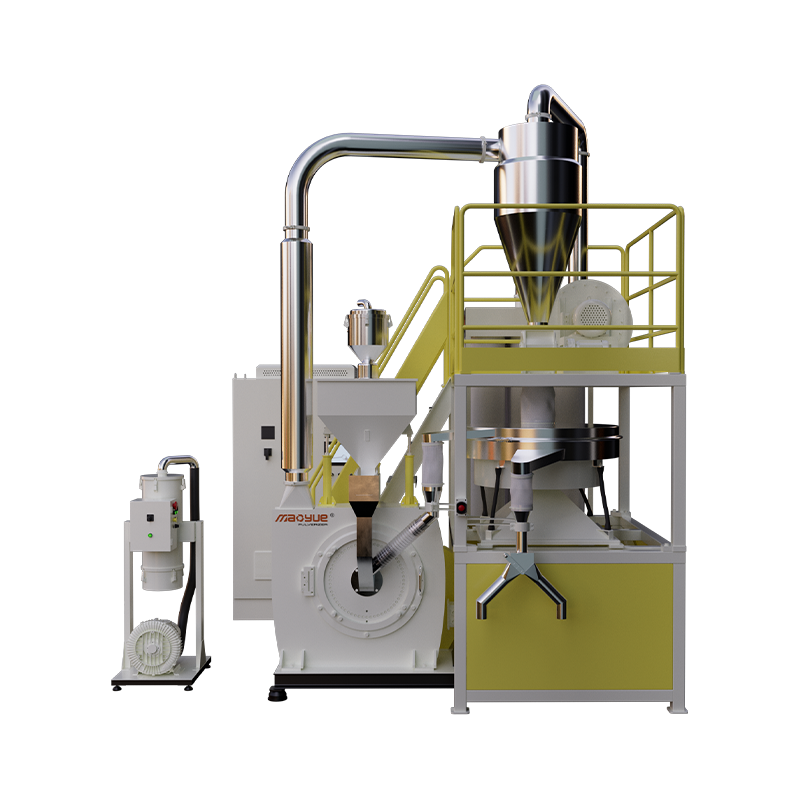
The manufacturer’s integrated capability also strengthens competitiveness. Because the company produces pulverizers and parts, it understands how the rotor interacts with the complete system: feeding, grinding chamber, cooling, classification, collection, motors, bearings, and control systems. This system-level knowledge helps produce rotors that work in real equipment, not only on paper.
Contribution to Green Manufacturing and Circular Economy Goals
PVC recycling and powder reuse are increasingly important as industries pursue lower waste, lower carbon intensity, and more efficient resource use. A high-performance pulverizer rotor supports these goals by improving the conversion of PVC scrap into reusable powder. Better powder quality increases the value of recycled material and makes it easier to reintroduce into manufacturing.
Energy efficiency also contributes to sustainability. If the rotor increases output at equivalent power, the energy consumed per unit of powder decreases. If the rotor lasts longer and requires fewer replacements, material consumption and waste are reduced. If powder quality improves, downstream scrap decreases. These benefits align with circular economy initiatives and green manufacturing trends.
For manufacturers using PVC in construction, packaging, cable, flooring, and industrial products, efficient pulverizing can turn internal scrap into a resource. Instead of sending offcuts or rejected parts to low-value disposal channels, companies can grind them into powder and use them in controlled production streams. The rotor is one of the key components that makes this process reliable and economically attractive.
Q&A Section
Q1: What is the main function of the large disc-shaped rotor in a PVC pulverizer?
The rotor converts motor power into high-speed cutting, shearing, friction, and grinding action. It breaks pre-crushed PVC material into fine powder and strongly influences output capacity, powder fineness, particle distribution, temperature control, and machine stability.
Q2: Why is a modular blade design better than a traditional one-piece disc?
A modular design allows operators to replace only the worn cutting blocks instead of replacing or regrinding the entire disc. This reduces downtime, lowers spare part costs, simplifies maintenance, and extends the effective service life of the rotor assembly.
Q3: What powder fineness can this rotor help achieve?
When paired with a suitable pulverizer, cooling system, and operating settings, the rotor can help produce PVC powder in a stable 20–100 mesh range. Actual fineness depends on material type, feed size, machine configuration, blade condition, and process control.
Q4: Is the rotor suitable for recycled PVC containing fillers?
Yes. The cutting blocks use high-wear-resistant alloy steel and heat treatment processes such as carburizing, quenching, and multiple tempering. These features improve abrasion resistance and impact resistance, making the rotor suitable for PVC materials containing fillers or recycled impurities.
Q5: How does the rotor reduce production downtime?
Because individual blade blocks can be replaced, maintenance is faster and more targeted. Operators do not need to remove and service a complete monolithic disc for localized wear. In suitable working conditions, downtime can be reduced dramatically compared with traditional disc maintenance.
Q6: How does the rotor improve output?
The optimized radial or interlaced multi-blade arrangement creates more cutting points and stronger shearing action. This increases grinding efficiency and can raise output by approximately 30–50 percent or more compared with less efficient traditional discs, depending on the application.
Q7: Why is cooling important when pulverizing PVC?
PVC is sensitive to excessive heat. Friction heat can cause softening, sticking, degradation, yellowing, or powder agglomeration. The rotor is designed to work with air and water cooling plus intelligent temperature control to maintain stable production and protect powder quality.
Q8: Can the rotor be customized?
Yes. Customization may include blade block quantity, cutting edge angle, surface wear-resistant coating, carbide inserts, and compatibility adjustments. This allows the rotor to match different PVC materials, fineness requirements, and production goals.
Q9: What manufacturing processes support rotor reliability?
Reliability is supported by CNC precision machining, accurate central shaft hole processing, carburizing, quenching, multiple tempering, precision grinding, high-strength bolt fastening, and dynamic balancing. These processes help ensure wear resistance, dimensional accuracy, and stable high-speed operation.
Q10: What industries can benefit from this rotor?
Industries include PVC recycling, pipe and profile manufacturing, flooring production, wall panel production, cable compound processing, foam board production, injection molding scrap recovery, polymer modification, masterbatch production, and laboratory or specialty powder preparation.
Conclusion
The large disc-shaped rotor for PVC pulverizing is a high-value component designed for demanding industrial powder production. Its large circular disc body, modular replaceable cutting blocks, high-strength bolted structure, optimized blade arrangement, precision shaft connection, wear-resistant alloy materials, and advanced heat treatment processes provide clear advantages over conventional monolithic and low-tooth-count disc designs.
The product’s benefits are practical and measurable: easier maintenance, reduced downtime, higher output, improved powder uniformity, stronger wear resistance, better temperature control, lower vibration, and stronger long-term cost-performance. These advantages are especially important for PVC recycling and manufacturing environments where abrasive fillers, heat sensitivity, continuous operation, and strict powder quality requirements create daily production challenges.
Changzhou Mao Yue Intelligent Equipment Co., Ltd. strengthens the value of the rotor through more than 30 years of experience in plastic crushing and pulverizing equipment, six modern processing workshops, precision CNC machining capability, advanced grinding and balancing equipment, heat treatment expertise, CE certification, ISO 9001 quality management, and long-term export experience. The company’s ability to provide customized solutions and spare part support makes the rotor not only a component purchase but also part of a complete pulverizing performance strategy.
For processors seeking higher PVC powder output, lower maintenance cost, cleaner particle distribution, and stable 24-hour operation, the large disc-shaped modular rotor represents a strong upgrade path. It supports the development of efficient recycling, higher-value PVC powder products, improved building materials, and greener manufacturing systems. In an industry where every hour of uptime and every kilogram of consistent powder matters, the rotor becomes one of the most important investments in the pulverizing line.
References
1. Brydson, J. A. Plastics Materials. Butterworth-Heinemann.
2. Osswald, T. A., and Menges, G. Materials Science of Polymers for Engineers. Hanser Publishers.
3. Harper, C. A. Handbook of Plastics Technologies. McGraw-Hill.
4. Goodship, V. Introduction to Plastics Recycling. Smithers Rapra Publishing.
5. ISO 9001 Quality Management Systems: Requirements. International Organization for Standardization.
6. CE Machinery Safety Principles and Conformity Assessment Guidance. European machinery compliance literature.
7. Industrial Size Reduction and Pulverizing Equipment Technical Manuals. Manufacturer and engineering reference materials.