

 English
 русский
 Español
 عربى
عربى 中文简体
中文简体
 中文简体
中文简体
Content
- 1 Product Positioning and Industrial Value
- 2 Key Technical Configuration
- 3 Technical Specification Table
- 4 Advantages Over Conventional Competitor Machines
- 5 Application in Large-Scale PVC Recycling
- 6 Application in PVC Pipe and Profile Production
- 7 Application in PVC Flooring and Building Materials
- 8 Application in Specialty PVC Compound Powder
- 9 Manufacturing Strength Behind the Machine
- 10 Why Source Manufacturing Matters
- 11 Powder Quality and Downstream Processing Benefits
- 12 Operation and Maintenance Considerations
- 13 Integration into Crushing and Pulverizing Lines
- 14 Economic Benefits and Return on Investment
- 15 Environmental and Sustainability Advantages
- 16 Quality Assurance and Certifications
- 17 Customization and Technical Support
- 18 Recommended Customer Profiles
- 19 Q&A Section
- 19.1 Q1: What materials can the Model 900 PVC Fine Powder Pulverizer process?
- 19.2 Q2: What powder size can the machine produce?
- 19.3 Q3: What is the production capacity of the Model 900?
- 19.4 Q4: Why is cooling important when pulverizing PVC?
- 19.5 Q5: How does the Model 900 compare with smaller pulverizers?
- 19.6 Q6: How does the machine reduce wear-related downtime?
- 19.7 Q7: Is the machine suitable for export-grade PVC powder production?
- 19.8 Q8: What manufacturing strengths support the machine’s reliability?
- 19.9 Q9: Can the pulverizer be integrated into a complete production line?
- 19.10 Q10: What information should a buyer provide before selecting the machine?
- 20 Conclusion
- 21 References
- 22 Product: Model 900 PVC Fine Powder Pulverizer
The Model 900 PVC Fine Powder Pulverizer is engineered for large-scale PVC powder production where capacity, consistency, durability, and energy efficiency determine the profitability of the entire operation. Designed for demanding recycling groups, building material manufacturers, PVC flooring producers, pipe and profile factories, compound powder processors, and export-oriented OEM plants, this pulverizer provides the high-output grinding performance required for continuous industrial production.
As a flagship fine powder machine in the PVC pulverizing category, the Model 900 is built around a large grinding chamber, high-power drive options, heavy-duty wear-resistant grinding discs, optimized air conveying, industrial cooling, and stable screening. Its purpose is not simply to reduce PVC material size, but to transform rigid, semi-rigid, and compound PVC waste or granules into controlled fine powder suitable for extrusion, calendering, foaming, injection molding, compounding, and recycling applications.
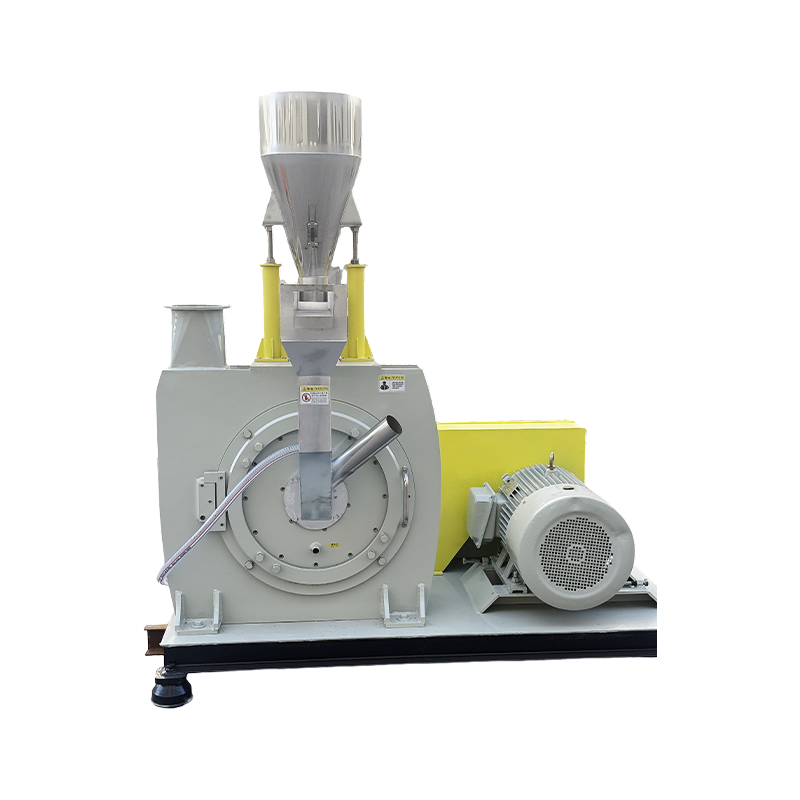
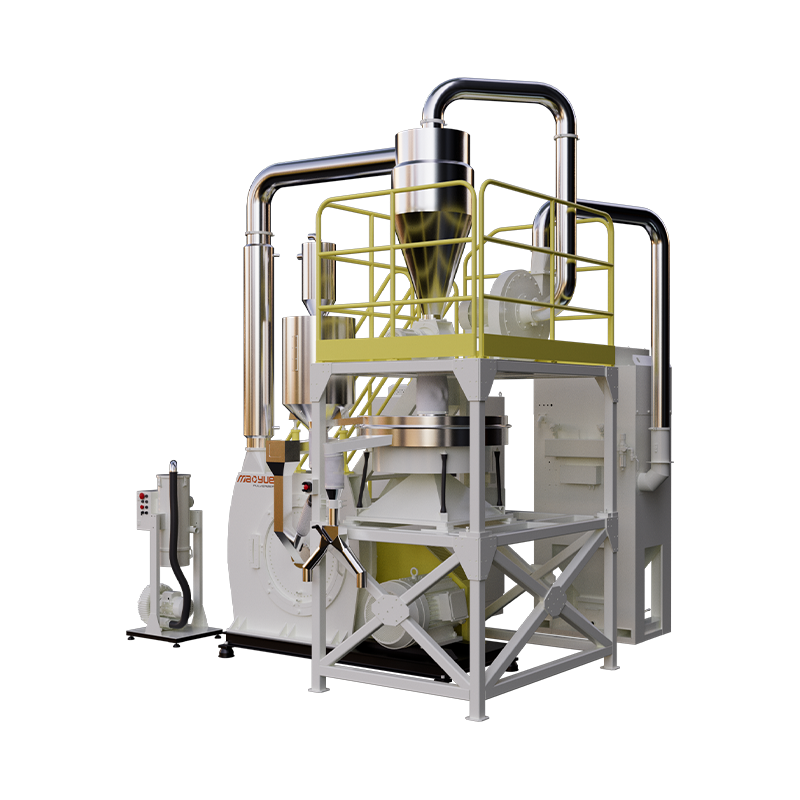
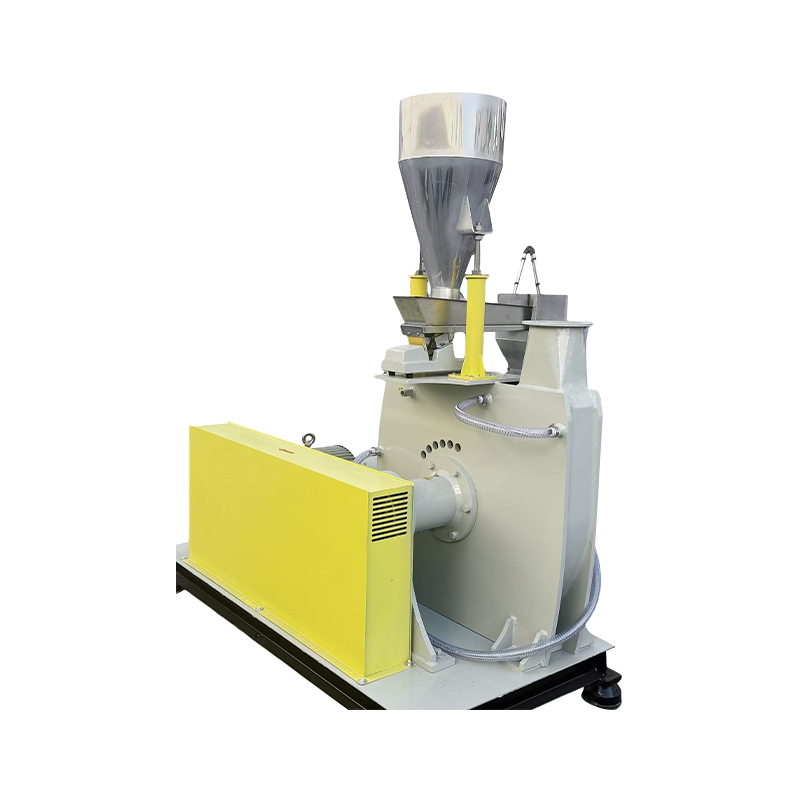
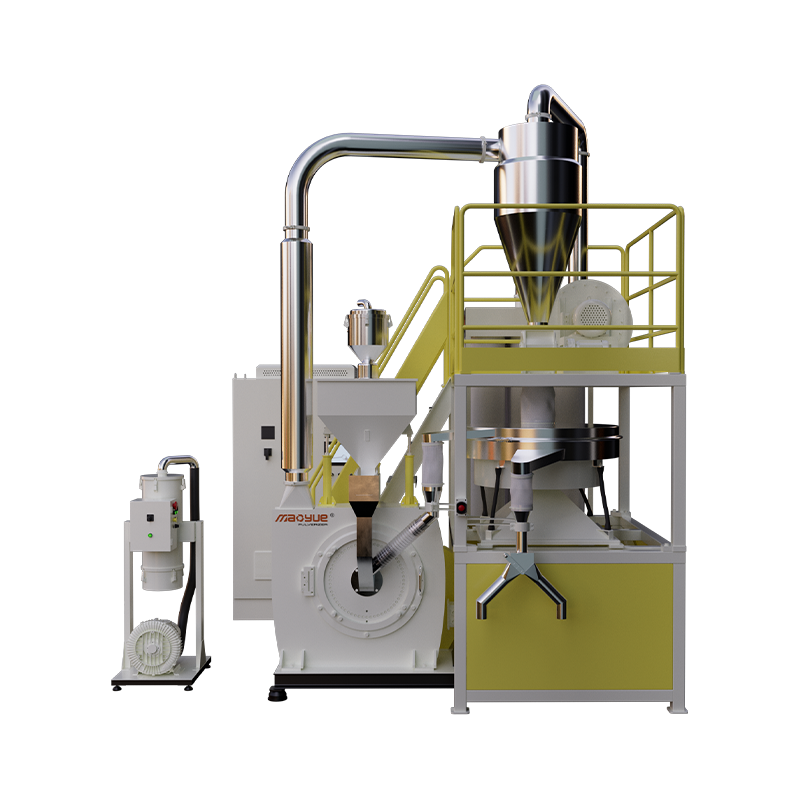
Model 900 PVC Fine Powder Pulverizer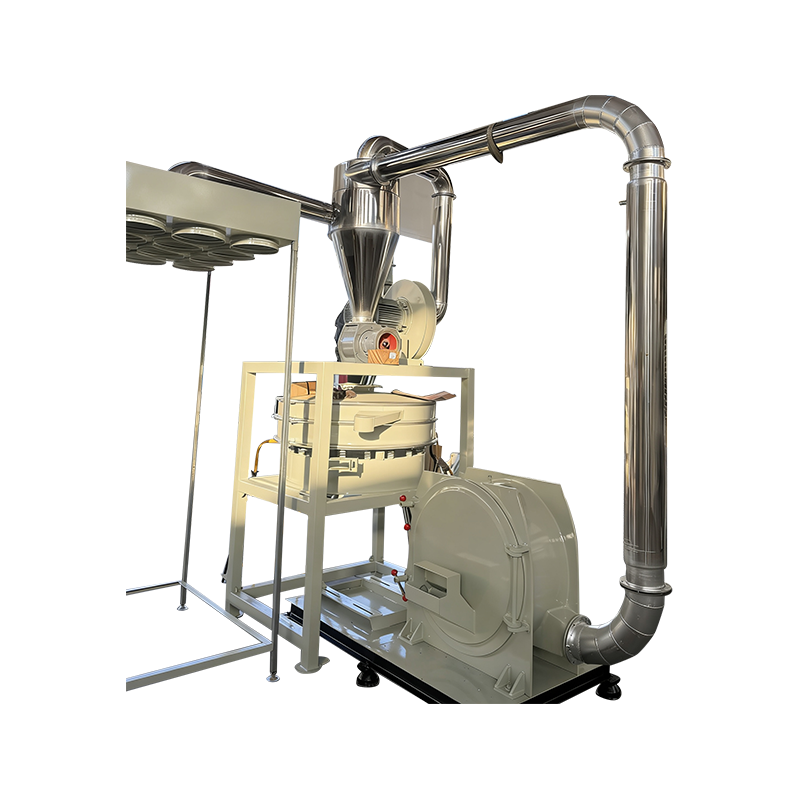
In high-volume PVC recycling and building material production, ordinary pulverizers often reach capacity limits quickly. Operators may experience overheating, unstable particle size, high blade wear, excessive vibration, material discoloration, dust leakage, or unplanned downtime. The Model 900 is developed to solve these problems by combining large-scale mechanical strength with precision manufacturing. It is suitable for facilities that require daily output at industrial scale and want a reliable core machine for long-term operation.
The machine is especially valuable for companies processing discarded PVC pipes, window profiles, door profiles, flooring scraps, cable sheathing, foam board offcuts, rigid PVC sheets, and compounded PVC materials. It can also support specialty PVC powder production where flame-retardant, impact-resistant, weather-resistant, chemical-resistant, or high-filler formulations must be ground with stable temperature control and uniform particle distribution.
Product Positioning and Industrial Value
The Model 900 PVC Fine Powder Pulverizer is positioned as a high-capacity production machine for customers who need more than laboratory testing or medium-scale powder output. It is intended for continuous production environments where the machine becomes a key part of the factory’s profit model. In these applications, every kilogram of stable powder contributes to downstream processing efficiency, product appearance, formulation accuracy, and recycling value.
Compared with smaller pulverizers, the Model 900 provides a larger grinding area and higher motor power, allowing it to handle more material per hour while maintaining powder quality. Compared with many conventional machines in the market, it emphasizes stronger wear resistance, better cooling, improved vibration control, and more stable long-duration operation. This makes it suitable for customers who evaluate equipment not only by purchase price, but by lifetime output, downtime reduction, powder quality, and maintenance frequency.
For PVC recyclers, the machine helps convert waste into reusable high-value powder. Instead of selling crushed scrap at a lower price, processors can grind PVC waste into fine powder that can be returned to extrusion and molding production. For pipe and profile manufacturers, the machine supports internal recycling by processing factory offcuts into reusable powder. For flooring and board manufacturers, it helps maintain closed-loop production, reducing waste disposal costs and improving material utilization.
For export-focused factories, the machine is useful because international customers often demand consistent particle size, controlled contamination, stable color, and reliable batch-to-batch quality. A high-output pulverizer with strong cooling, stainless steel conveying pipes, iron-removal feeding, and dependable screening supports these requirements by reducing quality fluctuations during mass production.
Key Technical Configuration
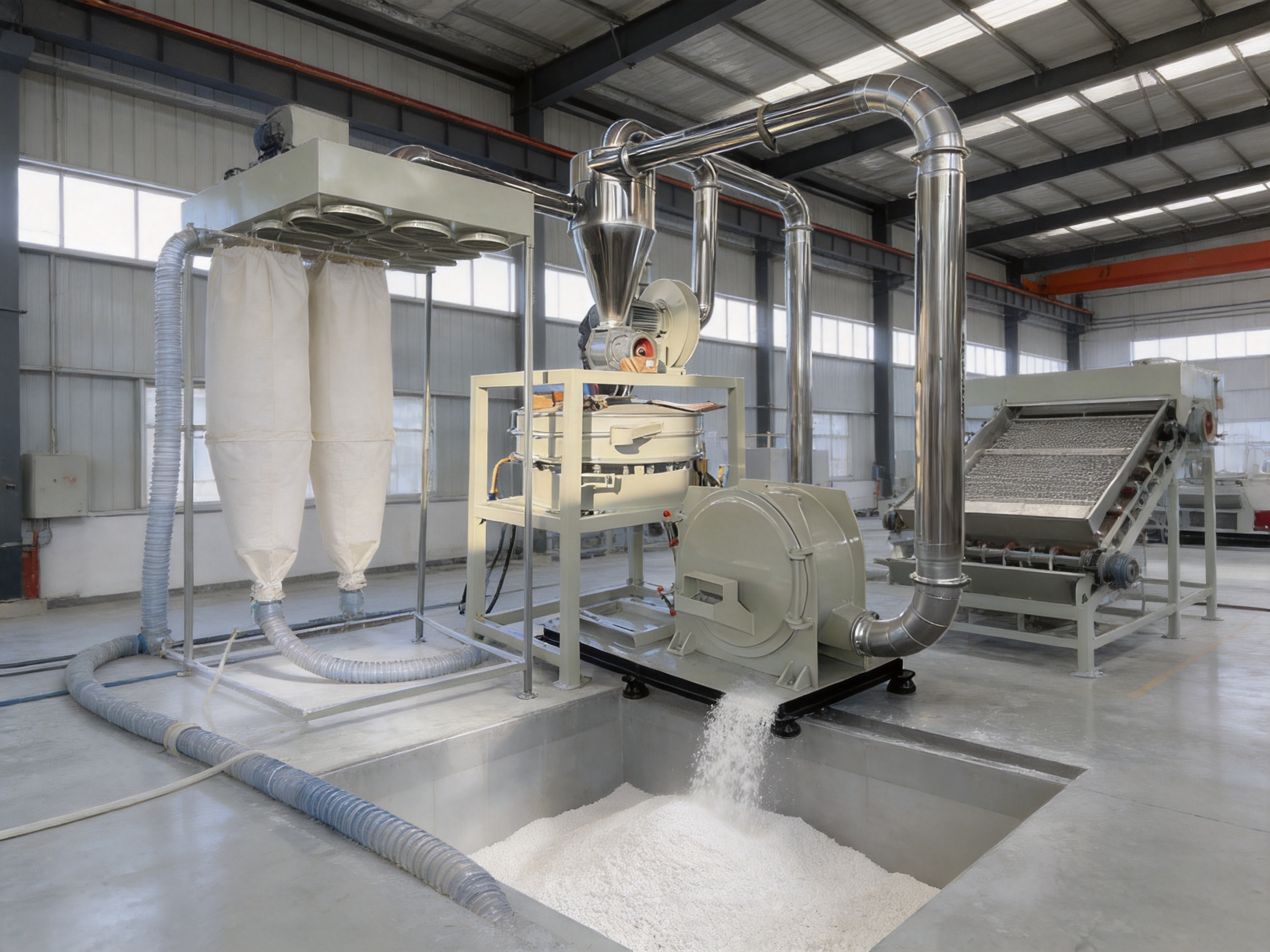
The Model 900 is designed with a heavy-duty structure and high-power pulverizing system. It uses a disc-type grinding principle, where material enters the grinding chamber and is subjected to strong shearing, friction, cutting, and impact forces between grinding discs. The result is fine powder with controllable mesh size, depending on material type, disc design, feeding rate, cooling, and screening configuration.
The machine may be configured with main drive motor options such as 90 kW, 110 kW, or 132 kW, allowing customers to match power selection with production targets and material conditions. The large disc structure and strong motor enable high throughput for PVC pulverizing applications. In practical production, capacity can vary according to raw material form, hardness, filler content, desired mesh size, feeding stability, cooling efficiency, and operator settings.
The grinding disc is a critical component. This model is equipped with high-chromium alloy or super-heavy-duty wear-resistant alloy grinding components, designed to withstand abrasive and high-filler PVC. The disc lifespan can be significantly longer than ordinary grinding elements when properly operated and maintained. Longer disc life reduces replacement frequency, labor cost, downtime, and production interruptions.
The machine also includes inverter speed control, allowing more flexible adjustment of operating speed. This is important because PVC materials can differ greatly in hardness, brittleness, filler ratio, plasticizer content, and heat sensitivity. By adjusting speed and feeding parameters, operators can improve powder fineness, control temperature rise, and optimize capacity.
Industrial cooling is another major feature. PVC is sensitive to heat during grinding. Excessive temperature can cause discoloration, degradation, softening, sticking, agglomeration, and unstable powder flow. The Model 900 uses water cooling with inlet and outlet circuits, and may be configured with advanced temperature control strategies to help maintain stable powder quality under heavy load.
Technical Specification Table
Item |
Specification |
Industrial Significance |
Machine Type |
Model 900 PVC Fine Powder Pulverizer |
Designed for large-scale PVC powder production and recycling applications. |
Disc Diameter |
Large disc configuration, approximately 800 to 900 mm depending on configuration |
Provides a broad grinding area for high throughput and efficient particle reduction. |
Capacity Range |
Approximately 650 to 1300 kg/h depending on material, mesh size, motor power, and operating conditions |
Supports continuous industrial production and high daily output requirements. |
Mesh Size |
10 to 50 mesh |
Suitable for recycled PVC powder, building material powder, and compound powder preparation. |
Main Drive Motor |
90 kW, 110 kW, or 132 kW options |
Allows customized power selection for capacity and material difficulty. |
Speed Control |
Inverter control |
Improves process flexibility and powder quality control. |
Bearing Configuration |
Imported bearing option such as NSK |
Supports stable high-speed operation and long service life. |
Grinding Disc Material |
High-chromium alloy or heavy-duty wear-resistant alloy |
Improves resistance to abrasive PVC and high-filler compounds. |
Blower Motor |
15 kW |
Supports material conveying, cooling, and powder collection efficiency. |
Pipe Material |
Stainless steel |
Improves cleanliness, corrosion resistance, and powder purity. |
Pipe Diameter |
Approximately 178 mm |
Provides adequate airflow and powder conveying capacity. |
Vibrating Screen Diameter |
Approximately 1500 mm |
Supports stable classification and uniform powder output. |
Vibrating Screen Motor |
2.2 kW |
Ensures efficient powder screening and oversize separation. |
Feeding Method |
Iron-removal feeding configuration |
Reduces metal contamination and protects grinding components. |
Dust Collector Bag Diameter |
Approximately 300 mm |
Supports powder collection and cleaner production. |
Cooling Method |
Water cooling with inlet and outlet circulation |
Helps prevent PVC overheating, discoloration, and degradation. |
Advantages Over Conventional Competitor Machines
The Model 900 provides several advantages over many traditional PVC pulverizers used in recycling and building material factories. These advantages are most visible in large production environments where machine reliability, powder stability, and maintenance intervals directly affect profitability.
Higher Production Capacity
The first major advantage is higher throughput. Many medium-size machines can process PVC effectively at moderate volumes, but they may struggle when a factory needs tens of tons of powder per day. The Model 900 is designed for large-scale output and can support continuous production lines that require high hourly capacity. This reduces the need for multiple smaller machines, simplifies plant layout, and lowers the number of operators required per ton of powder produced.
For factories with 10,000-ton-scale annual production plans, capacity is not a secondary detail; it is the foundation of delivery capability. A machine that produces more powder per hour can shorten order cycles, support peak season demand, and reduce bottlenecks in extrusion, calendering, or compounding operations.
Improved Energy Efficiency Per Unit Output
High motor power alone does not guarantee efficient production. A well-designed pulverizer must convert installed power into usable grinding work while controlling heat, airflow, and particle classification. The Model 900 combines high-power drive options with a large grinding chamber and optimized shearing structure, helping reduce energy consumption per unit of output when compared with smaller machines operating near overload.
In many factories, a smaller pulverizer may consume less power per hour but more power per ton because it operates longer, overheats more often, and requires frequent interruptions. The Model 900 is intended to maintain higher output under stable conditions, improving the relationship between electricity consumption, labor input, and final powder volume.
Longer Grinding Disc Service Life
Wear parts are a major cost in PVC pulverizing, especially when processing high-filler materials, rigid pipe scrap, calcium-carbonate-rich compounds, flooring waste, and abrasive recycled blends. Ordinary discs may lose sharpness quickly, leading to lower capacity, larger particles, increased heat, and more frequent maintenance.
The Model 900 uses high-wear-resistant alloy grinding discs designed for heavy-duty PVC production. With correct operation, proper feeding, metal removal, and regular inspection, the grinding components can offer extended service life. Longer disc life improves total equipment economics because it reduces production stoppages, spare parts consumption, and labor hours spent on replacement.
Better Temperature Control for PVC Materials
PVC is more heat-sensitive than many other plastics. During pulverizing, friction generates heat rapidly. If temperature rises too high, PVC powder may yellow, darken, degrade, agglomerate, or lose processing performance. Competitor machines with weak cooling or insufficient airflow may be unable to maintain stable quality during long runs.
The Model 900 addresses this issue with water cooling and strong process design. Cooling helps maintain the grinding zone within a safer range, protecting color stability and material performance. This is particularly important for white PVC profiles, light-colored flooring, decorative panels, cable compounds, and export-grade recycled powder where appearance and quality consistency are essential.
Stable Particle Size Distribution
Powder fineness is not only a matter of mesh size. A good pulverizer should provide a narrow and consistent particle size distribution, because downstream extrusion and calendering performance depend on uniform melting, blending, feeding, and flow behavior. Wide particle variation can cause unstable product thickness, surface defects, poor mixing, or inconsistent mechanical properties.
The Model 900 uses disc grinding, airflow conveying, and vibrating screening to help deliver controlled powder output. The large vibrating screen supports classification, separating oversize particles and improving product uniformity. When matched with proper operating parameters, the machine can produce powder suitable for demanding production lines.
Stronger Mechanical Stability
Large pulverizers must run at high speed under heavy load. If the structure is weak, vibration can increase rapidly, causing bearing wear, noise, unstable grinding, loose fasteners, and shortened component life. The Model 900 is built with a heavy-duty base and industrial vibration damping to support continuous production.
Mechanical stability is a competitive advantage because it affects both machine life and powder quality. Stable operation reduces abnormal noise, protects bearings and shafts, and keeps the grinding gap more consistent. For factories running multiple shifts or 24-hour production, this stability becomes a major cost-saving factor.
Application in Large-Scale PVC Recycling
PVC recycling has become increasingly important as manufacturers and governments focus on circular economy, resource recovery, and reduced landfill waste. Large volumes of PVC waste come from construction demolition, pipe replacement, window and door production, flooring production, cable manufacturing, and industrial trimming. These materials can often be reused if they are properly sorted, cleaned, crushed, and pulverized.
The Model 900 is especially suitable for centralized PVC recycling operations. After pre-crushing and metal removal, the material can be fed into the pulverizer for fine grinding. The resulting powder can be used in recycled pipes, profiles, boards, mats, injection molded parts, and compound blends. This process increases the value of waste material and allows recycling plants to sell a more refined product.
In large recycling centers, capacity and reliability are critical. Incoming waste volumes may be high, and delays can create storage pressure. A high-capacity pulverizer helps keep material moving through the production system. The Model 900 can support large daily output targets, helping recycling companies meet supply contracts and improve market competitiveness.
Another important advantage in recycling is the ability to process variable feedstock. Recycled PVC may contain different colors, fillers, additives, and hardness levels. While proper sorting remains essential, the machine’s powerful grinding system and adjustable operation help accommodate a range of PVC forms. The iron-removal feeding configuration also helps protect the machine from metal contamination commonly found in recycled streams.
Application in PVC Pipe and Profile Production
PVC pipe and profile manufacturers generate offcuts, start-up waste, defective products, and trimming material during normal production. If this material is discarded, the factory loses raw material value and increases waste handling costs. If it is converted into controlled powder, it can be blended back into production according to formulation requirements.
The Model 900 supports this closed-loop manufacturing approach. Pipe scrap and profile waste can be crushed and pulverized into reusable powder. Because the machine provides stable grinding and cooling, the recycled powder can maintain better consistency and reduce the risk of discoloration or thermal damage. This is important for pipe extrusion and profile extrusion, where material flow, surface finish, dimensional stability, and impact strength must be controlled.
For large pipe factories, the machine can help balance production waste and raw material consumption. Instead of relying only on virgin PVC resin and purchased additives, manufacturers can integrate internal recycled powder into selected formulations. This improves material utilization and may reduce production costs, especially when raw material prices fluctuate.
Application in PVC Flooring and Building Materials
PVC flooring, foam board, wall panel, decorative sheet, and building material manufacturers require powder with good flowability, uniform particle size, and stable color. These products often use fillers, stabilizers, modifiers, pigments, and recycled components. The powder preparation stage affects how evenly these materials mix and how reliably they process in downstream equipment.
The Model 900 is suitable for high-volume building material production because it can supply large quantities of powder while maintaining consistency. In flooring production, stable powder contributes to smooth surface layers, uniform backing layers, and reliable wear layer performance. In foam board production, powder consistency helps achieve stable foaming, uniform cell structure, and consistent board density. In decorative panels, powder quality affects surface smoothness, color uniformity, and dimensional performance.
Large building material enterprises often need to combine high output with strict quality management. A pulverizer that overheats or creates inconsistent powder can affect entire batches of finished products. The Model 900 helps reduce this risk through its high-capacity grinding system, cooling design, and screening configuration.
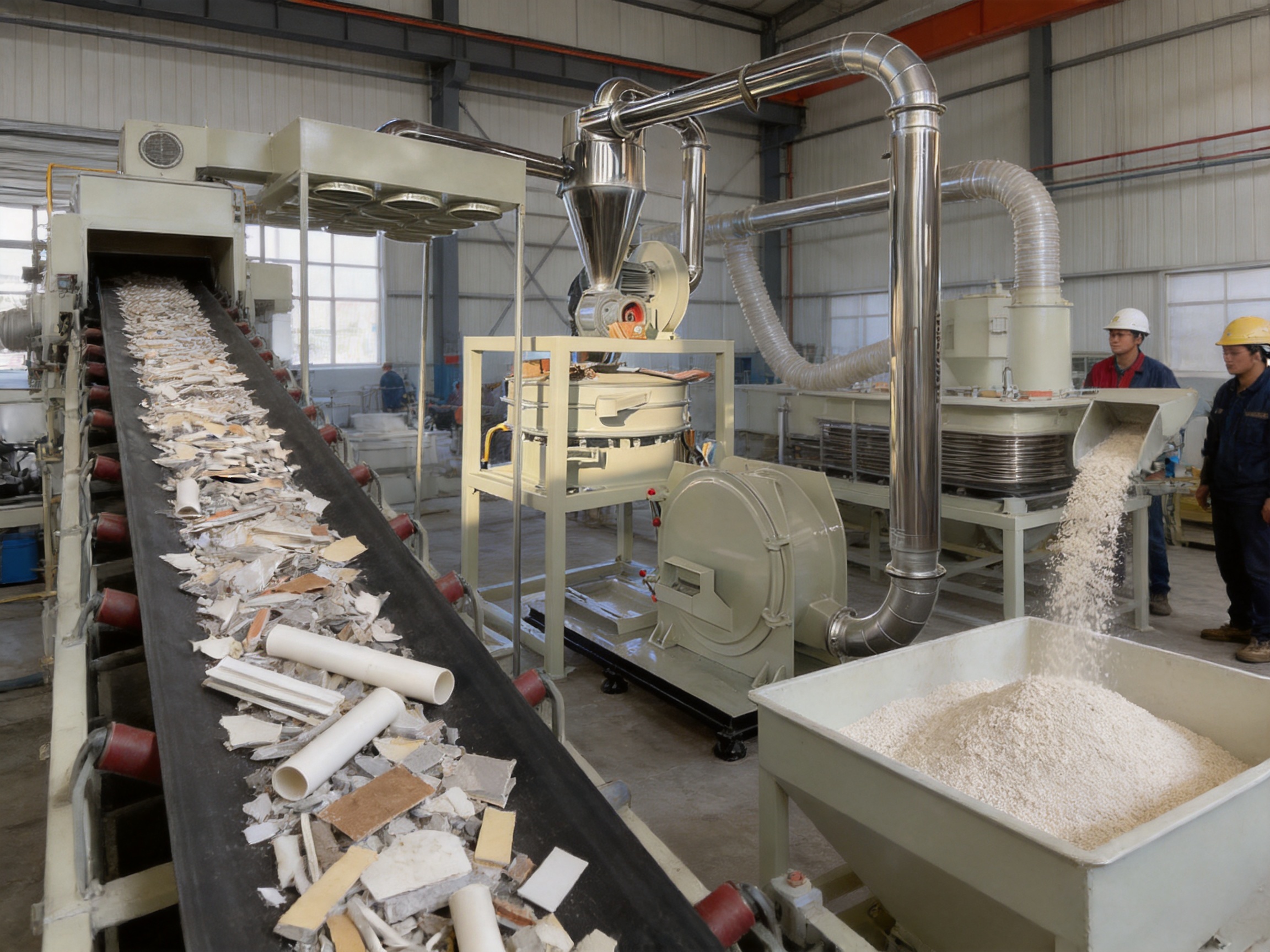
Application in Specialty PVC Compound Powder
Specialty PVC compounds may include flame retardants, impact modifiers, UV stabilizers, heat stabilizers, plasticizers, fillers, and other functional additives. These materials can be more difficult to grind than ordinary PVC because they may be more abrasive, more heat-sensitive, or more demanding in particle size control.
The Model 900 is useful for producing functional PVC powders for automotive interiors, cable sheathing, electronic housings, construction materials, weather-resistant profiles, chemical-resistant products, and high-performance compound applications. Its wear-resistant grinding discs are beneficial when processing high-filler or mineral-loaded formulations. Its cooling system helps protect heat-sensitive additives and maintain powder quality.
For compounders, powder uniformity helps improve blending accuracy and downstream processing stability. If powder particles vary widely, additives may distribute unevenly, leading to inconsistent mechanical or flame-retardant properties. A stable pulverizing process supports better formulation control and product repeatability.
Manufacturing Strength Behind the Machine
The performance of a pulverizer depends not only on its design but also on how it is manufactured. Changzhou Mao Yue Intelligent Equipment Co., Ltd. is a source manufacturer with 30 years of experience in plastic crushing and pulverizing equipment. This long-term specialization gives the company deep understanding of plastic size reduction, disc pulverizer structure, wear part design, balancing, welding, machining, assembly, and customer application requirements.
The company manufactures plastic pulverizers, pulverizer parts, and crushing and pulverizing lines for industries including rotational molding, masterbatch, polymer processing, PVC, PE, recycling, and powder coating. Its broad industry experience helps it understand different material behaviors and machine configurations. This is important because PVC pulverizing is not identical to PE, masterbatch, or powder coating grinding. Each application requires specific attention to heat, fineness, airflow, disc geometry, and wear resistance.
The factory operates multiple processing workshops, each with substantial production space. This manufacturing foundation allows the company to handle machining, fabrication, assembly, inspection, and customization more effectively than trading companies or simple assembly suppliers. As a source manufacturer, it can control component quality directly, respond to technical requirements, and provide practical solutions for specific production lines.
Precision Grinding and Machining
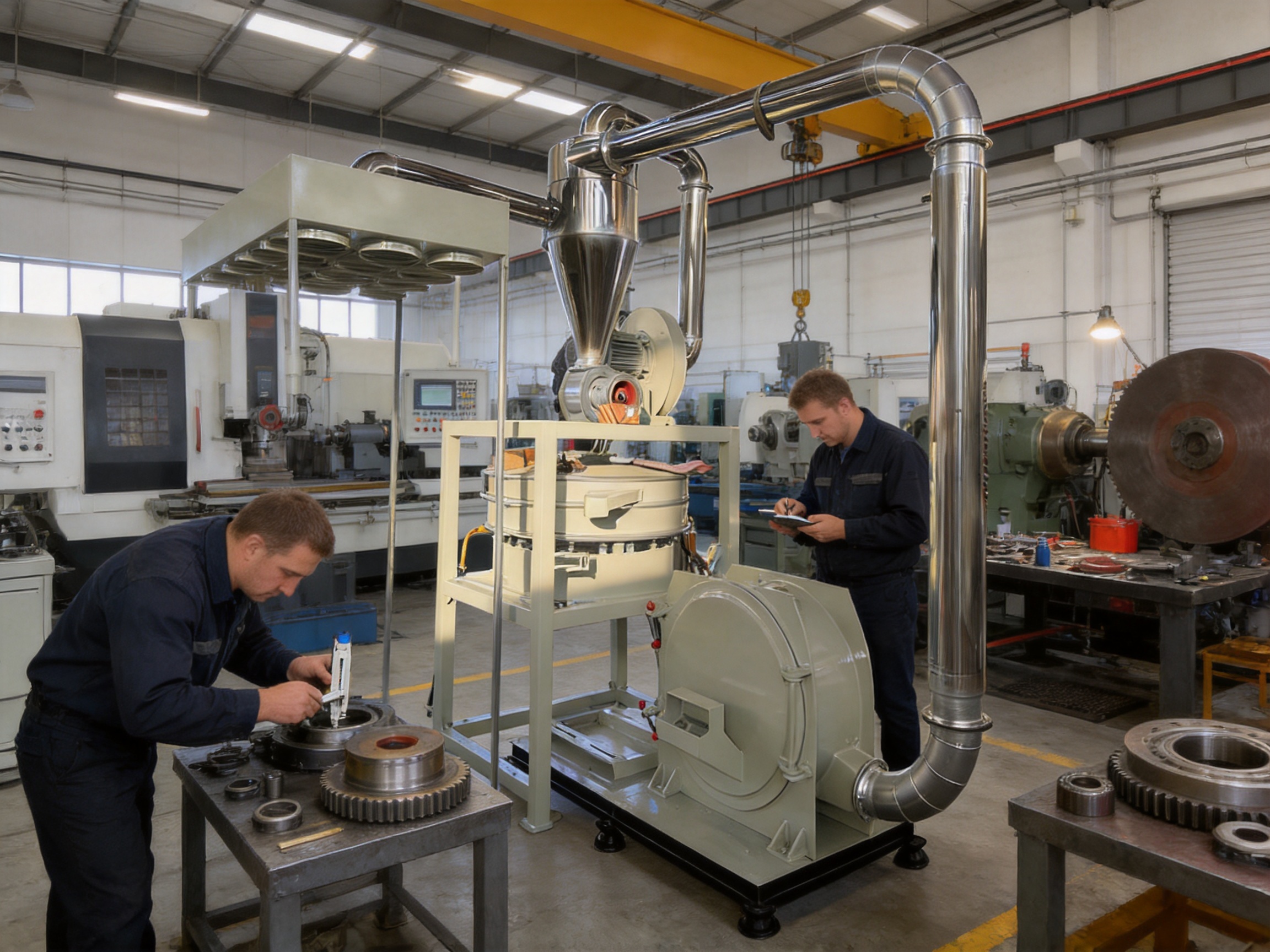
High-speed pulverizers require accurate machining. If the grinding disc, shaft, bearing seat, pulley, or frame is not manufactured precisely, the machine may vibrate, generate heat, wear unevenly, and produce unstable powder. The company uses high-precision grinding machines imported from Taiwan and built to German standards. This supports accurate component dimensions, better surface finish, and improved assembly quality.
Precision machining is particularly important for the grinding chamber and disc interface. The clearance and geometry of the grinding system influence powder fineness, output, heat generation, and wear pattern. A machine produced with better machining accuracy can maintain a more stable grinding gap and deliver more reliable performance over time.
Dynamic Balancing for Stable High-Speed Operation
Dynamic balancing is essential for high-speed rotating equipment. Even small imbalance in rotating parts can create vibration, noise, bearing stress, and mechanical fatigue. The company uses German dynamic balancing equipment to improve the stability of critical rotating components. This is a major manufacturing advantage for large pulverizers such as the Model 900.
Proper balancing helps reduce vibration during operation, which protects the bearings, motor, belt drive, frame, and grinding disc assembly. It also improves operator comfort and reduces the risk of abnormal wear. For customers operating continuously, dynamic balancing contributes directly to machine reliability and lower maintenance cost.
Advanced Welding and Structural Strength
The base, frame, and welded components of a pulverizer must withstand vibration, load, and long-term stress. Weak welding can lead to deformation, cracks, misalignment, and reduced service life. The company uses Japanese welding systems to improve welding consistency and structural reliability. Strong fabrication supports the heavy-duty requirements of the Model 900.
A stable frame is especially important for large-capacity PVC pulverizing because the machine handles strong forces during grinding. Better structural strength allows the machine to maintain alignment and performance over long operating periods. This is one reason the Model 900 is suitable for industrial environments rather than only light-duty applications.
European Quality-Oriented Component Standards
The company is committed to manufacturing components according to European quality standards. This approach influences design, material selection, machining tolerance, assembly inspection, and safety considerations. The use of imported bearing options, stainless steel conveying pipes, high-chromium alloy grinding components, and controlled manufacturing processes reflects this quality orientation.
For international buyers, quality standards matter because equipment must perform safely and reliably across different production environments. A pulverizer exported to another market must be easy to maintain, consistent in operation, and capable of supporting local production requirements. The company’s CE mechanical certification and ISO 9001 quality management system certification further support customer confidence.
Why Source Manufacturing Matters
Buying a pulverizer is different from buying a simple commodity. Customers often need technical advice, layout planning, material testing, spare parts supply, customized configurations, and after-sales support. A source manufacturer has direct access to engineering, production, machining, assembly, and quality control resources. This makes it easier to adapt the machine to actual customer needs.
For example, a customer processing rigid PVC pipe scrap may need different feeding, cooling, or disc configuration than a customer processing PVC flooring waste with high filler content. A customer targeting 20 mesh powder may need different operating recommendations than one targeting 50 mesh powder. A source manufacturer can evaluate these details and propose practical configurations.
In contrast, general equipment traders may rely on standard models without deep technical adjustment. When problems occur, they may not have direct engineering capability to analyze disc wear, airflow, temperature, vibration, or powder distribution. The ability to manufacture and support the equipment directly is a strong advantage for customers purchasing high-capacity pulverizing systems.
Powder Quality and Downstream Processing Benefits
The purpose of pulverizing is to create powder that performs well in the next process. Powder quality affects feeding stability, mixing uniformity, melting behavior, extrusion pressure, surface finish, foaming quality, and final product properties. The Model 900 is designed to produce powder that supports downstream manufacturing efficiency.
Uniform powder improves bulk flow and reduces bridging or inconsistent feeding in mixers and extruders. Controlled particle size helps the material melt or blend more evenly. Stable temperature during grinding reduces the risk of degraded particles that could cause black spots, discoloration, odor, or performance defects. Reduced contamination helps maintain product purity, especially for export orders and high-end applications.
For PVC flooring, this can mean smoother surfaces and better layer consistency. For pipes, it can mean more stable extrusion and dimensional control. For profiles, it can mean improved appearance and mechanical reliability. For compound powder, it can mean better additive distribution and repeatable performance.
Operation and Maintenance Considerations
The Model 900 is built for industrial durability, but proper operation remains essential. Operators should ensure that feed material is properly crushed before pulverizing. Oversized material can reduce efficiency and increase load. Material should be cleaned and sorted as much as possible, especially in recycling applications. Metal contamination should be removed to protect the grinding discs and chamber.
Feeding should be stable rather than sudden or irregular. Uneven feeding can cause current fluctuation, inconsistent powder, heat spikes, and unnecessary wear. Inverter control allows operators to adjust speed according to material behavior. Cooling water should be maintained at proper flow and temperature to support stable operation.
Regular inspection of grinding discs is important. When discs become worn, capacity may decline and powder fineness may become unstable. Timely maintenance prevents excessive energy consumption and protects the machine. Bearings, belts, screens, dust collection bags, pipelines, and fasteners should also be checked as part of routine maintenance.
Because the machine is designed for heavy-duty production, preventive maintenance is more cost-effective than reactive repair. A planned maintenance schedule helps factories avoid unexpected downtime and maintain stable output.
Integration into Crushing and Pulverizing Lines
The Model 900 can be used as a core machine within a complete crushing and pulverizing line. A typical PVC recycling or production waste line may include material sorting, metal detection or removal, primary crushing, conveying, pulverizing, screening, dust collection, and powder storage. The pulverizer must match the capacity of upstream and downstream equipment to avoid bottlenecks.
When integrated into a properly designed line, the Model 900 can help create a continuous process from bulky waste to usable fine powder. Stainless steel pipelines improve powder cleanliness and conveying durability. The blower supports powder movement and cooling. The vibrating screen classifies powder and helps ensure final mesh consistency. Dust collection supports a cleaner working environment.
For large factories, line integration also reduces labor intensity. Automated feeding and conveying can reduce manual handling, improve safety, and increase production stability. With correct layout planning, the pulverizer can become part of an efficient closed-loop material recovery system.
Economic Benefits and Return on Investment
The Model 900 requires a larger initial investment than smaller machines, but its economic value should be measured over long-term production. In high-volume operations, the most important financial indicators include output per hour, energy cost per ton, wear part cost per ton, labor cost per ton, downtime, powder quality, and finished product value.
A machine with higher capacity can reduce the number of machines needed for the same production target. This can lower workshop space requirements, operator workload, electrical installation complexity, and maintenance points. Longer grinding disc life reduces spare parts spending and replacement downtime. Better cooling reduces rejected powder caused by discoloration or degradation. Stable powder can improve downstream product quality and reduce waste.
For recycling companies, the machine can increase the value of PVC waste by producing powder suitable for higher-grade applications. For manufacturers, it can reduce raw material waste and support internal recycling. For export-oriented factories, it can support stable quality and faster delivery, improving customer satisfaction and repeat orders.
Environmental and Sustainability Advantages
PVC waste management is a global challenge. Large quantities of PVC materials are generated from construction, packaging, electrical, industrial, and manufacturing sectors. When properly recycled, PVC can be reused in many applications, reducing the demand for virgin materials and lowering waste disposal pressure.
The Model 900 supports sustainability by enabling efficient fine grinding of PVC waste. By turning scrap into reusable powder, factories can reduce landfill volume and create circular production systems. The machine also helps manufacturers reuse internal waste, improving resource efficiency within the plant.
Energy efficiency per unit output is also part of sustainability. A high-capacity pulverizer operating efficiently can reduce electricity consumption per ton compared with overloaded smaller machines. Better dust collection and sealed conveying also contribute to cleaner production environments.
Quality Assurance and Certifications
Changzhou Mao Yue Intelligent Equipment Co., Ltd. has obtained CE mechanical certification and ISO 9001 quality management system certification. These certifications demonstrate attention to safety, manufacturing control, and quality consistency. For customers purchasing equipment for domestic or international projects, certification helps support compliance and procurement confidence.
Quality assurance is reflected not only in certificates but also in production processes. Precision machining, dynamic balancing, reliable welding, controlled assembly, and component inspection all contribute to final machine performance. For a large pulverizer, quality cannot be added after assembly; it must be built into every component from the beginning.
The company’s long-term partnerships with thousands of enterprises also demonstrate market experience. A manufacturer that has served many customers in different industries accumulates practical knowledge about material behavior, machine configuration, maintenance issues, and production optimization. This experience is valuable when selecting a high-capacity pulverizer.
Customization and Technical Support
Different customers require different solutions. Some may prioritize maximum capacity, while others prioritize finer mesh size, lower temperature rise, specific dust collection requirements, or integration with existing production lines. The Model 900 can be discussed and configured according to customer application needs.
Customization may involve motor power selection, feeding method, cooling arrangement, screening configuration, electrical control, line layout, dust collection, spare part planning, and material contact components. The company’s engineering and manufacturing capability allows it to support these requirements more effectively than suppliers offering only fixed standard machines.
Technical communication before purchase is important. Customers should provide information about material type, source, moisture, size after crushing, desired mesh, capacity target, operating hours, factory voltage, cooling water conditions, and downstream use. With this information, the manufacturer can recommend a more suitable configuration and help reduce commissioning problems.
Recommended Customer Profiles
The Model 900 is recommended for large PVC recycling groups that need high daily output and stable powder quality. It is also suitable for PVC pipe and profile factories that want to recycle production waste at scale. PVC flooring and building material factories can use it to support internal powder preparation and closed-loop material utilization.
Specialty compound manufacturers can benefit from its wear-resistant discs and temperature control when processing high-filler or functional PVC formulations. Export-oriented OEM manufacturers can use the machine to meet large order volumes and strict quality consistency requirements. It is particularly appropriate for factories that operate continuously and need equipment with strong mechanical durability.
Smaller workshops with limited production targets may not need such a large machine. However, companies planning expansion, centralized recycling, or high-volume production should consider the Model 900 because it provides capacity reserve and long-term industrial value.
Q&A Section
Q1: What materials can the Model 900 PVC Fine Powder Pulverizer process?
The machine is mainly designed for PVC materials, including rigid PVC pipe scrap, window and door profiles, flooring waste, cable sheathing, PVC sheets, foam board offcuts, industrial trimming waste, and compounded PVC materials. It is especially suitable for large-scale PVC recycling and building material production.
Q2: What powder size can the machine produce?
The typical mesh range is about 10 to 50 mesh, depending on material type, grinding disc condition, feeding rate, screen configuration, motor power, and operating parameters. For best results, the required powder fineness should be discussed before machine configuration.
Q3: What is the production capacity of the Model 900?
Capacity can vary widely based on raw material and required fineness. Practical production may range from approximately 650 kg/h to more than 1000 kg/h, and optimized configurations may reach higher output under suitable conditions. Hardness, filler content, moisture, feeding stability, and mesh size all influence final capacity.
Q4: Why is cooling important when pulverizing PVC?
PVC is heat-sensitive. Excessive grinding temperature can cause discoloration, degradation, agglomeration, odor, and reduced processing performance. The Model 900 uses water cooling to help maintain stable temperature and protect powder quality during high-load production.
Q5: How does the Model 900 compare with smaller pulverizers?
The Model 900 provides higher capacity, stronger motor options, a larger grinding area, heavier structure, better suitability for continuous operation, and stronger wear-resistant configuration. Smaller machines may be suitable for limited production, but large factories usually benefit from the Model 900’s higher output and lower unit production cost.
The machine uses high-chromium alloy or heavy-duty wear-resistant grinding discs designed for abrasive PVC applications. Combined with proper feeding, iron removal, cooling, and maintenance, these components can extend service intervals and reduce downtime caused by frequent disc replacement.
Q7: Is the machine suitable for export-grade PVC powder production?
Yes. The machine supports stable particle size, temperature control, stainless steel conveying, dust collection, and consistent output, all of which are useful for export-oriented manufacturers. For strict international requirements, customers should also manage raw material sorting, contamination control, formulation, and quality inspection.
Q8: What manufacturing strengths support the machine’s reliability?
The manufacturer has 30 years of experience in plastic crushing and pulverizing equipment, multiple processing workshops, precision grinding machines, German dynamic balancing equipment, Japanese welding systems, CE mechanical certification, and ISO 9001 quality management certification. These strengths support machining accuracy, structural reliability, and stable machine performance.
Q9: Can the pulverizer be integrated into a complete production line?
Yes. The Model 900 can be integrated with crushers, conveyors, iron-removal feeding systems, blowers, vibrating screens, dust collectors, and powder storage equipment. This creates a complete crushing and pulverizing line for continuous PVC recycling or powder production.
Q10: What information should a buyer provide before selecting the machine?
Buyers should provide material type, material size after crushing, desired mesh size, required capacity, operating hours, filler content, moisture level, voltage, cooling water conditions, workshop layout, and downstream application. This helps the manufacturer recommend a suitable configuration.
Conclusion
The Model 900 PVC Fine Powder Pulverizer is a flagship solution for high-capacity PVC powder production. It combines large-scale grinding power, strong wear-resistant components, water cooling, inverter control, stainless steel conveying, vibrating screening, and heavy-duty structural design. These features make it suitable for industrial recycling groups, pipe and profile manufacturers, flooring producers, building material factories, specialty compound processors, and export-oriented OEM operations.
Its advantages over many conventional competitor machines include higher throughput, better temperature control, longer wear part life, more stable particle size, stronger mechanical stability, and improved long-term production economics. For factories operating at large scale, these advantages can translate into lower unit cost, less downtime, better powder quality, and stronger market competitiveness.
Behind the machine is a manufacturer with decades of experience, advanced machining resources, dynamic balancing capability, reliable welding systems, quality certifications, and a strong focus on customized pulverizing solutions. This manufacturing foundation is essential because high-performance pulverizing equipment requires precision, strength, process knowledge, and long-term technical support.
For companies seeking to transform PVC waste into valuable powder, improve closed-loop production, increase powder output, and meet demanding industrial quality requirements, the Model 900 represents a powerful and practical equipment choice. It is not merely a pulverizer; it is a production platform for large-scale PVC value recovery and high-quality powder manufacturing.
References
1. Rauwendaal, C. Polymer Extrusion. Hanser Publishers.
2. Wilkes, C. E., Summers, J. W., and Daniels, C. A. PVC Handbook. Hanser Publishers.
3. Goodship, V. Introduction to Plastics Recycling. Smithers Rapra Publishing.
4. Tadmor, Z., and Gogos, C. G. Principles of Polymer Processing. Wiley-Interscience.
5. ISO 9001 Quality Management Systems: Requirements. International Organization for Standardization.
6. European Committee for Standardization. Safety Requirements for Plastics and Rubber Machines.