

 English
 русский
 Español
 عربى
عربى 中文简体
中文简体
 中文简体
中文简体
Content
- 1 Industrial Positioning of the Model 900 Pulverizer
- 2 Large Grinding Capacity and High-Output Performance
- 3 Grinding Disc Design for Abrasive PVC
- 4 Multi-Stage Shearing and Fine Particle Production
- 5 Temperature Control for Color Stability and Material Protection
- 6 Heavy-Duty Structure and Vibration Reduction
- 7 Integrated Feeding, Screening, and Dust Collection
- 8 Applications in PVC Recycling
- 9 Applications in PVC Building Materials
- 10 Specialty PVC and Functional Powder Production
- 11 Advantages Compared with Conventional Pulverizers
- 12 Manufacturing Strengths of the Equipment Supplier
- 13 Quality Control and Assembly Considerations
- 14 Energy Efficiency and Total Cost of Ownership
- 15 Recommended Production-Line Configuration
- 16 Installation and Commissioning
- 17 Maintenance Strategy
- 18 Safety and Environmental Considerations
- 19 Technical Specification Summary
- 20 How to Select the Correct Configuration
- 21 Why the Model 900 Fits Large PVC Operations
- 22 Q&A
- 22.1 What materials can the Model 900 pulverize?
- 22.2 What is the capacity of the Model 900?
- 22.3 What motor options are available?
- 22.4 What mesh size can the machine produce?
- 22.5 How long do the grinding discs last?
- 22.6 Does the pulverizer include cooling?
- 22.7 Can the machine process high-filler PVC?
- 22.8 Is the Model 900 suitable for continuous production?
- 22.9 Does the machine include screening and conveying equipment?
- 22.10 What is the advantage of inverter speed control?
- 22.11 Is the Model 900 appropriate for a small workshop?
- 22.12 What should be checked before ordering?
- 23 Conclusion
- 24 References
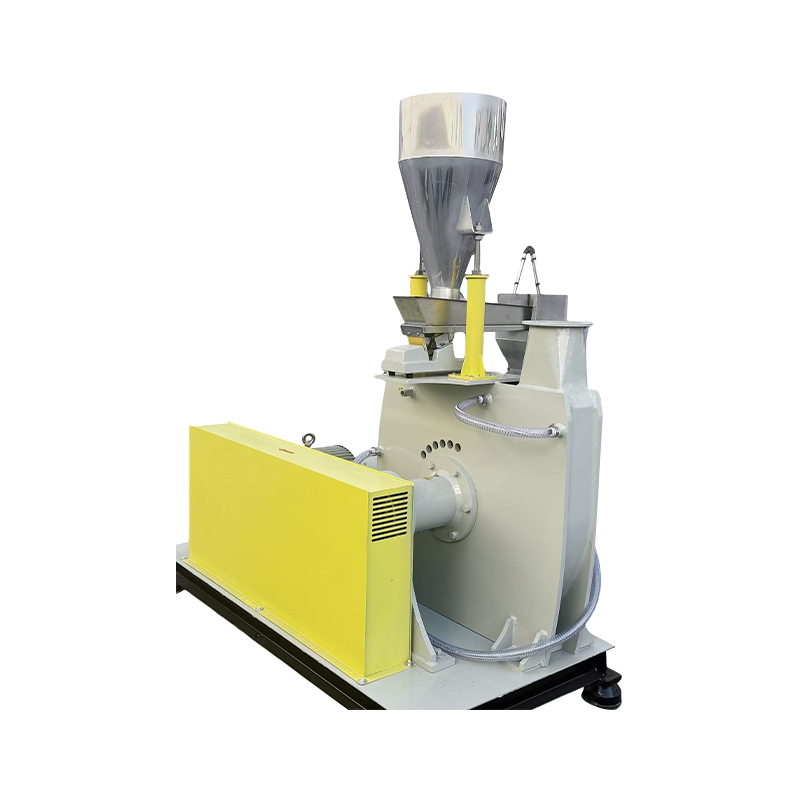
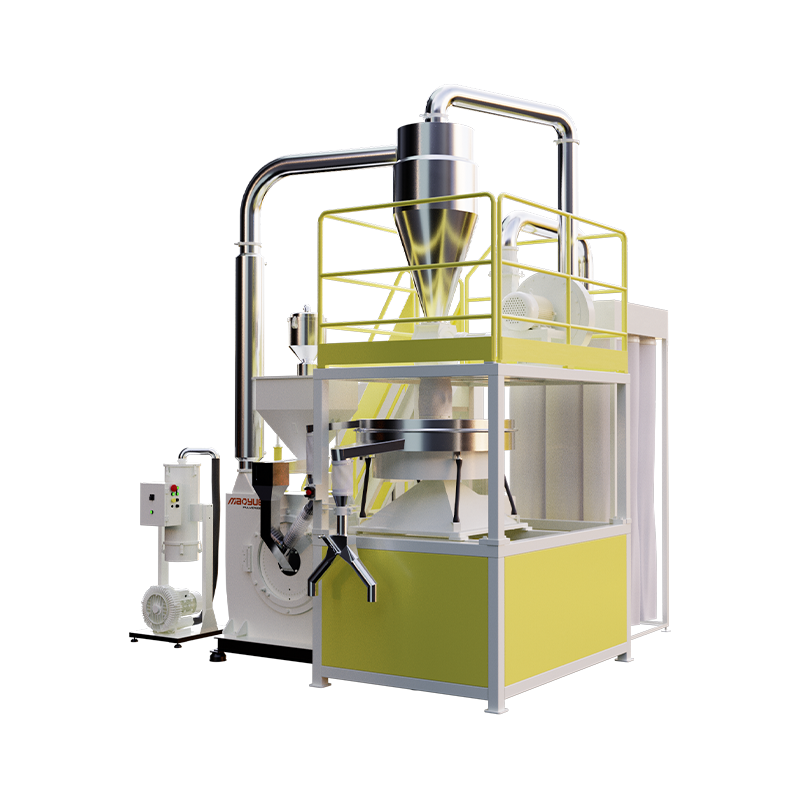
- 25 Product: Model 900 PVC Fine Powder Pulverizer
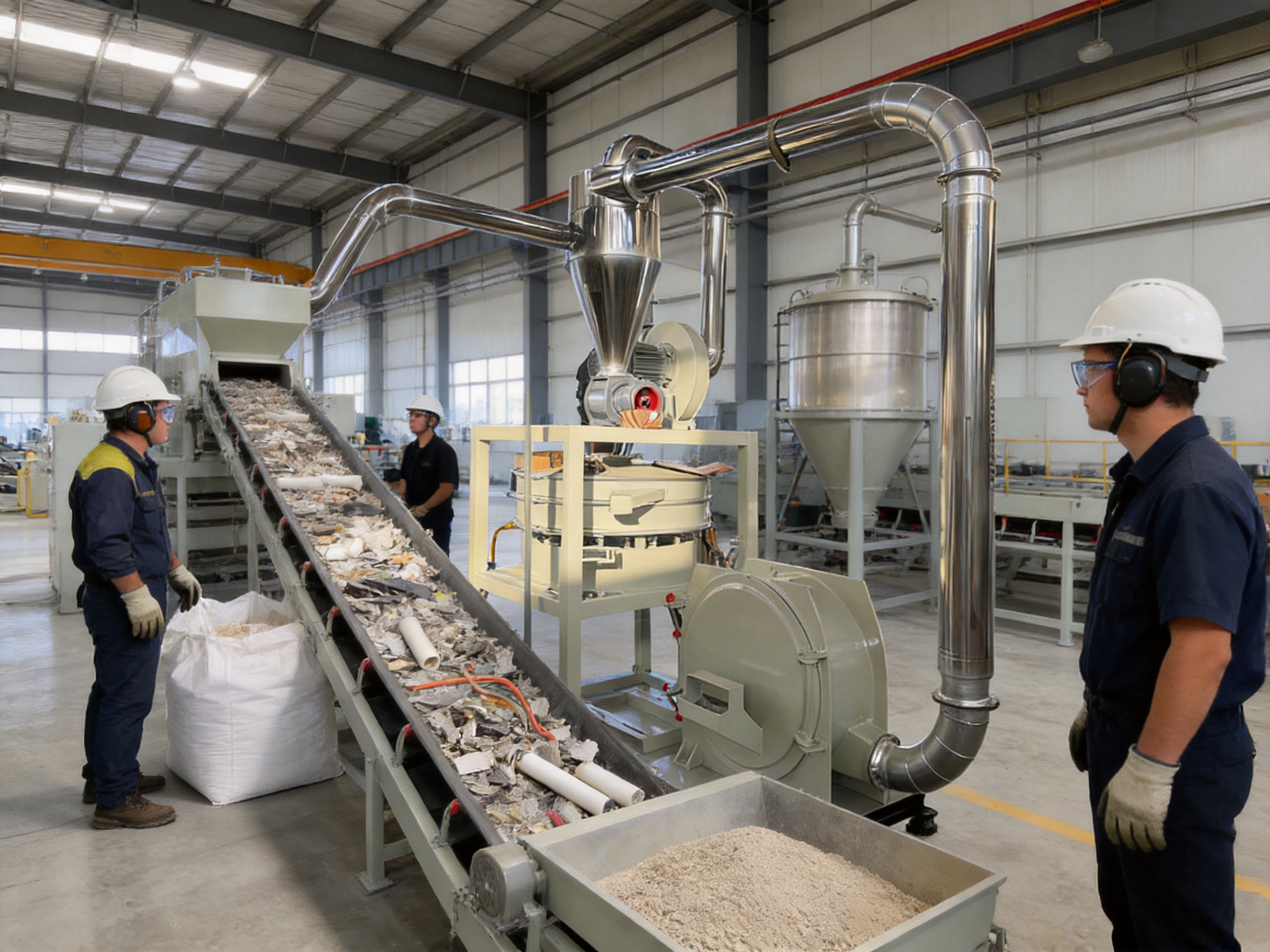
The Model 900 PVC Fine Powder Pulverizer is designed for large-scale PVC recycling, building-material production, specialty compound manufacturing, and export-oriented processing. It combines a large grinding chamber, high-powered drive system, water cooling, inverter-based speed control, high-chromium alloy grinding components, and integrated powder classification equipment in one industrial pulverizing solution.
With a stated production range of approximately 650–1,000 kg/h in the listed configuration, and higher output potential depending on material preparation, formulation, mesh size, and operating conditions, this machine is positioned as a flagship solution for demanding production lines. The product is also described as capable of reaching approximately 900–1,300 kg/h or more under suitable high-capacity configurations. Final capacity should be confirmed through material testing and technical specification review before purchase.
The pulverizer is intended for companies that require stable operation, high throughput, consistent particle size, reduced energy consumption per unit of output, and reliable processing of abrasive or filler-rich PVC materials. It is especially suitable for recycling plants, PVC pipe and profile manufacturers, flooring producers, cable-material processors, functional-powder suppliers, and international OEM factories.
Industrial Positioning of the Model 900 Pulverizer
PVC waste and production scrap are valuable secondary resources, but they are not always easy to process. Rigid pipes, window profiles, floor tiles, cable sheathing, edge trim, injection-molding runners, and industrial offcuts may contain mineral fillers, pigments, stabilizers, impact modifiers, or other additives. These materials can place heavy demands on a pulverizer’s grinding discs, bearings, motor, cooling system, and discharge equipment.
The Model 900 is engineered for this type of high-load application. Its large disc structure and heavy-duty construction allow it to process substantial quantities of prepared PVC feedstock while maintaining a controlled grinding environment. Rather than functioning as a small laboratory or workshop machine, it is designed to become the central pulverizing unit in a continuous production line.
Its target users include large recycling groups and building-material producers operating at ten-thousand-ton annual scales. In high-volume facilities, equipment availability is as important as nominal capacity. A machine that produces a high output but requires frequent shutdowns may create greater costs than a slightly slower machine with stable long-term operation. The Model 900 addresses this requirement through wear-resistant grinding parts, temperature management, vibration control, and a configuration intended for continuous industrial use.
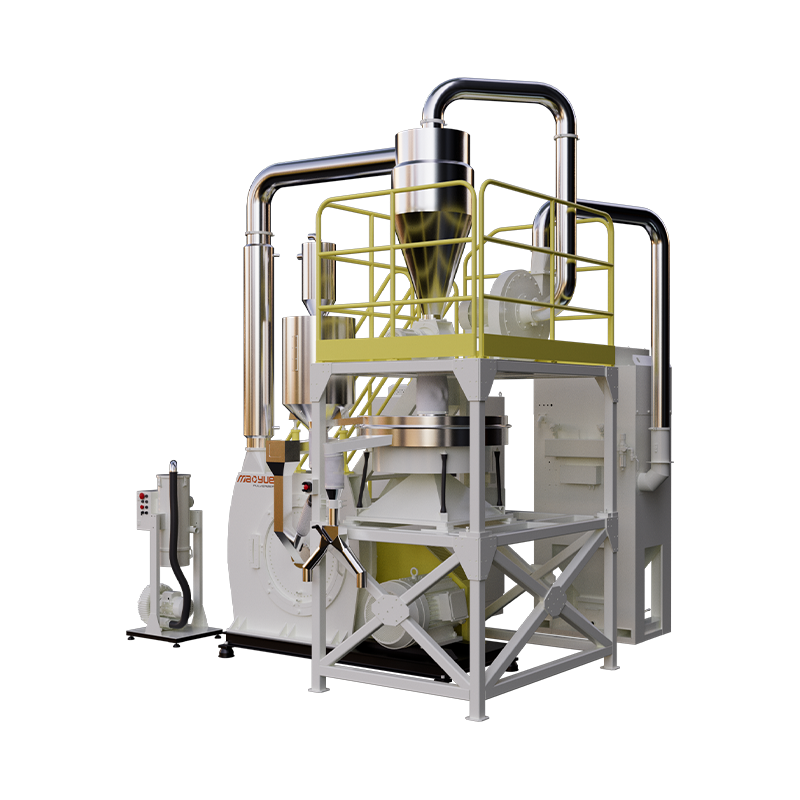
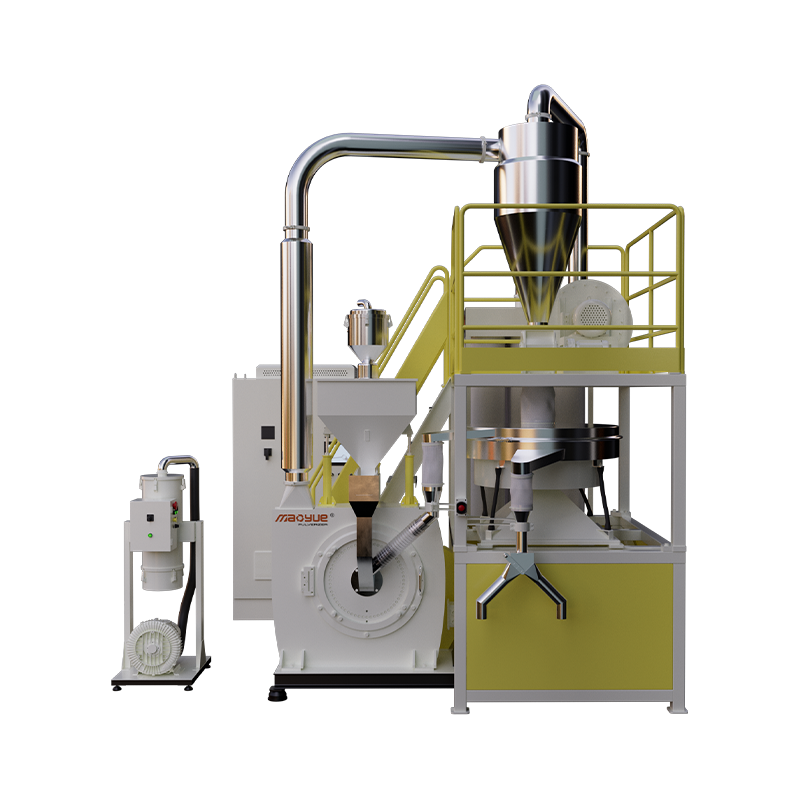
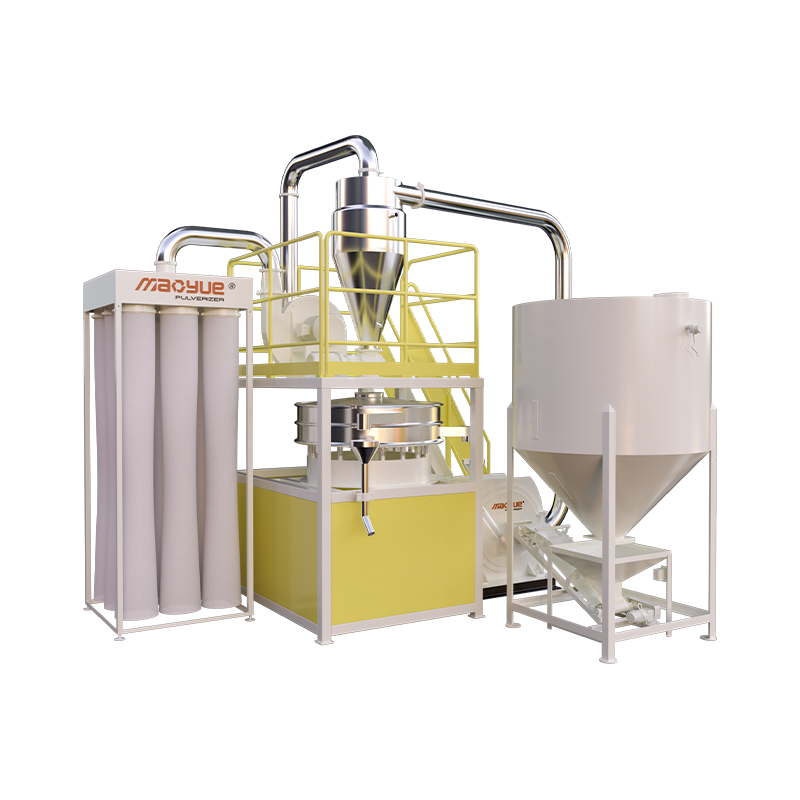
The machine can be installed as part of a complete PVC crushing and pulverizing line. A typical line may include feeding equipment, iron removal, primary crushing, secondary size reduction, pulverizing, conveying, vibration screening, dust collection, and finished-powder packing. The Model 900 can therefore serve not only as an individual pulverizer but also as the core processing unit within a larger automated recycling or powder-production system.
Large Grinding Capacity and High-Output Performance
The most important advantage of the Model 900 is its production scale. Its approximately 900-class design provides a substantially larger working area than smaller pulverizers. The enlarged grinding chamber gives the material more active contact with the grinding discs, supporting higher throughput when the feedstock has been correctly prepared.
The listed drive-motor options are 90 kW, 110 kW, and 132 kW. This range allows users to select a configuration according to the hardness of the material, required mesh size, daily production target, and available electrical capacity. A lower-power configuration may be appropriate for less abrasive or lower-throughput applications, while the 110 kW or 132 kW versions are more suitable for high-volume production and difficult PVC formulations.
The product information identifies the machine as a production champion within its series, with a claimed output increase of approximately 40–60 percent compared with an 850-class model. Actual results depend on many factors, including feed particle size, moisture, material temperature, PVC formulation, filler content, screen or classifier settings, operator adjustments, and desired powder fineness. Nevertheless, the larger disc and more powerful drive provide a strong foundation for higher capacity.
For industrial buyers, capacity should be evaluated as usable production rather than only a theoretical hourly number. Usable production includes the time required for feeding, grinding, screening, cooling, cleaning, routine inspection, and wear-part replacement. The Model 900 is designed to improve usable production by reducing unnecessary interruptions and maintaining a stable process temperature during extended operation.
Its production range is specified as 650–1,000 kg/h in the technical table, while the broader product description indicates a peak capacity of approximately 900–1,300 kg/h or more. These figures should be understood as configuration-dependent reference values. A buyer processing clean, pre-crushed rigid PVC may achieve a different result from a buyer processing mixed post-consumer scrap containing fillers, metal contamination, moisture, or irregular shapes.
Grinding Disc Design for Abrasive PVC
Grinding discs are among the most important wear components in a plastic pulverizer. They directly influence output, particle size, energy consumption, maintenance intervals, and finished-powder quality. The Model 900 uses high-chromium alloy grinding components, with the flagship configuration described as heavy-duty and highly resistant to wear.
High-chromium alloy is suitable for applications in which the feedstock contains abrasive mineral fillers or hard contaminants that would rapidly damage ordinary steel components. PVC used in flooring, profiles, pipes, cable products, and specialty compounds may contain calcium carbonate, flame retardants, impact modifiers, pigments, and other additives. These materials can increase grinding resistance and accelerate component wear.
The stated service life for the heavy-duty grinding discs is approximately 1,500–2,200 operating hours, depending on material composition, feed preparation, operating speed, product fineness, and maintenance practice. This service-life range is important for factories planning preventive maintenance. Longer wear life can reduce the frequency of production stoppages, spare-part consumption, labor requirements, and unplanned repairs.
A competitor’s nominally cheaper machine may have a lower initial purchase price but use ordinary grinding materials, lighter structural components, or less effective cooling. In that case, the total cost of ownership may become higher because of shorter disc life, frequent adjustments, inconsistent powder quality, and greater downtime. The Model 900 is intended to compete on long-term production value rather than only initial equipment cost.
Wear life should always be confirmed through a sample test when the feedstock is highly abrasive or contains an unusually high filler percentage. The same pulverizer may show different disc-life results when processing clean factory scrap, post-consumer profiles, calcium-carbonate-rich flooring waste, or mixed cable materials. A professional supplier should assess the application before finalizing the grinding-disc specification.
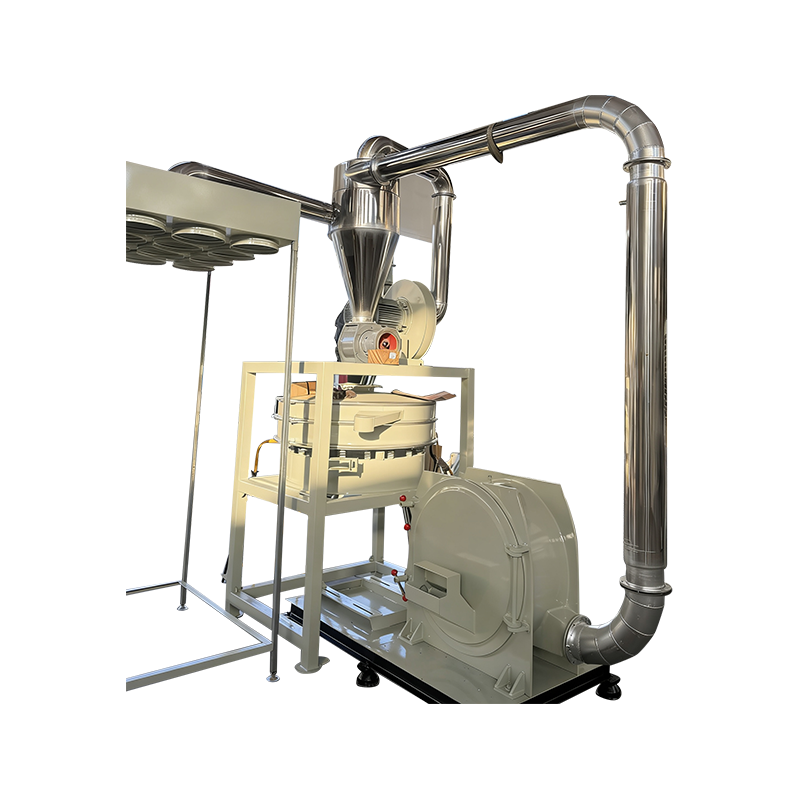
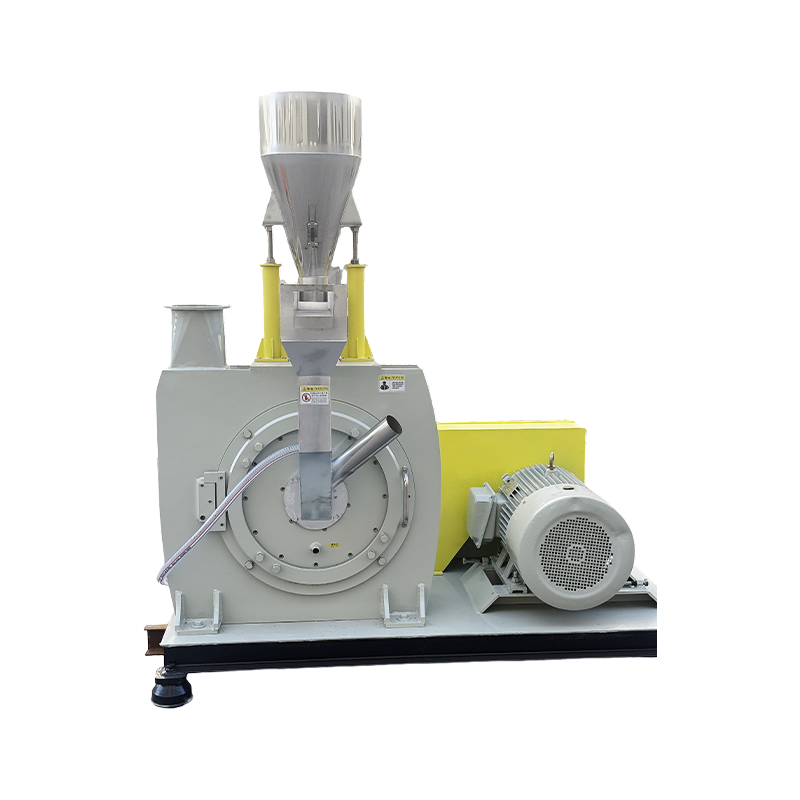
Model 900 PVC Fine Powder Pulverizer
Multi-Stage Shearing and Fine Particle Production
The Model 900 uses a high-speed grinding process supported by multi-stage shearing. This process is designed to break down pre-crushed PVC material into fine powder while maintaining a controlled particle-size distribution. Multi-stage grinding action can improve the contact between the feedstock and the grinding surfaces, helping the machine handle high feed rates without depending on a single aggressive grinding point.
The listed mesh-size range is 10 to 50 mesh. The appropriate setting depends on the final application. Coarser powder may be suitable for certain recycled compounds or downstream agglomeration processes, while finer powder may be required for calendering, extrusion, specialty compounds, or high-grade recycled material. The final output is influenced by the feed material, grinding clearance, machine speed, screen or classification arrangement, and operating temperature.
Uniform particle size is particularly important in PVC processing. If powder contains too many coarse particles, downstream extrusion or calendering may experience inconsistent melting, surface defects, weak points, or uneven thickness. If the powder contains excessive fines, the material may show poor flow, dust generation, feeding instability, or higher surface area and thermal sensitivity.
The Model 900 is designed to balance fineness and throughput. Its large grinding chamber supports high-volume processing, while inverter control allows the operator to adjust rotational speed according to the target product. This flexibility is valuable for manufacturers producing several grades of powder on the same line.
For recycled PVC, particle-size consistency can also improve blending. Recycled powder with a narrow distribution is easier to combine with virgin resin, stabilizers, processing aids, pigments, and other additives. It may also improve feeding stability in mixers and extruders, helping the downstream process achieve more predictable mechanical and visual properties.
Temperature Control for Color Stability and Material Protection
Temperature management is essential when pulverizing PVC. Excessive heat can cause discoloration, scorching, agglomeration, degradation, odor, and changes in material performance. The risk increases when the machine operates continuously at high speed, when the feedstock contains difficult additives, or when the desired powder is very fine.
The Model 900 uses water cooling, with separate inlet and outlet circulation. The technical information identifies a dual-circuit cooling concept combined with intelligent temperature control. This arrangement is intended to remove process heat efficiently and keep the powder within a more stable operating range.
The product description also refers to AI-assisted temperature control. In practical terms, an intelligent control system can monitor temperature conditions and support automatic adjustment of cooling or operating parameters. The specific control functions should be confirmed according to the supplied electrical cabinet and software configuration, but the purpose is clear: prevent excessive temperature rise during high-load production.
Stable temperature control supports color consistency. This is important for white, light-colored, and transparent PVC products, where even a small degree of thermal discoloration may affect product value. It is also important for recycled powder used in high-end building materials, decorative panels, flooring, cable products, and specialty compounds.
Temperature stability can provide several additional benefits. It may reduce the chance of material sticking to grinding surfaces, limit powder agglomeration, maintain better flowability, and reduce thermal stress on machine components. It can also make process conditions easier to reproduce from one production shift to another.
Cooling performance depends on water temperature, flow rate, pressure, water quality, ambient conditions, and the cleanliness of the internal cooling passages. For this reason, users should establish a cooling-water maintenance plan, inspect the circulation system regularly, and verify that the cooling system is correctly connected before operation.
Heavy-Duty Structure and Vibration Reduction
A pulverizer operating with a large disc and a powerful motor generates substantial mechanical forces. If the base is too light or the machine is poorly balanced, vibration can affect bearing life, noise levels, powder quality, and operator comfort. It can also cause fatigue in connected pipes and damage to surrounding equipment.
The Model 900 features a heavy-duty base and industrial vibration-damping design. The product information states that operating noise can be maintained below 90 dB under the specified configuration. Actual noise depends on the installation room, foundation, feed material, connected equipment, and acoustic treatment, but the structural approach is intended to support a more controlled industrial environment.
Effective vibration control begins with accurate manufacturing. The rotating assembly must be dynamically balanced, the grinding discs must be installed concentrically, bearings must be correctly seated, and the base must be level and firmly anchored. These details are especially important in large pulverizers, where even a small imbalance can become significant at high rotational speed.
Reduced vibration helps protect the main bearings, belts, couplings, motor, and connected conveying equipment. It can also make maintenance inspections more reliable because abnormal vibration is easier to identify when normal operating vibration is controlled. For a factory operating around the clock, these benefits can contribute to longer service intervals and fewer emergency shutdowns.
Noise should be evaluated as part of the overall plant design. Operators may need hearing protection, enclosed processing areas, acoustic insulation, or additional sound-control measures according to local regulations. The machine’s structural damping provides a useful foundation, but workplace safety requirements should always be assessed by the end user.
Integrated Feeding, Screening, and Dust Collection
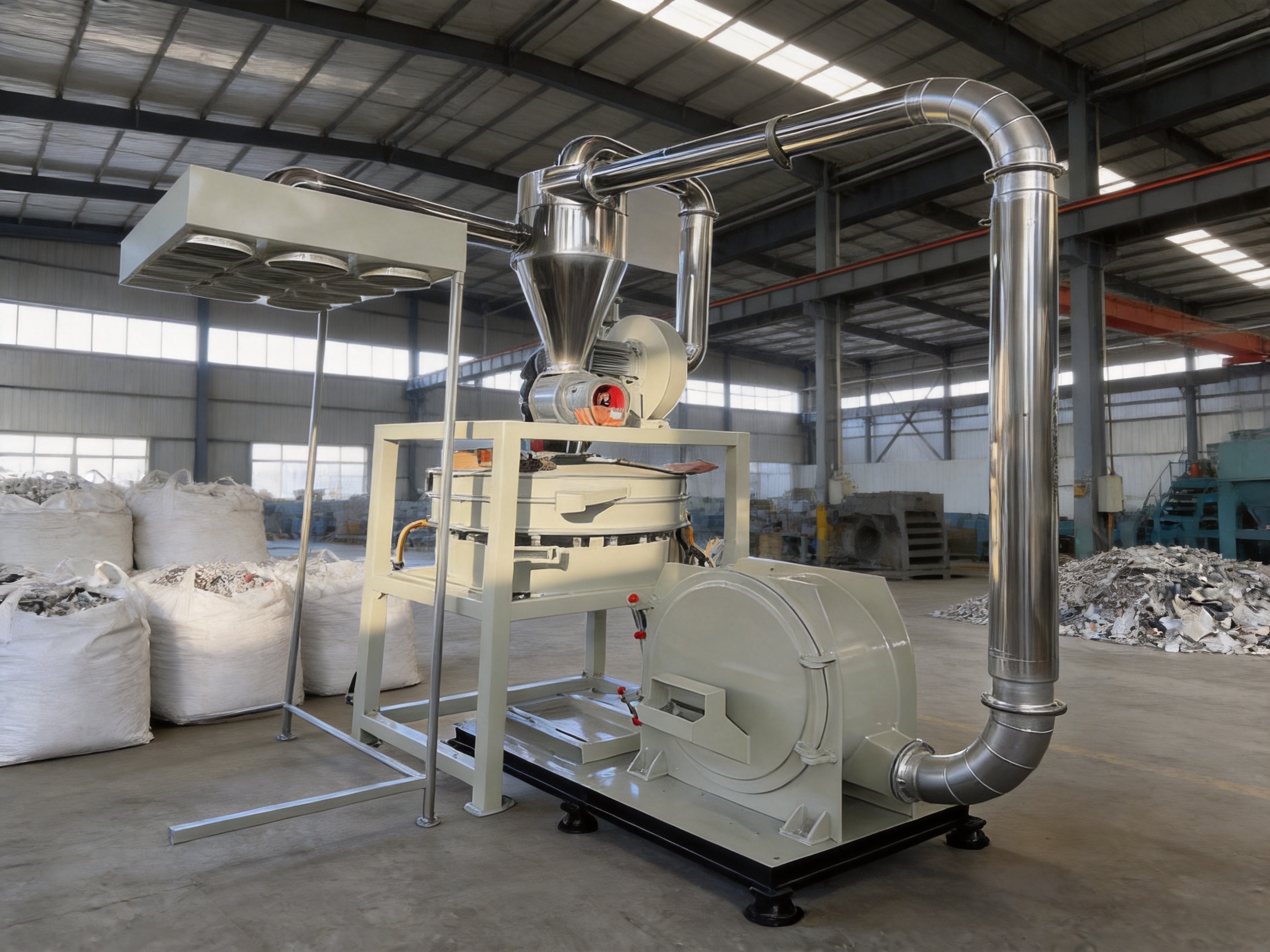
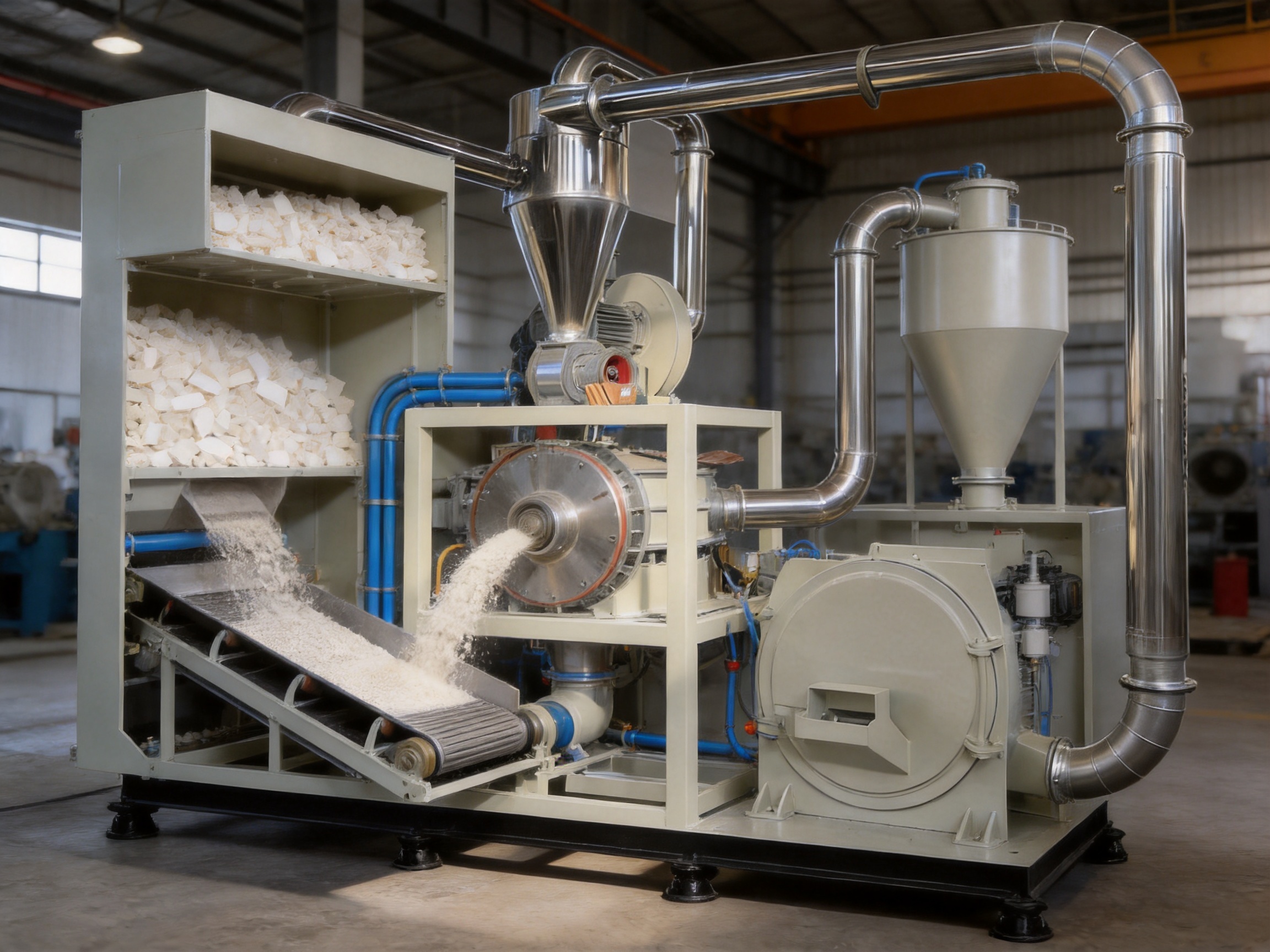
The Model 900 is not limited to a grinding chamber. Its listed configuration includes a 15 kW blower motor, all-stainless-steel piping, a pipe diameter of 178 mm, a 1,500 mm vibrating screen, a 2.2 kW vibrating-screen motor, and a dust-collector bag diameter of 300 mm.
These components support a more complete processing system. After pulverization, the blower conveys the powder through the stainless-steel pipeline toward the screening or collection section. Stainless steel is advantageous where cleanliness, corrosion resistance, and long-term durability are important. It can also simplify cleaning when the line is used for different PVC colors or formulations.
The vibrating screen helps separate powder according to the desired size. Oversized particles may be returned for additional grinding, while qualified powder proceeds to collection or packing. This closed-loop arrangement can improve product consistency and reduce the amount of oversize material entering downstream processes.
The 1,500 mm screen diameter provides a relatively large screening area for a high-output pulverizing system. The screening result depends on screen design, mesh selection, powder flow, feed rate, moisture, and the condition of the screen surface. Regular inspection is necessary because blocked or damaged screen sections can reduce capacity and affect particle-size distribution.
Dust collection is necessary for both product recovery and workplace cleanliness. Fine PVC powder can become airborne during conveying, screening, discharge, and bag filling. A properly designed collector helps capture airborne particles, reduce housekeeping requirements, and improve the working environment. Dust-control equipment must be operated and maintained according to applicable industrial safety standards.
The listed feeding method includes iron-removal tie feeding. This indicates that the material-feeding arrangement is designed to incorporate removal of ferrous contamination before it reaches the grinding chamber. Metal removal is especially important when processing post-consumer waste, construction scrap, or mixed industrial offcuts. It protects the grinding discs and reduces the likelihood of severe mechanical damage.
Applications in PVC Recycling
Large-scale PVC recycling is one of the primary applications for the Model 900. PVC recycling facilities may receive discarded pipes, window and door profiles, flooring, cable insulation, sheet material, injection-molding waste, and production scrap. These materials must normally be sorted, cleaned, separated from metals, and reduced to a suitable feed size before pulverization.
The pulverizer can produce recycled PVC powder for use in pipes, profiles, flooring, injection-molded products, extrusion compounds, and other applications. The value of the powder depends on its purity, color, particle-size consistency, thermal history, and formulation. A stable grinding process helps the recycler create a more consistent feedstock for downstream production.
For centralized recycling groups, high capacity is a major commercial advantage. Processing more material per shift can reduce the cost per kilogram, improve equipment utilization, and support larger supply contracts. When the powder is used internally, the recycler can reduce purchases of external filler or recycled feedstock and create a more integrated material loop.
Rigid PVC waste is particularly suitable for this type of application when it has been properly pre-crushed. Pipes and profiles can be difficult to handle if they enter the pulverizer in large or irregular pieces. A primary crusher or shredder should reduce the material to an appropriate size before the fine-powder stage. Proper preparation improves feeding stability and reduces unnecessary load on the pulverizer.
Material sorting remains essential. PVC waste containing large quantities of metal, rubber, wood, glass, or incompatible plastics may require additional separation equipment. The Model 900 includes an iron-removal feeding concept, but no pulverizer should be expected to process uncontrolled contamination without risk of damage or reduced product quality.
Applications in PVC Building Materials
The machine is suitable for manufacturers producing PVC flooring, thick-walled pipes, foam boards, decorative panels, profiles, and related building materials. These industries often require large quantities of consistent powder and may operate continuous extrusion or calendering lines.
For PVC flooring, the recycled or functional powder must support a smooth surface, consistent color, good dimensional stability, and reliable mechanical performance. Uneven powder can create visible defects, inconsistent wear resistance, or irregular product thickness. A controlled pulverizing process helps improve the uniformity of the raw material entering the formulation stage.
In pipe and profile manufacturing, consistent powder quality can support stable extrusion behavior. Particle size, flowability, moisture, and additive distribution all influence feeding and melting. High-quality recycled powder may be blended with virgin PVC and other ingredients to produce products that meet the required performance level.
Foam boards and decorative panels can also benefit from stable powder characteristics. These products often require controlled density, smooth surfaces, uniform foaming, and consistent appearance. Excessive coarse particles or thermally degraded material may interfere with cell formation and surface quality.
For large building-material companies, the Model 900 can contribute to a closed-loop manufacturing strategy. Factory scrap and selected post-consumer PVC can be converted into usable powder and returned to production. This approach may reduce waste-disposal costs, lower dependence on new raw materials, and support corporate resource-efficiency objectives.
Specialty PVC and Functional Powder Production
In addition to conventional recycled PVC, the Model 900 can be used for specialty powder applications. These may include flame-retardant, impact-resistant, weather-resistant, chemically resistant, and high-temperature-resistant PVC compounds.
Specialty formulations often contain fillers or additives that increase abrasiveness. High-chromium alloy grinding parts and high-capacity cooling are therefore valuable in these applications. The machine’s ability to adjust speed with an inverter can also help users develop process conditions for different material grades.
Functional PVC powders may be used in premium construction products, automotive interior components, electronic enclosures, cable sheathing, and other engineered applications. These markets typically demand stable color, reliable performance, controlled particle size, and low contamination.
Because specialty formulations can be sensitive to heat and contamination, users should clean the line thoroughly when changing materials. Stainless-steel conveying pipes and accessible equipment design can assist with cleaning, but the specific cleaning procedure should be developed around the formulation and production schedule.
Before commercial production, a trial should evaluate particle size, color, bulk density, flowability, thermal stability, and downstream processing performance. A test is particularly important when the powder will be used in a high-value application or when the feedstock contains unusual additives.
Advantages Compared with Conventional Pulverizers
The Model 900 has several advantages over lighter or smaller pulverizers. The first is its scale. The large grinding structure and powerful motor enable higher throughput, making it more appropriate for industrial production than for low-volume processing.
The second advantage is wear resistance. High-chromium alloy grinding components are designed for longer service in abrasive PVC applications. This can reduce maintenance frequency and support a lower total cost per kilogram over the life of the machine.
The third advantage is temperature management. Water cooling combined with intelligent monitoring helps protect color and material quality during extended operation. Some conventional systems rely mainly on passive cooling or manual adjustment, which may be less responsive when the load changes.
The fourth advantage is process flexibility. Inverter speed control allows the operator to adjust the machine according to material type and target fineness. A fixed-speed machine may be simpler, but it offers less ability to optimize the balance between capacity, particle size, energy use, and temperature.
The fifth advantage is the integrated line arrangement. Feeding, conveying, screening, dust collection, and iron removal are considered as part of the overall solution rather than being treated as completely separate components. This can simplify line planning and improve compatibility between major equipment sections.
The sixth advantage is suitability for continuous production. The heavy-duty base, vibration damping, industrial bearings, cooling system, and replaceable wear components are designed for demanding operating schedules. For a plant that runs multiple shifts, these features can be more valuable than a low purchase price.
The Model 900 is not necessarily the right choice for every buyer. Small workshops, laboratories, and companies with limited daily production may obtain better economic results from a smaller model. The Model 900 is intended for users who can take advantage of its capacity and who require an industrial machine for continuous, high-volume operation.
Manufacturing Strengths of the Equipment Supplier
The supplier has approximately 30 years of experience in plastic crushing and pulverizing equipment. This experience is significant because a pulverizer is not only a collection of standard motors and steel plates. Its performance depends on the relationship between disc geometry, rotational balance, bearing arrangement, cooling, feed design, conveying, screening, and control logic.
The company operates six processing workshops, each averaging approximately 1,400 square meters. A multi-workshop production structure can support specialized operations such as machining, welding, assembly, testing, painting, electrical integration, and spare-part preparation.
The factory is equipped with high-precision grinding machines imported from Taiwan and manufactured to German standards, German dynamic-balancing equipment, and Japanese welding systems. These capabilities are directly relevant to pulverizer quality.
High-precision grinding machines help produce accurate disc surfaces and critical mechanical parts. Precision is important because uneven grinding surfaces can influence particle-size distribution, vibration, energy consumption, and wear. Accurate machining also supports correct assembly between the grinding chamber, shaft, bearings, and drive system.
Dynamic balancing equipment is essential for large high-speed rotating assemblies. A properly balanced rotor reduces vibration and mechanical stress. It also helps protect bearings and supports quieter operation. This manufacturing step is one of the differences between a professionally engineered pulverizer and a machine assembled without sufficient rotating-equipment control.
Japanese welding systems support consistent fabrication of frames, housings, brackets, pipelines, and other structural components. Stable welding quality helps reduce deformation and improves the reliability of the machine base and working chamber. For heavy-duty equipment, structural accuracy contributes to long-term performance.
The company states that its components are manufactured according to European quality standards and that the equipment has CE mechanical certification and ISO 9001 quality-management certification. These certifications provide a framework for safety, manufacturing control, documentation, and quality procedures. Buyers should still review the applicable certificates and technical documents for the exact machine configuration being purchased.
Quality Control and Assembly Considerations
Quality control for a large PVC pulverizer should cover both individual parts and the complete assembled machine. Important inspection points include grinding-disc material, disc flatness, shaft alignment, bearing installation, pulley condition, belt tension, motor performance, cooling-water flow, screen integrity, electrical protection, and dust-collection connections.
The supplier’s use of precision machining and dynamic balancing can support these requirements, but final assembly and testing remain equally important. The rotating system must be checked after assembly because the relationship between parts can affect the balance of the complete unit.
Electrical control should include appropriate overload protection, emergency-stop functions, temperature monitoring, interlocks, and motor-starting procedures. A high-powered motor requires correct cable sizing, electrical protection, grounding, and installation by qualified personnel.
Factory testing should verify that the machine starts smoothly, reaches operating speed correctly, maintains stable vibration, circulates cooling water, conveys material effectively, and operates with the intended screen and dust-collection arrangement. A material trial is recommended for customers who require a guaranteed output, a specific mesh size, or a particular powder-quality target.
Documentation is also part of equipment quality. Buyers should receive operating instructions, installation guidance, lubrication requirements, electrical diagrams, maintenance schedules, recommended spare-part lists, and safety information. Clear documentation makes it easier for operators and maintenance personnel to use the equipment correctly.
Energy Efficiency and Total Cost of Ownership
Energy use is an important consideration in PVC pulverizing because the process requires high-speed mechanical work. The Model 900 uses a powerful motor, but high motor power does not automatically mean poor energy efficiency. The relevant measurement is energy consumption per unit of usable output.
A larger pulverizer may produce more kilograms per hour and therefore distribute fixed operating costs across a greater volume of powder. If the machine is correctly matched to the production requirement, the energy cost per kilogram may be lower than that of several smaller machines operating near their limits.
The inverter provides additional control over motor speed. Operators can select a suitable speed for the material instead of always running at maximum intensity. This may help reduce unnecessary energy use, limit heat generation, and optimize particle size. The best setting must be established through testing because lower speed may reduce capacity while higher speed may increase heat and wear.
Longer grinding-disc life also contributes to total cost savings. Wear parts create direct expenses, but the indirect cost of replacing them includes labor, cleaning, inspection, machine downtime, and lost production. A heavy-duty disc that remains effective for a longer period can improve the overall economics of the line.
Cooling-water management affects energy performance as well. A clean and correctly sized cooling circuit can remove heat more efficiently than a restricted or poorly maintained system. Users should monitor water flow, inspect filters and pipes, and maintain the recommended operating conditions.
For a complete economic evaluation, the buyer should calculate expected annual throughput, electricity consumption, labor, spare parts, maintenance, dust-collection operation, cooling-water costs, and downtime. The Model 900 is most economically attractive when it is used at a high utilization rate and when the factory has a reliable supply of suitable PVC feedstock.
Recommended Production-Line Configuration
A complete PVC powder production line normally begins with material inspection and sorting. The feedstock should be separated by polymer type, color, product category, and contamination level. Ferrous metals and other unwanted materials should be removed before fine pulverizing.
The next stage is primary crushing or shredding. Large pipes, profiles, sheets, and flooring pieces should be reduced to a controlled size suitable for the pulverizer feeder. Consistent feed dimensions improve the stability of the pulverizing process and reduce sudden load peaks.
After pre-crushing, the material can pass through iron removal and controlled feeding. The feeder should provide a steady flow rather than allowing large surges into the grinding chamber. Stable feeding helps maintain consistent motor load, temperature, and output.
The Model 900 then performs fine pulverization. The operating speed, grinding clearance, cooling conditions, and feed rate should be adjusted according to the target mesh size and material type. The discharge system conveys the powder to the vibrating screen, where qualified material is separated from oversize particles.
Oversize material may be returned to the pulverizer for additional processing. Qualified powder proceeds to dust collection, temporary storage, blending, or automatic packing. The final line arrangement depends on plant capacity, product grade, available floor space, and customer requirements.
Automation can be added to improve production control. Sensors may monitor motor current, temperature, cooling-water conditions, vibration, conveying pressure, and dust-collector status. Automatic alarms and shutdowns can protect the machine when abnormal conditions occur.
Installation and Commissioning
Correct installation is necessary to achieve the expected performance of the Model 900. The foundation must be strong, level, and suitable for the machine’s weight and dynamic forces. Anchor bolts should be installed according to the approved foundation drawing, and the machine should be aligned before connection to the surrounding equipment.
The electrical system must match the selected motor configuration. The 90 kW, 110 kW, and 132 kW options require different electrical planning. Voltage, frequency, cable capacity, circuit protection, motor starting, grounding, and control-panel configuration should be confirmed before shipment and installation.
The cooling circuit should be connected with clearly identified inlet and outlet pipes. Water flow should be tested before material is introduced. The user should verify that the cooling water is clean enough for the system and that the water temperature remains within the recommended range during continuous operation.
The conveying and screening sections must be installed without excessive bends, restrictions, or unsupported pipe weight. Poorly installed pipes can increase pressure loss, reduce conveying efficiency, and transmit vibration to the pulverizer. The dust collector should be positioned and connected in a way that supports effective airflow and convenient maintenance.
Commissioning should begin with an empty-machine inspection and no-load test. The operator should check rotation direction, abnormal noise, vibration, bearing temperature, belt tracking, cooling-water flow, electrical alarms, and emergency-stop operation. Material should then be introduced gradually while motor current and product quality are monitored.
Initial settings should not be treated as permanent settings. The best operating conditions may change with PVC formulation, ambient temperature, feed size, moisture, and target mesh. Production personnel should record the settings and results so that successful operating conditions can be repeated.
Maintenance Strategy
Preventive maintenance is essential for continuous pulverizing. Operators should inspect the grinding chamber, grinding discs, bearings, belts, pulleys, fasteners, cooling lines, screen, blower, dust collector, and electrical cabinet at regular intervals.
Grinding-disc wear should be measured rather than judged only by visual appearance. As the grinding surfaces wear, the gap and grinding action may change. This can reduce fineness, lower capacity, increase energy consumption, or create excessive heat. Replacing or refurbishing wear components at the appropriate time helps maintain stable output.
Bearings should be lubricated according to the supplier’s instructions. Over-lubrication can create heat, while under-lubrication can accelerate wear. Bearing temperature and vibration should be recorded during operation to identify changes before failure occurs.
Belts should be checked for tension, cracks, alignment, and slippage. A loose belt can reduce transmission efficiency and generate heat, while an over-tightened belt can place unnecessary stress on the motor and bearings. Pulleys should remain aligned and securely fastened.
The vibrating screen must be cleaned and inspected regularly. Blocked screen openings can reduce output and produce an incorrect particle-size distribution. Damaged screen sections should be replaced promptly to prevent oversize material from entering the finished powder stream.
The dust collector requires regular cleaning and inspection. Filter bags, seals, discharge equipment, and airflow should be maintained to prevent powder leakage and reduced collection performance. Dust accumulation around electrical equipment and motors should be avoided.
Maintenance records should include operating hours, material type, motor load, temperature, vibration, disc condition, bearing condition, screen changes, and repairs. These records help the factory plan spare-parts inventory and predict the next service interval.
Safety and Environmental Considerations
Operators must be trained before using the Model 900. The grinding chamber should never be opened while the machine is running or while stored energy remains in the drive system. Lockout and tagout procedures should be followed during inspection, cleaning, and maintenance.
Personal protective equipment may include hearing protection, safety glasses, gloves suitable for maintenance work, protective footwear, and respiratory protection where required. The exact requirements depend on the plant’s risk assessment and local regulations.
Dust control is a major environmental and occupational consideration. The pulverizer should operate with a properly connected collection system, and transfer points should be sealed where practical. The factory should monitor airborne dust and maintain housekeeping procedures around the line.
PVC processing may involve additives that require special handling. The user should obtain information about the incoming material and assess potential hazards associated with stabilizers, pigments, flame retardants, or other formulation components. Waste powder and cleaning residues should be managed in accordance with applicable environmental requirements.
Noise, heat, vibration, and moving mechanical parts should be considered during plant layout. Protective guards should remain installed, access doors should be secured, and emergency-stop devices should be accessible to operators.
Technical Specification Summary
Item |
Specification |
Application Note |
Model |
900 |
Large-capacity PVC pulverizer class |
Disc diameter |
Approximately 800 mm in the listed technical table |
Confirm the exact disc configuration before ordering |
Capacity |
650–1,000 kg/h listed range |
Higher peak output may be available according to configuration and material |
Mesh size |
10–50 mesh |
Final result depends on feedstock and operating settings |
Main drive motor |
90 kW, 110 kW, or 132 kW |
Select according to capacity and material resistance |
Speed control |
Inverter |
Supports process adjustment and speed optimization |
Bearing standard |
Imported NSK bearings |
Supports reliable high-speed operation |
Grinding component material |
High-chromium alloy |
Designed for abrasive and filler-rich PVC |
Blower motor |
15 kW |
Supports powder conveying |
Pipe material |
Stainless steel |
Provides durability and easier cleaning |
Pipe diameter |
178 mm |
Used in the conveying arrangement |
Vibrating-screen diameter |
1,500 mm |
Provides classification area for high-volume output |
Vibrating-screen motor |
2.2 kW |
Supports powder classification |
Feeding method |
Iron-removal tie feeding |
Helps reduce ferrous contamination before grinding |
Dust-collector bag diameter |
300 mm |
Supports powder collection and dust management |
Cooling method |
Water cooling with inlet and outlet circulation |
Designed to control process temperature |
How to Select the Correct Configuration
The correct configuration should begin with the material. Buyers should identify whether the feedstock is rigid PVC, flexible PVC, cable scrap, flooring waste, pipe waste, profile waste, production trim, or a mixed stream. The material’s hardness, filler content, moisture, color, contamination level, and initial particle size all affect machine selection.
The required final powder should also be defined. A target of 10 mesh has different capacity and energy requirements from a target of 50 mesh. The buyer should specify the acceptable particle-size distribution rather than only requesting a general description such as “fine powder.”
Daily production is another key factor. A plant processing five tons per day may not require the same configuration as a facility processing thirty tons or more. The operating schedule, number of shifts, planned maintenance time, and future expansion should be considered together.
Electrical conditions must be reviewed early. The 132 kW configuration may be suitable for maximum output, but the site must have sufficient electrical capacity and appropriate protection. The buyer should also consider the power requirements of the blower, vibrating screen, feeding system, cooling system, dust collector, crusher, and auxiliary equipment.
Finally, the buyer should request a technical confirmation of the exact disc diameter, capacity, motor configuration, control functions, wear-part material, and included accessories. The provided product information contains both an approximately 900-class description and a technical-table reference to an 800 mm disc, so the final commercial specification should clearly identify the supplied configuration.
Why the Model 900 Fits Large PVC Operations
The Model 900 is best suited to companies that need more than basic size reduction. It is designed for high-volume, continuous pulverizing where powder quality, equipment durability, and process stability directly affect business performance.
Its combination of large capacity, powerful drive options, wear-resistant grinding parts, water cooling, intelligent temperature management, vibration damping, conveying, screening, and dust collection makes it suitable for integrated industrial lines. These features help address the main challenges of PVC powder production: abrasive materials, high heat generation, variable feedstock, airborne dust, particle-size control, and production downtime.
The supplier’s manufacturing infrastructure adds another layer of value. Precision machining, dynamic balancing, advanced welding, quality-management procedures, and long experience in plastic pulverizing support the reliability of the complete machine. The company’s history of serving more than 5,000 domestic and international enterprises also indicates experience with different production conditions and customized equipment requirements.
For large recycling groups and PVC manufacturers, the primary benefit is not simply a high hourly output. The greater benefit is the ability to establish a stable material-conversion process, from selected PVC waste to consistent recycled powder and then to higher-value finished products.
Q&A
What materials can the Model 900 pulverize?
The machine is designed primarily for PVC materials, including rigid PVC pipes, window and door profiles, flooring, cable sheathing, industrial offcuts, production scrap, and selected PVC compound materials. Feedstock should be sorted and pre-crushed, and excessive metal or incompatible-material contamination should be removed before pulverizing.
What is the capacity of the Model 900?
The listed technical specification gives a capacity of approximately 650–1,000 kg/h. The broader product description refers to a peak capacity of approximately 900–1,300 kg/h or more under suitable configurations. Actual capacity depends on material type, feed size, filler content, moisture, mesh size, operating speed, and cooling conditions. A material test is recommended for a confirmed production value.
What motor options are available?
The listed main drive-motor options are 90 kW, 110 kW, and 132 kW. The appropriate motor should be selected according to the required capacity, target fineness, material hardness, filler content, and available site power.
What mesh size can the machine produce?
The stated mesh-size range is 10–50 mesh. The final particle-size distribution depends on the feedstock, grinding clearance, speed, screen arrangement, and operating conditions. Users should define their required powder specification before finalizing the machine configuration.
How long do the grinding discs last?
The heavy-duty wear-resistant grinding discs are described as having an approximate service life of 1,500–2,200 operating hours. Actual life varies according to PVC formulation, filler content, contamination, throughput, operating speed, and maintenance practice.
Does the pulverizer include cooling?
Yes. The listed cooling method is water cooling with one inlet and one outlet. The product description also identifies a premium dual-circuit cooling and intelligent temperature-control concept for high-load operation. Cooling-water quality, flow, and temperature must be maintained by the user.
Can the machine process high-filler PVC?
Yes. The flagship configuration is specifically intended for high-abrasion and high-filler PVC. High-chromium alloy grinding components are used to improve wear resistance. Because filler types and concentrations differ, testing is recommended before commercial installation.
Is the Model 900 suitable for continuous production?
It is designed for heavy-duty industrial operation and continuous high-volume production. Long-term performance depends on correct installation, stable feeding, cooling, preventive maintenance, proper lubrication, and regular replacement of wear components.
Does the machine include screening and conveying equipment?
The listed configuration includes a blower motor, stainless-steel conveying pipes, a vibrating screen, and a vibrating-screen motor. The final scope of supply should be confirmed in the purchase contract, including dust collection, feeding, return conveying, packing, electrical controls, and installation accessories.
What is the advantage of inverter speed control?
Inverter control allows the operator to adjust rotational speed according to material conditions and target powder fineness. It can help optimize the balance among output, energy use, temperature, and wear. The best settings should be established through testing and recorded for repeat production.
Is the Model 900 appropriate for a small workshop?
The machine is primarily intended for large recycling facilities, building-material manufacturers, specialty-compound producers, and high-volume OEM operations. A smaller model may be more economical for low daily production or occasional processing.
What should be checked before ordering?
Buyers should confirm the exact disc diameter, motor power, expected capacity, mesh-size requirement, feed particle size, cooling-water conditions, dust-collection scope, electrical standards, screen configuration, wear-part material, spare parts, installation requirements, and after-sales service. A sample test is strongly recommended for difficult or highly abrasive materials.
Conclusion
The Model 900 PVC Fine Powder Pulverizer is a large-scale processing solution for companies that require high output, stable powder quality, and reliable operation under demanding conditions. Its powerful motor options, large grinding structure, high-chromium alloy components, inverter speed control, water-cooling system, intelligent temperature management, vibration-damping base, conveying equipment, vibrating screen, and dust-collection arrangement provide a comprehensive foundation for industrial PVC powder production.
Compared with conventional lighter-duty pulverizers, the machine is better positioned for abrasive, filler-rich PVC and continuous multi-shift operation. Its value is reflected in long wear-part life, reduced interruption risk, improved temperature control, and the ability to integrate with large recycling and building-material lines.
The manufacturer’s long experience, precision machining capability, dynamic-balancing equipment, advanced welding systems, CE mechanical certification, ISO 9001 quality-management certification, and international customer base further support the equipment’s industrial positioning. For companies processing large PVC volumes and seeking to convert waste or compound materials into consistent high-value powder, the Model 900 offers a practical flagship configuration.
Before purchase, customers should verify the final technical specification because capacity and disc-diameter references may vary by configuration. A material trial and complete line review will help ensure that the selected Model 900 meets the required production rate, particle-size distribution, temperature limits, and downstream product standards.
References
1. Manufacturer-provided technical specification for the Model 900 PVC Fine Powder Pulverizer.
2. Manufacturer-provided information on PVC recycling, crushing, pulverizing, cooling, screening, and dust collection.
3. ISO 9001 quality-management principles for manufacturing organizations.
4. CE machinery-safety principles and conformity requirements for industrial equipment.
5. General industrial guidance on polymer processing, particle-size control, wear-part management, and preventive maintenance.
6. General occupational guidance concerning machine guarding, dust control, vibration, noise, and lockout procedures.