

 English
 русский
 Español
 عربى
 中文简体
 中文简体
Content
- 1 1. The Role of the Rotor in PVC Pulverizing
- 2 2. Large Disc-Shaped Construction
- 3 3. Modular Cutting Blocks and Maintenance Efficiency
- 4 4. Advanced Material and Heat-Treatment Technology
- 5 5. Optimized Blade Arrangement
- 6 6. Powder Quality and Particle-Size Control
- 7 7. Dual Cooling and Temperature Management
- 8 8. Manufacturing Precision and Quality Control
- 9 9. Compatibility and Customization
- 10 10. Comparison with Traditional and Imported Alternatives
- 11 11. Application in PVC Recycling
- 12 12. Application in PVC Powder and Building Materials
- 13 13. Application in Polymer Modification and Chemical Processing
- 14 14. Operating Practices for Maximum Rotor Life
- 15 15. Company Manufacturing Strengths
- 16 16. Technical Performance Summary
- 17 17. Economic Value and Total Cost of Ownership
- 18 18. Selection Guide for Buyers
- 19 19. Questions and Answers
- 19.1 Q1: What is the main advantage of the large disc-shaped rotor?
- 19.2 Q2: Can the entire rotor remain in service when one blade block is worn?
- 19.3 Q3: What materials can the rotor process?
- 19.4 Q4: What hardness do the cutting blocks achieve?
- 19.5 Q5: What particle size can be produced?
- 19.6 Q6: How does the rotor help prevent PVC yellowing?
- 19.7 Q7: Is the rotor compatible with other brands of pulverizers?
- 19.8 Q8: Can the blade arrangement be customized?
- 19.9 Q9: Why is dynamic balancing important?
- 19.10 Q10: What information should a customer provide when requesting a replacement rotor?
- 20 20. Conclusion
- 21 References
- 22 Product: PVC Pulverizer Large disc-shaped Rotor
PVC processing and recycling operations depend heavily on the quality, stability, and service life of the pulverizing system. While the main machine frame, cooling system, feeding structure, and drive motor all influence production performance, the rotor remains one of the most important working components. It directly contacts the material, creates the cutting and friction forces required for size reduction, and determines how efficiently waste PVC is converted into a uniform powder.
The large disc-shaped rotor described in this article is designed for demanding PVC pulverizer applications where high output, fine particle size, low maintenance, and dependable continuous operation are essential. Its modular cutting-block structure, precision-machined disc body, heat-treated alloy steel blades, optimized blade arrangement, and compatibility with advanced cooling systems provide a comprehensive solution for modern plastic recycling and powder production.
Unlike traditional monolithic cutter heads, this rotor uses multiple sets of independently replaceable cutting blocks distributed around a large circular disc. This configuration allows maintenance personnel to replace only worn components instead of removing and replacing the entire rotor. As a result, users can reduce downtime, control spare-part expenditure, and maintain consistent pulverizing performance throughout the operating life of the equipment.
The rotor is manufactured by Changzhou Mao Yue Intelligent Equipment Co., Ltd., a specialized producer of plastic crushing and pulverizing equipment with more than three decades of industry experience. The company operates multiple processing workshops, uses precision CNC equipment, and applies professional heat-treatment and balancing procedures to produce components for PVC, PE, polymer, masterbatch, rotational molding, recycling, and powder-coating applications.
1. The Role of the Rotor in PVC Pulverizing
A PVC pulverizer reduces plastic material into fine powder through a combination of high-speed cutting, shearing, impact, and friction. The rotor rotates at high speed inside the pulverizing chamber while stationary cutting surfaces work together with the rotating blade blocks. As the material passes through the working gap, it is repeatedly processed until the particles reach the required size.
The rotor affects nearly every important result of this process. Its diameter influences the working circumference and processing capacity. Its weight and balance affect vibration. Its blade arrangement determines how material is captured and sheared. Its metallurgy determines resistance to wear, cracking, chipping, and deformation. Its replaceable-block structure determines how quickly maintenance can be completed.
In PVC applications, these requirements are especially demanding. PVC can be processed in rigid or flexible forms and may contain fillers, pigments, stabilizers, plasticizers, glass fibers, mineral additives, or other contaminants. Some waste streams are relatively clean, while others contain abrasive components that rapidly wear ordinary cutting edges. The rotor must therefore provide strong cutting performance while maintaining dimensional stability under continuous mechanical and thermal stress.
A poorly designed rotor may cause several problems. The powder can become too coarse or inconsistent, the machine may consume excessive energy, and friction can generate enough heat to soften PVC. Softened material may stick to the disc, block the air passages, reduce output, or begin to degrade and discolor. Excessive vibration can damage bearings and drive components, while difficult blade replacement can create long production interruptions.
The large disc-shaped rotor addresses these concerns through a combination of mechanical design, material selection, precision manufacturing, and modular maintenance. Instead of treating the disc as a single disposable part, the design separates the structural rotor body from the replaceable wear components. This creates a more practical balance between high-performance operation and long-term ownership cost.
2. Large Disc-Shaped Construction
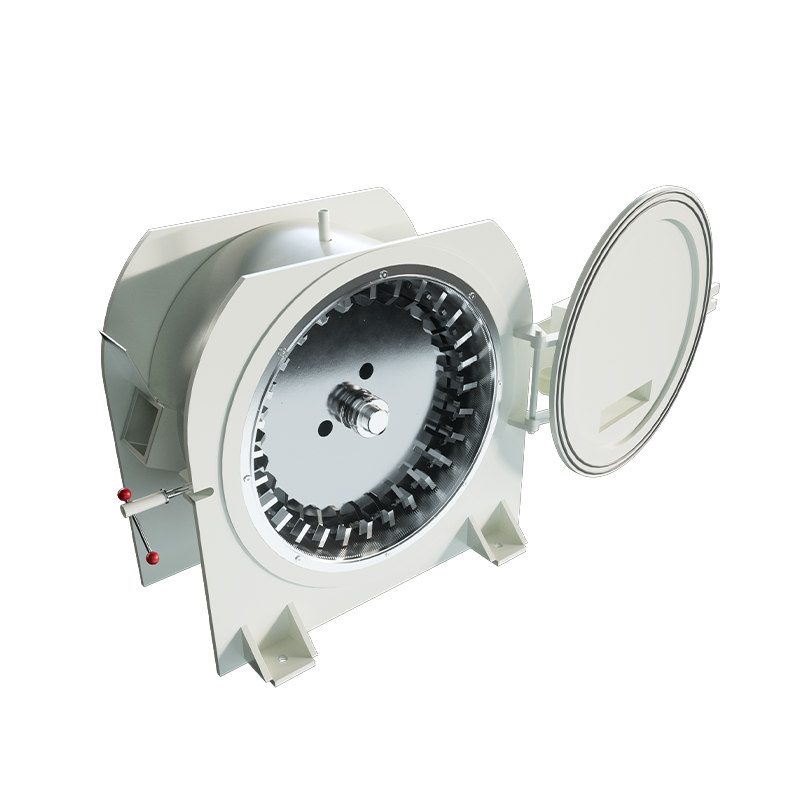
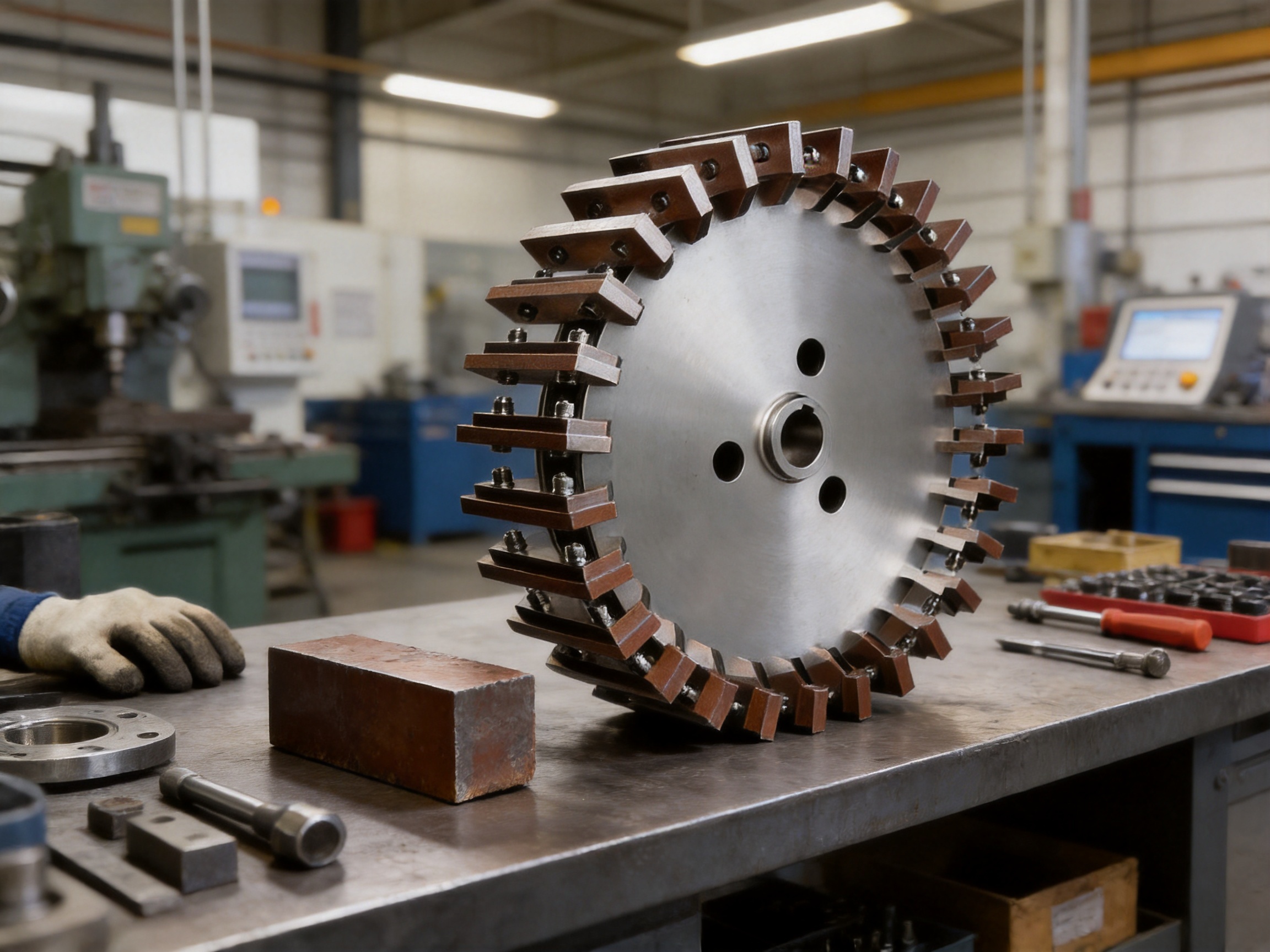
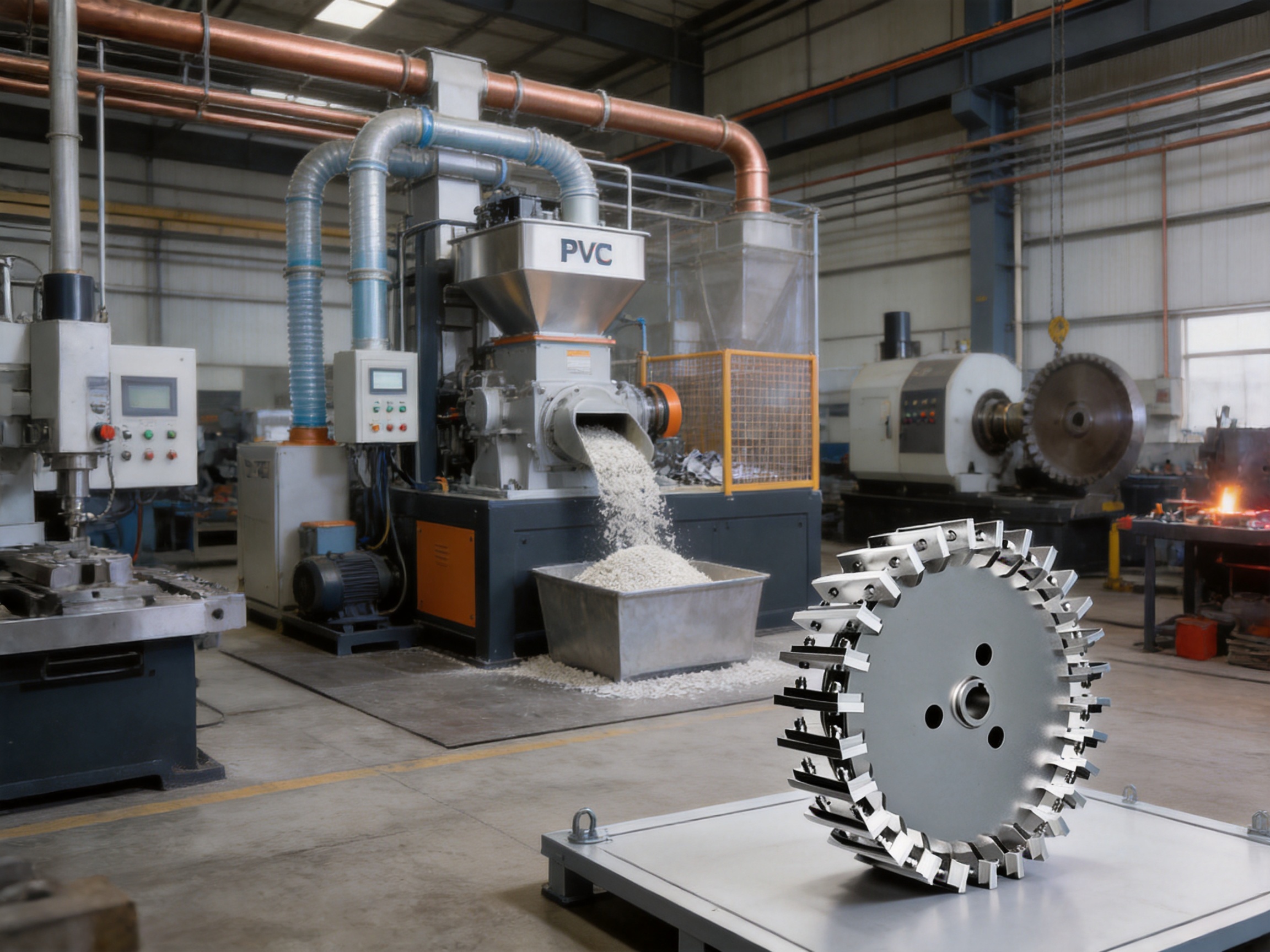
The rotor uses a large circular disc structure with multiple blade-block sets arranged around the peripheral working area. The disc provides the primary rotating mass and supports the cutting elements during high-speed operation. The modular cutting blocks are positioned in an engineered pattern to create repeated contact points with the PVC feedstock.
A large disc design offers several practical advantages. First, it creates a broad and stable working circumference. This allows more cutting elements to participate in the pulverizing process during each revolution. Second, the disc can support different blade arrangements, including radial, interlaced, and other customized configurations. Third, the structure can be adapted to different pulverizer disc diameters and machine models.
Each cutting-block set is secured using high-strength bolts. Proper fastening is essential because the blocks are subjected to centrifugal force, impact, vibration, and repeated thermal cycling. The bolted structure allows the blocks to be removed when required, while the precision-machined seating surfaces help maintain alignment during operation.
The central shaft hole is manufactured for a precise connection to the main spindle. A properly aligned shaft interface is critical for minimizing eccentricity and maintaining stable rotation. The rotor assembly is designed to work with professional dynamic balancing procedures, helping reduce vibration, noise, bearing stress, and unnecessary energy losses.
The surface appearance of the finished rotor is typically deep brown or rust-brown. This appearance results from the applied heat-treatment, oxidation, or specialized surface-finishing process. Although appearance is not the primary measure of rotor quality, the finish reflects the processing route used to improve surface durability, corrosion resistance, and long-term wear performance.
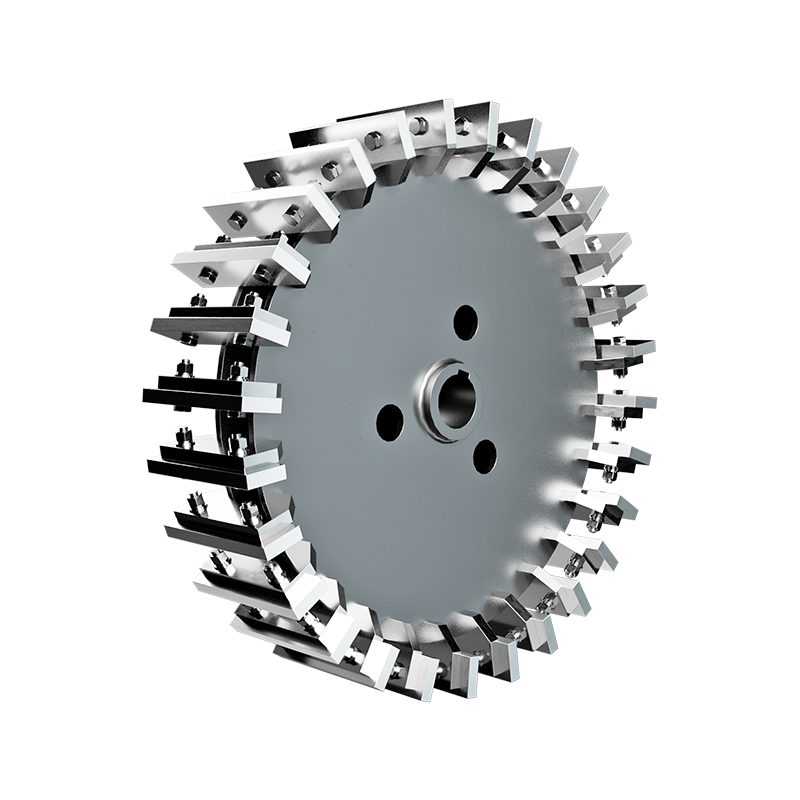
PVC Pulverizer Large disc-shaped Rotor
3. Modular Cutting Blocks and Maintenance Efficiency
The most distinctive feature of this rotor is its modular multi-blade architecture. Traditional pulverizer discs may use a monolithic cutting surface or a low number of permanently integrated teeth. When these designs become damaged or excessively worn, operators may need to remove the entire disc or perform extensive rebuilding work. Such maintenance can require considerable labor, specialized tools, and long machine stoppages.
With the modular design, worn cutting blocks can be removed individually. The remaining blocks can continue to be used if they are still within acceptable wear limits. This approach reduces unnecessary replacement and allows maintenance teams to respond to localized wear rather than treating the entire rotor as unusable.
The modular structure is especially valuable when processing PVC containing fillers or other abrasive materials. Different parts of the working area may experience different wear rates because of variations in material flow, feeding conditions, or blade contact. Independent replacement allows users to correct these differences without replacing components that remain serviceable.
Reduced maintenance time contributes directly to higher equipment availability. According to the supplied performance information, the modular arrangement can reduce downtime by more than 80 percent compared with less convenient traditional maintenance structures. Actual results depend on machine size, material condition, operating procedures, and maintenance planning, but the basic advantage remains clear: replacing a small blade block is generally faster than rebuilding or changing an entire cutter head.
Spare-part costs can also be controlled. A complete disc is a large and expensive component, while individual blocks represent a smaller replacement investment. Users can maintain a practical inventory of commonly used wear parts and replace them according to actual inspection results. This makes preventive maintenance easier to organize and reduces the risk of unexpected production interruptions.
Modularity also provides flexibility when processing different materials. Blade-block quantity, edge angle, material grade, surface coating, and carbide-insert options can be selected according to the application. A rotor intended for clean rigid PVC may use a different configuration from one processing abrasive, filled, or contaminated recycling material.
Maintenance Benefits of the Modular Structure
The modular rotor provides several maintenance benefits. Individual cutting blocks can be replaced without discarding the complete rotor body. Maintenance work can be scheduled during short production pauses. Spare parts can be stored in smaller quantities and selected according to actual wear. Damaged blocks can be isolated, reducing the risk of operating with a seriously compromised cutting surface. The rotor body can remain in service for a longer period when its structural integrity is maintained.
These features are important for recycling companies that operate multiple shifts or continuous production lines. Every hour of unnecessary downtime can affect material delivery schedules, labor planning, electricity consumption, and downstream extrusion or compounding operations. A rotor that is easier to maintain can therefore create value beyond the component itself.
4. Advanced Material and Heat-Treatment Technology
The cutting blocks use a proprietary high-wear-resistant alloy steel substrate intended for heavy-duty plastic pulverizing. The material is selected to provide a balance of hardness, toughness, wear resistance, and impact resistance. Excessive hardness without sufficient toughness can increase the risk of cracking or chipping, while insufficient hardness can cause rapid edge rounding and reduced cutting efficiency.
The manufacturing process includes carburizing and quenching, followed by multiple tempering stages. Carburizing increases the carbon content near the surface, allowing the cutting area to achieve higher hardness while retaining a tougher internal structure. Quenching develops the required metallurgical condition, and tempering reduces excessive brittleness while stabilizing the material for repeated mechanical loading.
The supplied technical information indicates a stable working hardness of approximately HRC 58–62 for the treated blades. The appropriate hardness may vary according to the exact blade grade, section thickness, working conditions, and quality-control requirements. Within the stated range, the cutting edges are designed to resist wear, impact damage, and edge deformation during continuous PVC processing.
Heat treatment is only effective when it is controlled carefully. Uneven heating or cooling can create distortion, residual stress, or inconsistent hardness. For this reason, heat-treated cutting parts require inspection and, when necessary, correction machining. The rotor and blade blocks are subjected to precision processing so that the final assembly can maintain the intended geometry and clearance.
Compared with ordinary untreated steel blades, a properly carburized and quenched alloy-steel cutting block can provide a substantially longer service interval. The benefit is not limited to longer blade life. Stable edge geometry also helps maintain particle-size consistency, reduce excess fines, lower the chance of material smearing, and keep energy consumption more predictable.
For filled PVC and other high-wear materials, resistance to chipping is particularly important. A blade that gradually wears can often be monitored and replaced according to a maintenance schedule. A blade that suddenly chips may contaminate the product, damage opposing components, or produce abnormal vibration. The combination of surface hardness and internal toughness is therefore a major advantage over low-grade cutting materials.
5. Optimized Blade Arrangement
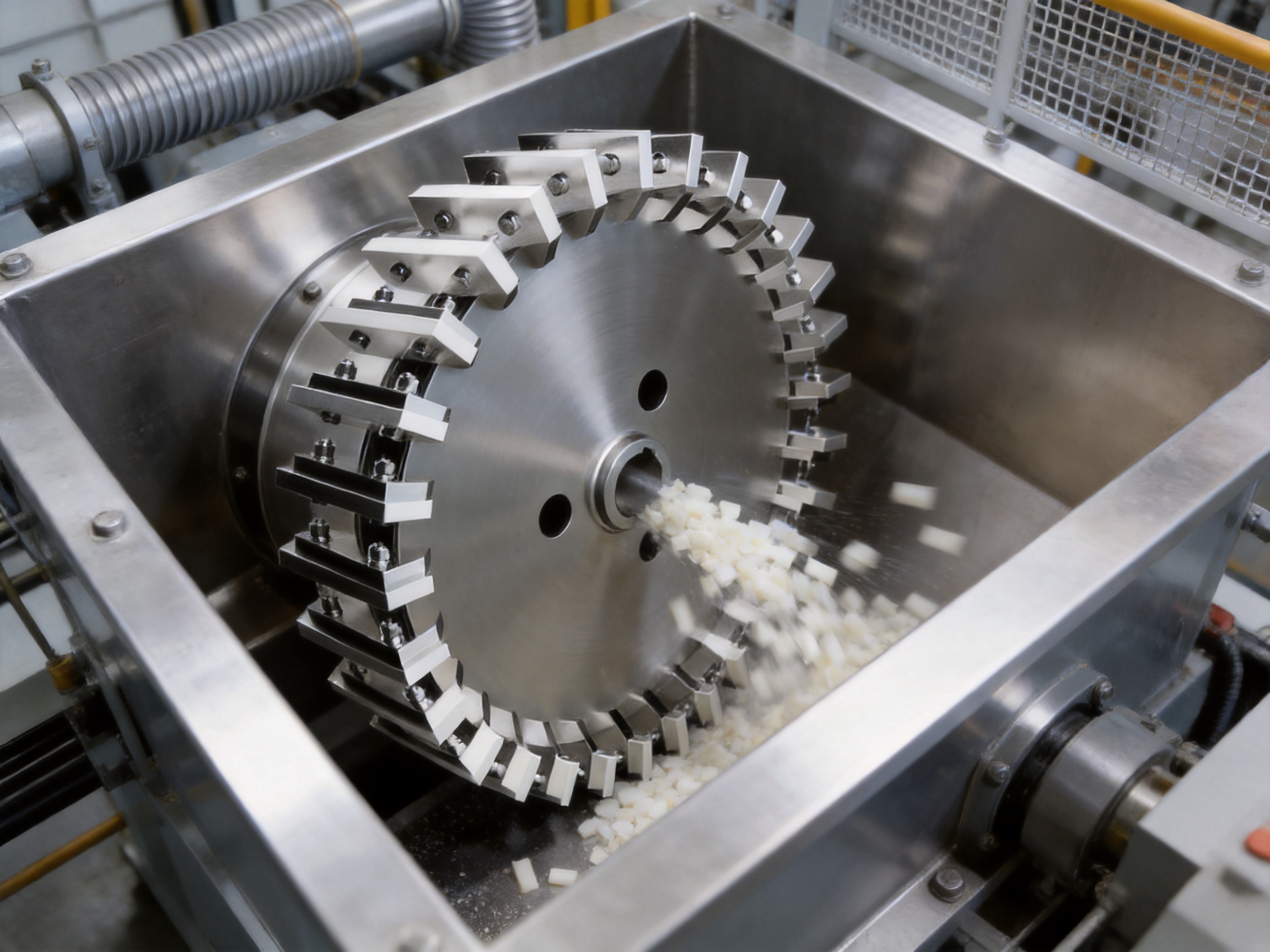
The rotor can use multiple interlaced or radial blade arrangements. The selected configuration determines how PVC enters the cutting zone, how many times it is contacted during each revolution, and how evenly the mechanical load is distributed around the disc. A well-designed arrangement creates multiple shearing points rather than relying on a limited number of large impacts.
Interlaced blade placement can improve the distribution of cutting action across the working area. Radial arrangements can create strong outward and inward shearing paths. The most suitable arrangement depends on disc diameter, rotor speed, feed characteristics, target fineness, and the physical properties of the PVC material.
During operation, the cutting edges interact with the stationary disc or opposing cutting surface. The material is captured, sliced, fractured, and repeatedly exposed to friction until it passes through the required working gap. The objective is not simply to create powerful impact. It is to achieve controlled size reduction while avoiding excessive heat generation and unnecessary energy consumption.
The supplied performance information states that the optimized arrangement can increase output by approximately 30–50 percent or more compared with traditional discs operating at equivalent power. Actual performance depends on the machine model and material, but the engineering principle is straightforward: more effective cutting contact, better material distribution, and reduced dead zones can increase throughput without requiring a proportional increase in motor power.
A consistent blade pattern also helps stabilize the load on the drive system. When the cutting elements are evenly distributed, the rotor can maintain smoother rotation and reduce periodic load peaks. This supports lower vibration and can extend the service life of bearings, couplings, shafts, and other related components.
Blade arrangement can be customized for specific applications. A user processing rigid PVC pipe may require a configuration optimized for strong cutting and high throughput. A producer manufacturing fine PVC powder may prefer an arrangement and clearance that emphasizes uniform particle size. A recycling operation handling mixed post-industrial scrap may require a more impact-resistant design with additional protection against contamination.
6. Powder Quality and Particle-Size Control
The rotor is intended to support a finished powder range of approximately 20–100 mesh, depending on the machine configuration, material condition, screen or gap settings, rotor speed, and cooling performance. This broad range allows the equipment to serve both recycling and powder-production applications.
Uniformity is as important as nominal fineness. A powder containing many coarse particles may create problems in extrusion, calendering, injection molding, coating, or compounding. Excessive fine particles can also affect bulk density, flow behavior, dust control, and thermal response. The optimized cutter arrangement is designed to produce a narrower particle-size distribution with fewer obvious coarse particles and fiber-like residues.
High-quality pulverization helps maintain product purity. When the cutting edges remain sharp and the rotor operates with stable clearance, PVC is more likely to be cut cleanly rather than smeared across the working surfaces. Clean cutting reduces the risk of agglomeration and supports better flowability in downstream processes.
Thermal control is also essential for powder quality. PVC can soften, stick, or begin to degrade when exposed to excessive friction heat. Discoloration, yellowing, odor, plate adhesion, and decomposition can result if the temperature is not controlled. A sharp and wear-resistant rotor reduces unnecessary friction, while the cooling system removes heat generated during high-throughput operation.
Stable powder quality benefits both recycling and manufacturing. Recycled PVC powder can be blended into new compounds more consistently. Manufacturers of flooring, profiles, wall panels, pipes, foam boards, cable compounds, and leather products can receive a more predictable feedstock. Consistent powder also helps reduce fluctuations in melt behavior, surface appearance, and finished-product color.
7. Dual Cooling and Temperature Management
The rotor is intended to operate with an air-and-water dual cooling system and intelligent temperature control. This combination is important because PVC pulverization produces heat through high-speed movement, cutting resistance, and friction between particles and working surfaces.
Air cooling helps remove heat from the pulverizing chamber and supports continuous airflow through the equipment. Water cooling can provide additional thermal capacity when production rates are high or when the material is particularly sensitive to heat. Intelligent temperature management helps operators maintain the process within an appropriate range instead of relying only on manual observation.
Effective cooling prevents several common problems. It reduces the risk of PVC softening on the disc, lowers the possibility of material adhesion, and helps prevent thermal degradation. It can also limit powder yellowing and reduce the formation of deposits that would otherwise alter the working clearance.
Cooling should be considered together with blade condition. Dull blades require more force to cut the material and may create additional friction. A worn rotor can therefore increase the thermal load even if the cooling system remains in good condition. Replacing worn modular blocks at the appropriate time helps the cooling system perform more efficiently.
The air-and-water approach is suitable for extended operation and high-volume production. With appropriate feeding, inspection, and temperature monitoring, the pulverizer can support long working periods, including continuous production schedules. The actual operating duration depends on the material, machine size, environmental conditions, and maintenance program.
8. Manufacturing Precision and Quality Control
The performance of a rotor depends not only on its design but also on manufacturing accuracy. Cutting blocks must have consistent dimensions, correct mounting surfaces, and precise edge geometry. The disc must maintain appropriate flatness, concentricity, and shaft alignment. Bolt holes must be positioned accurately so that the blocks remain secure and evenly distributed.
Changzhou Mao Yue Intelligent Equipment Co., Ltd. uses CNC machining and specialized equipment to produce pulverizer components. The company operates six processing workshops, each with an average area of approximately 1,400 square meters. Its production resources include high-precision grinding equipment imported from Taiwan and manufactured to German standards, German dynamic balancing equipment, and Japanese welding systems.
CNC machining allows the rotor body and cutting components to be manufactured according to controlled digital dimensions. This improves repeatability from one part to another and supports compatibility across different machine models. Precision grinding helps produce smooth working surfaces and accurate blade edges, while professional balancing equipment helps verify the rotor assembly before delivery.
Dynamic balancing is especially important for a high-speed disc. Even a relatively small mass difference can create significant centrifugal force when the rotor operates at high speed. An unbalanced assembly can cause vibration, increase bearing loads, loosen fasteners, and reduce the service life of the pulverizer. Proper balancing helps the equipment run more smoothly and quietly.
Welding quality is also important for supporting frames, guards, brackets, and related structures. The use of professional welding systems contributes to dimensional stability and structural reliability. Although the rotor is the focus of this article, it must operate as part of a complete machine in which every supporting component affects safety and performance.
Quality control should cover raw-material verification, machining inspection, heat-treatment inspection, hardness testing, dimensional measurement, balancing, surface examination, and final assembly checks. A professional manufacturing process reduces the risk that a component will fail because of inconsistent material, incorrect hardness, poor alignment, or inadequate fastening.
The company manufactures components according to European quality expectations and has obtained CE mechanical certification and ISO 9001 quality management system certification. These certifications support the company’s commitment to documented production procedures, equipment safety, and consistent quality management.
9. Compatibility and Customization
The rotor is designed for direct adaptation to different disc-diameter models in the manufacturer’s PVC pulverizer series. It is also partially compatible with disc-type grinders from other manufacturers, subject to confirmation of dimensions, shaft configuration, mounting pattern, chamber clearance, and operating parameters.
Compatibility should always be confirmed before ordering. Important technical information includes the disc diameter, central shaft-hole dimensions, rotor thickness, number and spacing of cutting blocks, bolt specifications, rotational direction, operating speed, and the required gap between rotating and stationary surfaces. Accurate machine data allows the manufacturer to select or produce the correct rotor assembly.
Customization options include blade-block quantity, cutting-edge angle, surface wear-resistant coating, and carbide inserts. The number of blocks can be selected according to the desired cutting frequency and material throughput. The edge angle can be adjusted to balance cutting sharpness, impact resistance, and service life. Coatings or carbide inserts may be considered for especially abrasive applications.
Customization is valuable because PVC waste streams are rarely identical. A producer may process clean production scrap one day and filled or contaminated material the next. A recycling company may need a robust configuration for mixed rigid PVC, while a powder manufacturer may prioritize fine particle control and low thermal exposure.
Technical communication is an important part of customization. The customer should provide material type, moisture level, bulk density, expected contamination, target particle size, required output, operating hours, and available cooling conditions. This information enables the manufacturer to recommend the appropriate rotor structure rather than applying a one-size-fits-all solution.
10. Comparison with Traditional and Imported Alternatives
The modular large disc-shaped rotor offers several advantages over traditional low-tooth-count or monolithic discs. The most obvious difference is maintenance. Traditional designs may require more extensive disassembly when the cutting surface is damaged. The modular design allows targeted replacement, which can reduce downtime and spare-part consumption.
The second advantage is wear management. A monolithic disc can become difficult to use when only a small portion of the cutting surface is worn. With independent blocks, the operator can replace the affected areas and continue using the main disc body. This maximizes the value of the structural component.
The third advantage is configuration flexibility. A conventional disc may be supplied in a fixed arrangement that is difficult to modify. Modular blocks provide more options for blade count, edge design, coatings, and carbide reinforcement. This makes the rotor more adaptable to different PVC grades and processing targets.
The fourth advantage is production stability. A properly arranged multi-blade rotor creates more frequent and evenly distributed cutting contact. This can increase throughput and support a more uniform powder, especially when combined with accurate clearance adjustment and effective cooling.
Compared with some imported alternatives, the rotor is positioned as a cost-effective option that combines domestic manufacturing efficiency with professional material treatment, precision machining, and customization. Lower acquisition cost alone does not define value. The more meaningful comparison includes service accessibility, replacement-part availability, lead time, technical support, compatibility, and lifetime operating expense.
Imported components may provide strong performance, but they can involve higher purchase prices, longer delivery cycles, complex communication, and expensive replacement parts. A locally manufactured modular rotor can provide a more practical service model for customers who need fast technical response and flexible customization.
The appropriate choice should always be based on verified operating data. Users should compare blade life, output, powder fineness, power consumption, maintenance time, spare-part price, and total cost of ownership rather than focusing only on the initial quotation.
11. Application in PVC Recycling
PVC recycling is one of the main application areas for the rotor. It can process waste PVC pipes, profiles, window and door trimmings, vinyl flooring, cable sheathing, rigid sheets, injection-molding scrap, bottle caps, and other suitable materials after appropriate pre-treatment.
In a typical recycling line, oversized waste is first sorted and reduced through primary crushing. The material may then be cleaned, separated, dried, and conveyed to the pulverizer. The disc rotor performs the fine grinding stage, producing a powder that can be used in regranulation, extrusion, profiling, injection molding, or calendering.
Fine PVC powder can improve the efficiency of subsequent blending and compounding. Uniform particles are easier to mix with stabilizers, plasticizers, pigments, fillers, and virgin resin. Better particle distribution can support more consistent melt behavior and help improve the quality of recycled products.
The rotor is also suitable for closed-loop recycling systems. Production scrap from a pipe, profile, flooring, or cable factory can be processed and returned to the manufacturing process. This reduces waste disposal requirements, lowers the demand for new raw materials, and supports more efficient use of industrial resources.
Because recycling material may contain dirt, labels, adhesives, mineral fillers, or metal fragments, pre-sorting and appropriate protection are essential. The rotor’s wear-resistant cutting blocks can handle demanding material, but operators must still use magnets, screens, separators, and inspection procedures where necessary to protect the pulverizer.
12. Application in PVC Powder and Building Materials
PVC powder is widely used in construction and industrial products. It serves as a feedstock for flooring, wall panels, pipes, window profiles, foam boards, cable compounds, synthetic leather, and related materials. The powder must have appropriate fineness, flowability, purity, and thermal stability for the intended formulation.
The rotor’s controlled cutting action helps produce powder with a uniform structure and limited coarse residue. This supports stable feeding into mixers, extruders, calenders, and other downstream equipment. A more consistent powder can also contribute to smoother product surfaces and fewer visible defects.
In flooring production, uniform PVC powder may help improve blending and surface quality. In profile and pipe manufacturing, consistent feedstock can support stable extrusion and dimensional control. In cable compounds, controlled particle size can improve dispersion of PVC and additives. In foam-board production, powder consistency can support more predictable cell structure and appearance.
Manufacturers should select the rotor configuration according to the formulation. Filled compounds may require higher wear resistance, while clean production scrap may allow a configuration focused on maximum throughput. The ability to customize the cutting blocks and edge geometry provides a practical way to adapt the pulverizer to the production recipe.
13. Application in Polymer Modification and Chemical Processing
The rotor can also support the preparation of functional PVC compound powders and modified polymer materials. PVC blends containing fillers, stabilizers, pigments, or performance additives may require fine and uniform pulverization to improve dispersion in later processing stages.
Fine particle preparation can help distribute components more evenly throughout a mixture. Better dispersion may improve mechanical properties, processing fluidity, surface appearance, and dimensional stability. The benefits depend on the formulation and downstream mixing equipment, but controlled size reduction is often an important first step.
Other applications include laboratory sample preparation, chemical carrier powder production, and the fine grinding of selected PVC components recovered from electronic waste. These applications may require especially close control of particle size and contamination. In such cases, the rotor can be configured for the material and production scale while maintaining the advantages of replaceable cutting blocks.
Laboratory and pilot users can also benefit from modular maintenance. A blade block that becomes worn during repeated testing can be replaced without purchasing an entire rotor. This helps reduce operating cost and allows the equipment to remain available for development work.
14. Operating Practices for Maximum Rotor Life
Even a high-quality rotor requires correct operation. The feed should be appropriately prepared and should not contain oversized material beyond the machine’s design capacity. Metal, stones, and other hard contaminants should be removed before pulverizing whenever possible.
Material should be fed steadily rather than in sudden surges. Irregular feeding can create temporary overloads, increase vibration, and reduce powder uniformity. A stable feed also allows the cooling system to respond more effectively to changes in thermal load.
Operators should monitor motor current, vibration, noise, temperature, output, and powder appearance. A sudden increase in current may indicate excessive feed, blade dulling, material adhesion, or a clearance problem. New vibration may indicate imbalance, loose fasteners, damaged blocks, or bearing wear.
Regular inspection should include cutting-edge condition, bolt tightness, disc clearance, shaft connection, cooling flow, air passages, and powder discharge. The modular design makes it practical to establish a preventive replacement schedule based on actual wear rather than waiting for a major failure.
When replacing cutting blocks, the machine must be isolated from all energy sources. Technicians should use appropriate lifting equipment, protective clothing, gloves, eye protection, and documented assembly procedures. After replacement, the rotor should be checked for correct installation, fastener security, balance, and clearance before returning to service.
Correct storage of replacement blocks is also important. Components should be kept clean and dry, protected from impact, and identified by model or specification. Mixing blocks from incompatible configurations can affect balance and cutting performance.
15. Company Manufacturing Strengths
Changzhou Mao Yue Intelligent Equipment Co., Ltd. is a source manufacturer specializing in plastic crushing and pulverizing equipment. The company has approximately 30 years of experience in the field and has developed equipment for rotational molding, masterbatch, polymer processing, PVC, PE, recycling, and powder coating.
The company operates six modern processing workshops and maintains a technical team that studies advanced equipment technologies from Europe and other industrial markets. Its production facilities include precision grinding machines, dynamic balancing systems, CNC processing equipment, and professional welding resources.
This manufacturing base allows the company to control more stages of production internally. Greater control over machining, assembly, quality inspection, and customization can improve communication between the engineering and production teams. It also supports faster response when a customer requires a non-standard rotor or replacement component.
The company reports long-term partnerships with more than 5,000 enterprises in domestic and international markets. Its export experience exceeds 20 years, providing familiarity with different customer requirements, machine standards, packaging expectations, and technical documentation.
Quality, service, innovation, and customized solutions are central to the company’s stated business approach. CE mechanical certification and ISO 9001 quality management system certification provide additional evidence of its focus on equipment safety and manufacturing consistency.
16. Technical Performance Summary
| Feature | Technical Description | Operational Benefit |
|---|---|---|
| Rotor structure | Large circular disc with modular cutting-block sets | Stable high-speed operation and convenient wear-part replacement |
| Blade connection | High-strength bolted mounting with precision central shaft hole | Secure assembly and accurate connection to the main spindle |
| Blade material | High-wear-resistant alloy steel substrate | Improved resistance to wear, impact, and edge chipping |
| Heat treatment | Carburizing, quenching, and multiple tempering processes | Stable hardness and improved service life |
| Approximate hardness | HRC 58–62, depending on specification | Strong resistance to abrasive PVC materials |
| Blade arrangement | Interlaced, radial, or customized configurations | Multiple shearing points and improved material distribution |
| Particle-size range | Approximately 20–100 mesh, depending on operating conditions | Adaptability for recycling and powder-production applications |
| Cooling compatibility | Air and water dual cooling with temperature control | Reduced softening, adhesion, degradation, and discoloration |
| Maintenance system | Independently replaceable cutting blocks | Lower downtime and reduced spare-part consumption |
| Customization | Blade quantity, edge angle, coatings, and carbide inserts | Adaptation to different PVC grades and operating requirements |
17. Economic Value and Total Cost of Ownership
The value of a pulverizer rotor should be evaluated over its complete operating life. Initial purchase price is only one part of the calculation. Other factors include output, powder quality, energy use, blade life, maintenance labor, replacement-part cost, production downtime, and the effect of rotor performance on downstream equipment.
The modular rotor can reduce total ownership cost in several ways. Replaceable blocks reduce the cost of restoring the cutting surface. Faster maintenance reduces lost production time. Longer blade life reduces the frequency of spare-part purchases. Stable cutting performance can reduce energy losses caused by dull edges and excess friction.
Higher throughput can create additional value when the downstream line has sufficient capacity. If the pulverizer produces more usable powder per hour without a proportional increase in power consumption, the cost per kilogram can decline. However, users should evaluate the complete line, including feeding, cooling, dust collection, conveying, screening, and packaging.
Stable powder quality also has economic importance. Coarse particles, fiber residue, yellowing, or contamination can lead to rejected batches or additional screening and reprocessing. A rotor that maintains consistent size reduction helps reduce these hidden costs.
For companies comparing domestic and imported components, service response should be included in the calculation. Faster access to technical support and replacement blocks can be highly valuable when the machine is part of a continuous recycling or production line.
18. Selection Guide for Buyers
Before selecting a rotor, buyers should identify the material to be processed. Important questions include whether the PVC is rigid or flexible, clean or contaminated, filled or unfilled, dry or moist, and whether it contains abrasive minerals or reinforcing fibers.
The required output and particle size should also be defined. A target of coarse recycling powder may require a different arrangement from a requirement for fine powder used in high-quality compounding. Buyers should provide expected hourly throughput, operating hours per day, and the desired service interval.
Machine dimensions must be confirmed carefully. The rotor diameter, shaft-hole size, disc thickness, bolt pattern, rotational speed, working clearance, and cooling arrangement should all match the pulverizer. For replacement applications, photographs and measurements of the existing assembly can help the manufacturer identify the correct configuration.
Buyers should also ask about blade-block material, heat-treatment records, hardness range, balancing procedures, fastening methods, surface treatment, and recommended maintenance intervals. Clear technical documentation supports safe installation and predictable performance.
Where a non-standard rotor is required, customers should discuss customization before production. The manufacturer can then evaluate whether to modify the number of blocks, cutting-edge angle, coating, carbide reinforcement, or central connection dimensions.
19. Questions and Answers
Q1: What is the main advantage of the large disc-shaped rotor?
The main advantage is the combination of high-performance cutting and modular maintenance. The large disc provides a stable working platform for multiple cutting blocks, while the independent blocks can be replaced individually when worn or damaged.
Q2: Can the entire rotor remain in service when one blade block is worn?
In many cases, yes. If the disc body and other blocks remain within acceptable condition, the damaged or worn block can be replaced individually. The rotor should be inspected and balanced as necessary before returning to operation.
Q3: What materials can the rotor process?
It is primarily intended for PVC materials, including rigid PVC scrap, pipes, profiles, flooring, sheets, cable sheathing, injection-molding scrap, and similar materials. The precise suitability depends on contamination, fillers, moisture, size, and the selected machine configuration.
Q4: What hardness do the cutting blocks achieve?
The supplied technical information indicates a typical hardness of approximately HRC 58–62 after carburizing, quenching, and multiple tempering processes. The final value may vary according to the blade specification and production requirements.
Q5: What particle size can be produced?
The rotor can support a finished powder range of approximately 20–100 mesh when used in a properly configured pulverizer. Actual particle size depends on disc clearance, rotor speed, feed rate, material properties, cooling, and the complete machine design.
Q6: How does the rotor help prevent PVC yellowing?
Sharp, wear-resistant blades reduce unnecessary friction and improve cutting efficiency. When combined with air-and-water cooling and temperature control, this helps reduce softening, adhesion, overheating, degradation, and yellowing.
Q7: Is the rotor compatible with other brands of pulverizers?
It may be partially compatible with other disc-type grinders, but compatibility must be confirmed through dimensional and operating data. Shaft dimensions, disc diameter, mounting holes, clearance, speed, and chamber design all need to be checked.
Q8: Can the blade arrangement be customized?
Yes. Available customization may include blade-block quantity, cutting-edge angle, surface wear-resistant coating, and carbide inserts. The best configuration depends on the PVC grade, filler content, desired output, and target powder fineness.
Q9: Why is dynamic balancing important?
Dynamic balancing reduces vibration caused by uneven mass distribution. Stable balance supports smoother operation, lower noise, reduced bearing load, improved fastener security, and longer service life for the rotor and related machine components.
Q10: What information should a customer provide when requesting a replacement rotor?
The customer should provide the pulverizer model, disc diameter, shaft-hole dimensions, rotor thickness, mounting-hole pattern, blade quantity, operating speed, material type, target output, target particle size, and photographs or drawings of the existing rotor if available.
20. Conclusion
The large disc-shaped rotor is a central performance component for modern PVC pulverizing systems. Its value comes from the way several design features work together: a stable circular disc, high-strength bolted cutting blocks, precision central shaft connection, wear-resistant alloy steel, controlled heat treatment, optimized blade arrangement, professional balancing, and compatibility with advanced cooling systems.
Its modular architecture provides a significant practical advantage over traditional monolithic or low-tooth-count discs. Worn blocks can be replaced individually, helping reduce downtime, control maintenance cost, and extend the useful life of the rotor body. This is particularly valuable for high-volume PVC recycling and powder-production lines.
The rotor also supports high-quality powder production. With suitable machine settings and cooling, it can help produce uniform PVC powder in an approximate range of 20–100 mesh while reducing coarse particles, fiber residue, adhesion, overheating, and discoloration. Its applications extend from recycling and regranulation to construction materials, polymer modification, laboratory testing, and chemical powder preparation.
Manufacturing precision is another important strength. CNC machining, precision grinding, controlled carburizing and quenching, multiple tempering, professional welding, and dynamic balancing all contribute to reliable performance. Changzhou Mao Yue Intelligent Equipment Co., Ltd. combines these capabilities with long-term experience in plastic crushing and pulverizing equipment, international export experience, customization support, and certified quality-management practices.
For processors seeking to improve output, reduce maintenance interruptions, and maintain stable PVC powder quality, this rotor provides a strong and adaptable solution. Its most important advantage is not one isolated specification, but the integration of durability, serviceability, precision, and application flexibility into a component designed for continuous industrial use.
References
1. Changzhou Mao Yue Intelligent Equipment Co., Ltd. Product information for PVC pulverizer rotors and disc-type grinding equipment.
2. Changzhou Mao Yue Intelligent Equipment Co., Ltd. Technical information concerning modular cutting blocks, alloy steel blades, heat treatment, and customization.
3. ISO 9001. Quality Management Systems: Requirements.
4. European machinery safety and conformity principles applicable to industrial plastic-processing equipment.
5. General engineering references on carburizing, quenching, tempering, dynamic balancing, and wear-resistant alloy steels.
6. General technical references on PVC recycling, polymer powder preparation, and particle-size control in plastic processing.