

 English
 русский
 Español
 عربى
عربى 中文简体
中文简体
 中文简体
中文简体
Content
- 1 Product Overview and Process Concept
- 2 Why Blade Cutting Offers Advantages Over Hammer Crushing
- 3 Core System Components
- 4 Technical Specifications
- 5 Powder Quality and Downstream Value
- 6 Application Areas
- 7 Manufacturing Strength Behind the Equipment
- 8 Competitive Advantages for Recycling Plants
- 9 Environmental and Workplace Benefits
- 10 Operational Considerations and Maintenance
- 11 Customization and Project Planning
- 12 Q&A Section
- 12.1 What types of plastic waste can the blade-type crushing and pulverizing production line process?
- 12.2 What final powder size can the line produce?
- 12.3 Why is a blade crusher better than a hammer crusher for this application?
- 12.4 Why is temperature control important during pulverizing?
- 12.5 How does the dust collection system improve production?
- 12.6 What makes the grinding discs important?
- 12.7 Can the production line be customized?
- 12.8 What industries can benefit from this system?
- 12.9 What company strengths support equipment reliability?
- 12.10 How does the line improve return on investment?
- 13 Conclusion
- 14 References
- 15 Product: Blade-type crushing and pulverizing production line
Modern plastic recycling is no longer defined only by the ability to break waste into smaller pieces. As recycled plastics move into higher-value applications such as masterbatch production, modified polymers, rotational molding powders, SPC flooring, profile extrusion, and engineered compounds, the market increasingly demands stable particle size, clean production, low dust emission, controllable processing temperature, and dependable automation. A blade-type crushing and pulverizing production line is designed precisely for this shift: it converts bulky, medium-hardness, and high-impact plastic waste into uniform fine powder through a coordinated system of cutting, grinding, conveying, separation, screening, and dust collection.
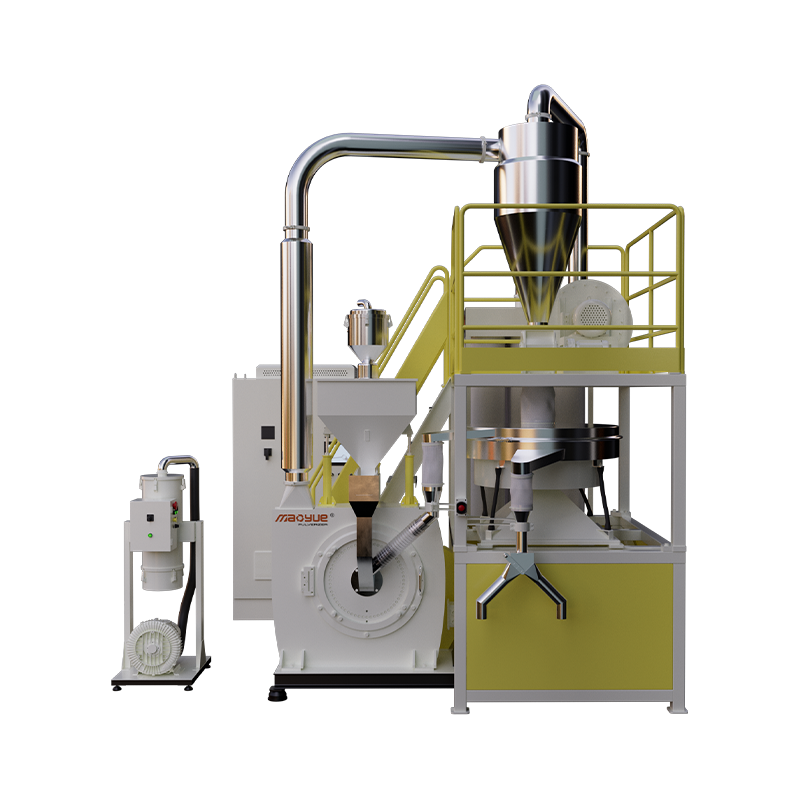
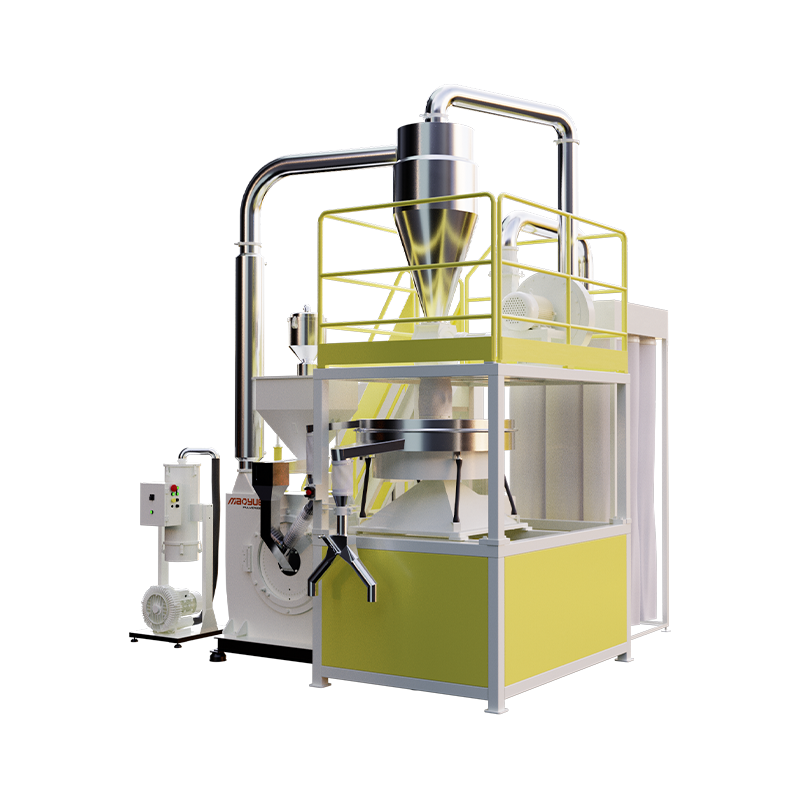
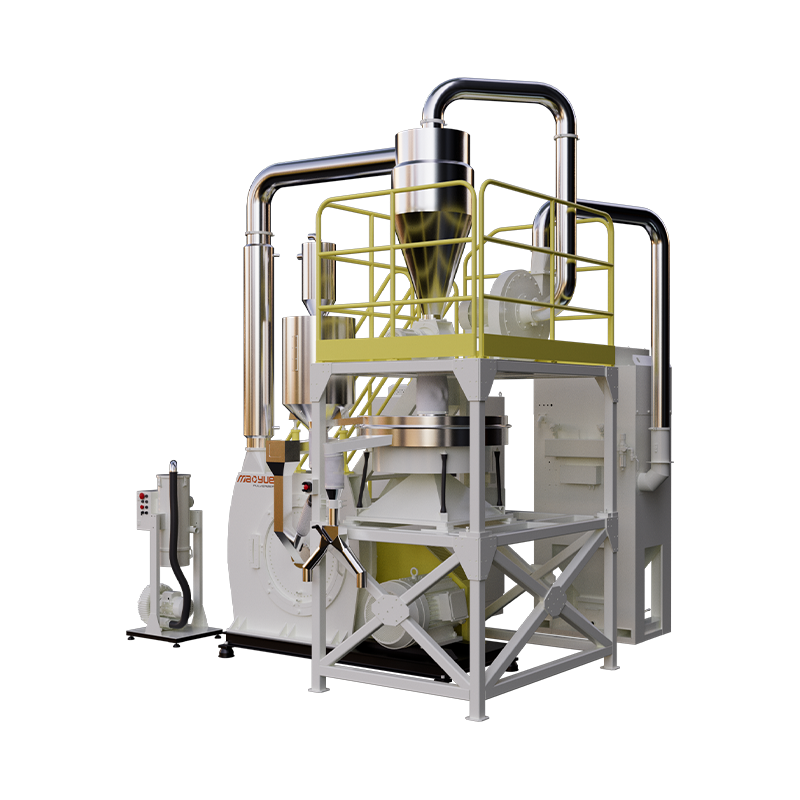
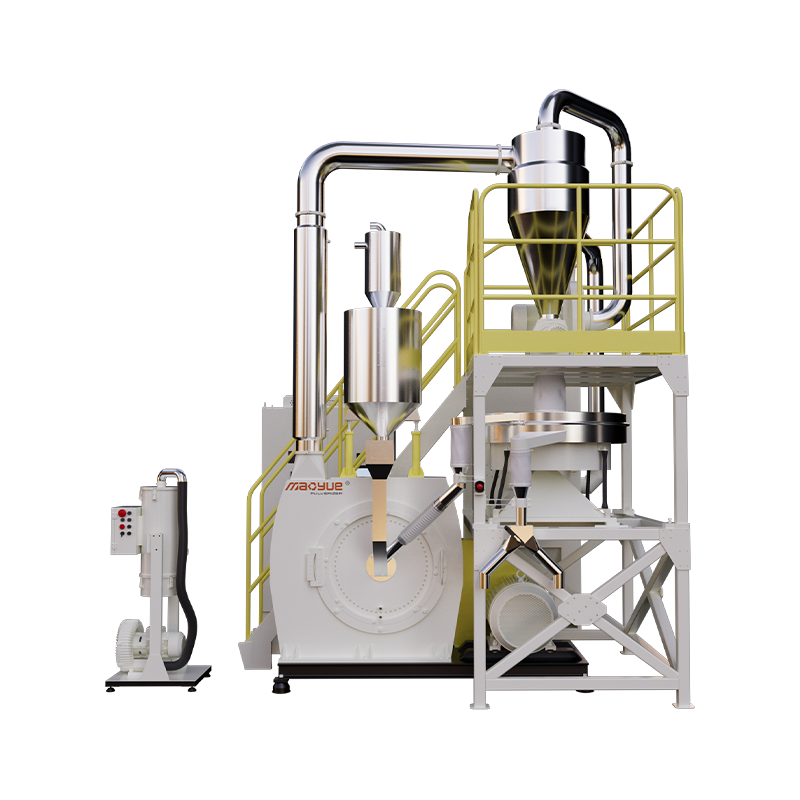
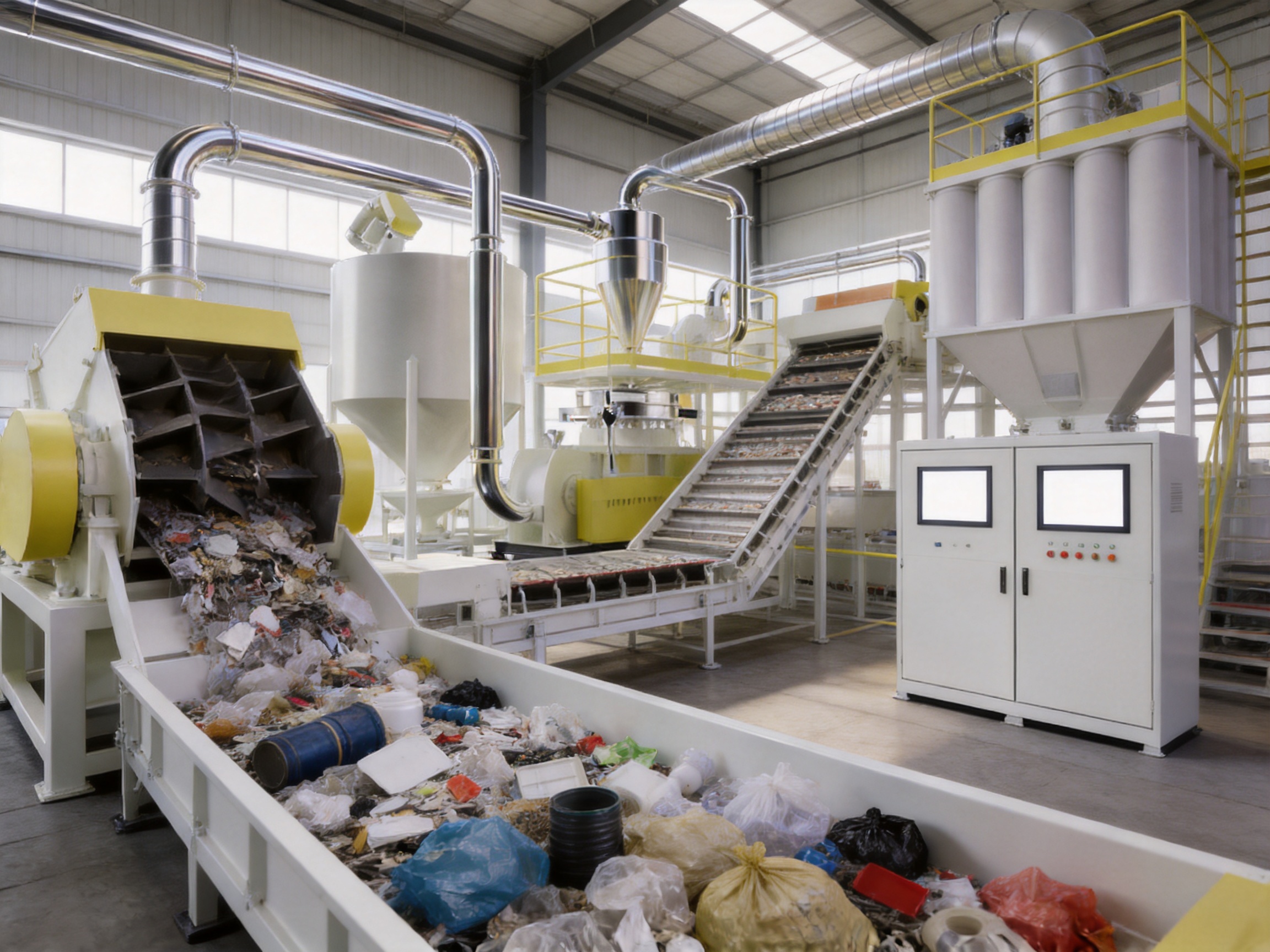
The blade-type crushing and pulverizing production line supplied by Changzhou Mao Yue Intelligent Equipment Co., Ltd. represents an integrated solution for plastics size reduction and regeneration. It is built around a heavy-duty multi-blade crusher as the front-end coarse size-reduction unit, then connected to a precision disc pulverizer, negative-pressure pneumatic conveying, cyclone separation, vibrating screening, and a pulse-jet baghouse dust collection system. This structure enables continuous processing from pipes, profiles, sheets, barrels, pallets, woven bags, bottle flakes, injection-molded rejects, and mixed rigid or flexible plastic waste into consistent powder, commonly in the range of 20 to 80 mesh or finer depending on material characteristics and production requirements.
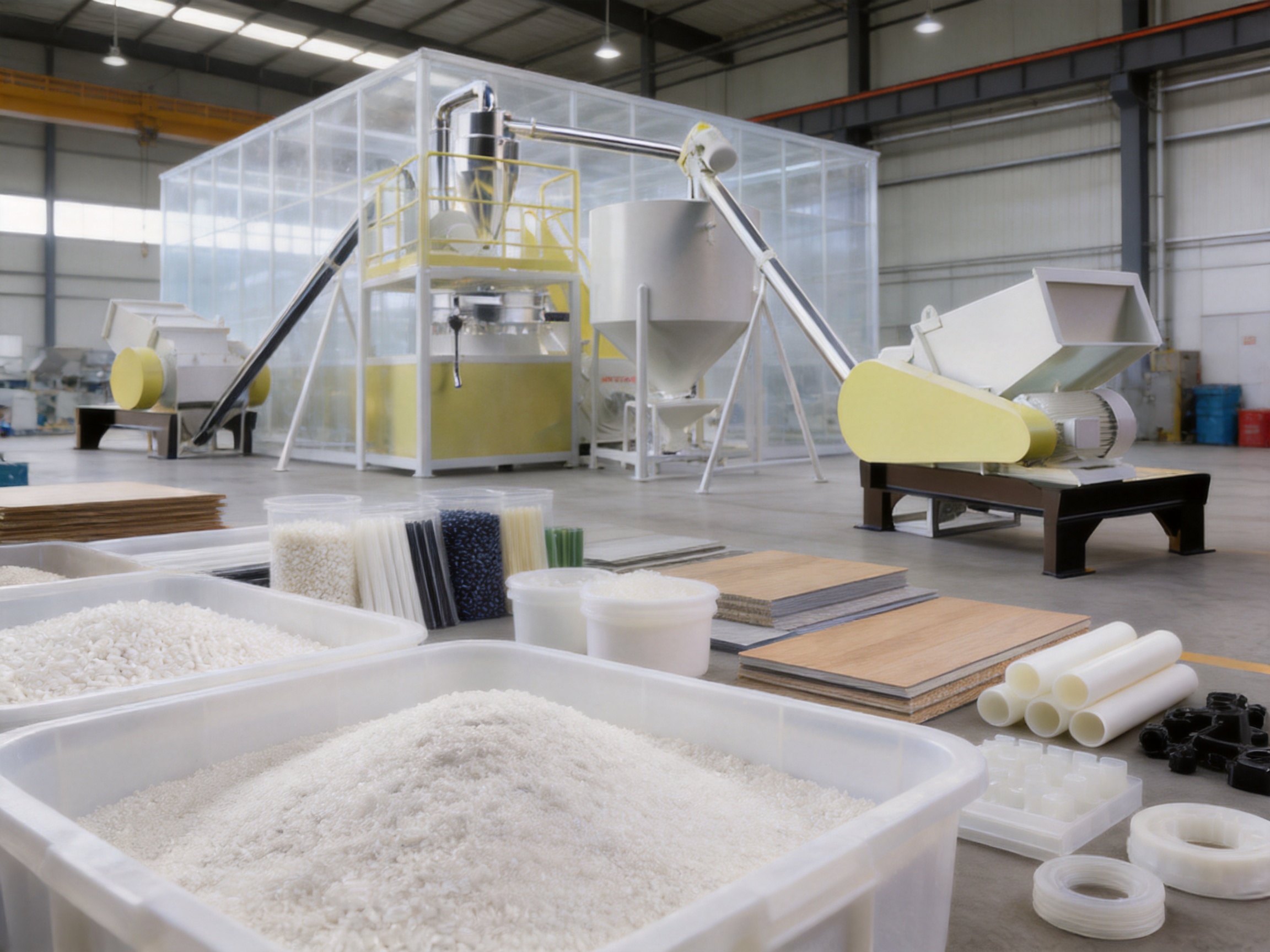
Unlike simple standalone crushers or conventional hammer milling arrangements, this production line is engineered as a complete process. Each machine section supports the next. The blade crusher prepares uniform small pieces that can be fed smoothly into the disc mill. The disc mill performs controlled fine grinding with precision-machined grinding discs. The negative-pressure conveying system prevents dust leakage while moving material through the line. The cyclone and vibrating screen help classify powder and return oversized particles if required. The pulse-jet dust collector captures airborne fine particles, protecting workshop cleanliness, improving raw material utilization, and supporting environmental compliance.
For recyclers and polymer processors, the value of this approach is clear. Better cutting and grinding accuracy can reduce waste, improve powder flowability, increase dispersion in downstream formulations, and reduce the operating problems that often affect older systems. For plant owners, the line offers a practical balance of capacity, reliability, automation, and maintainability. For downstream users of recycled powder, it supports more stable production because the powder has narrower particle distribution, fewer overheated agglomerates, and less contamination from uncontrolled dust.
Blade-type crushing and pulverizing production line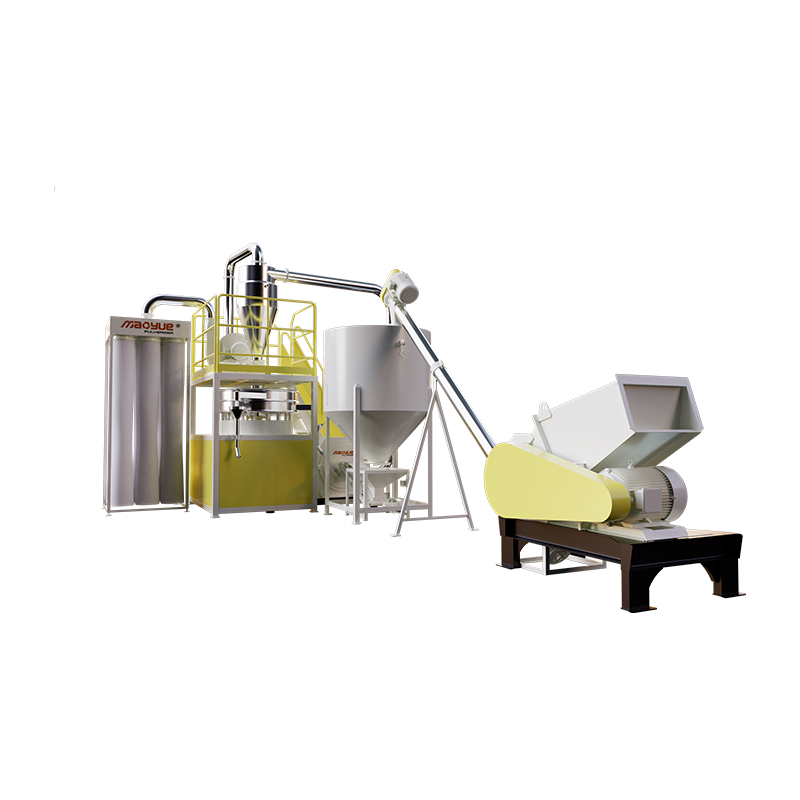
Product Overview and Process Concept
The blade-type crushing and pulverizing production line is intended for medium-hardness, brittle, semi-rigid, and high-impact plastic waste. Typical materials include PVC, PE, PP, PET, ABS, PS, EVA, and related blends. It can process scrap injection-molded products, electrical appliance shells, toy rejects, bottle flakes, film clumps, packaging straps, rigid panels, flooring offcuts, plastic sheets, pipes, profiles, barrels, pallets, and woven bag waste. The purpose is not only to reduce the physical volume of waste, but also to transform it into reusable powder suitable for higher-value regeneration processes.
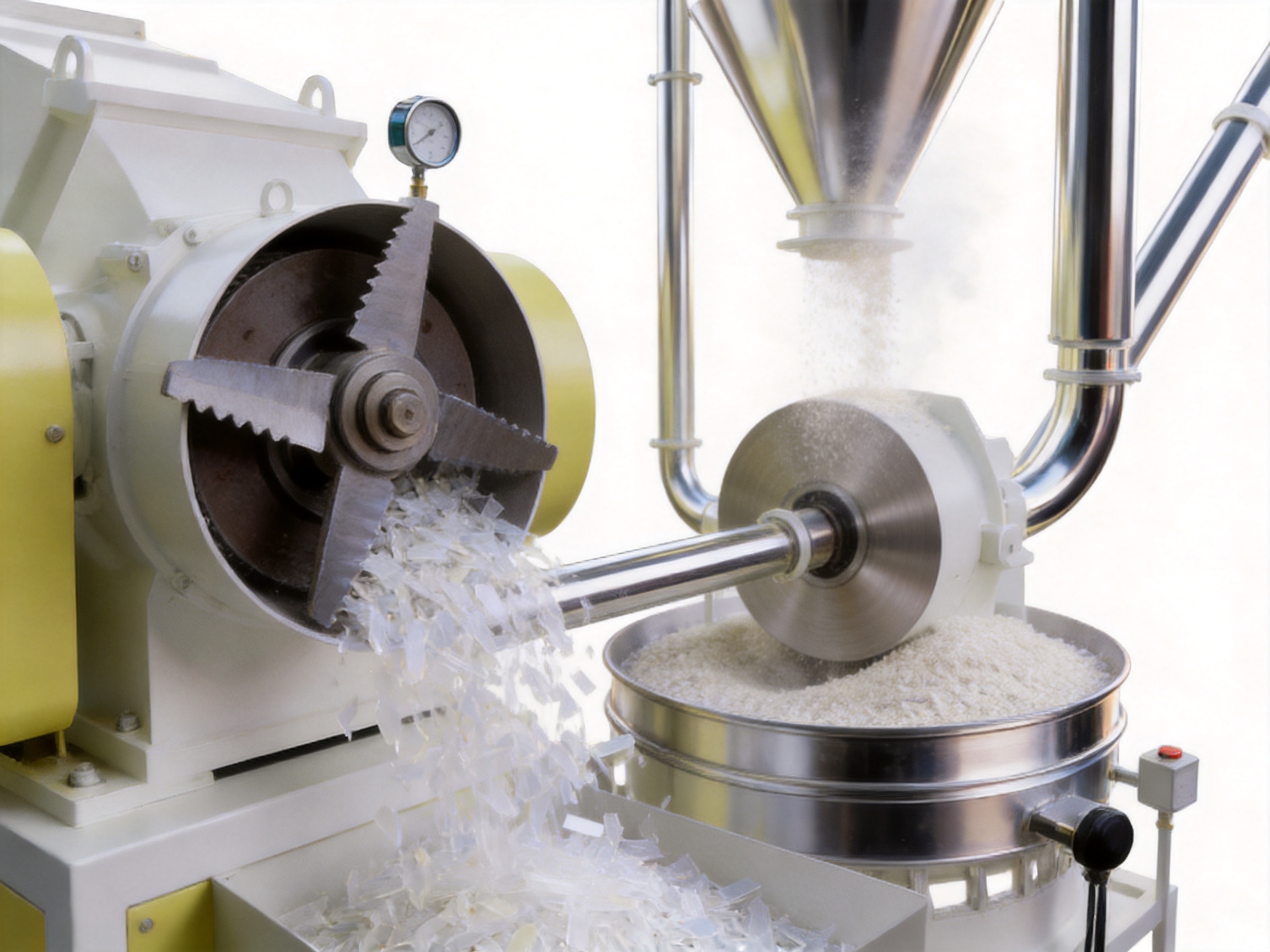
The front-end blade crusher performs rapid shearing and cutting. Its high-speed rotary blades work with fixed knives to cut plastic into controlled flakes or chips. The standard screen mesh size for the crusher section is 16 mm, which allows the system to produce a stable coarse feed for the downstream pulverizer. A stable feed size is important because disc pulverizers operate most efficiently when the incoming material is consistent. If the incoming flakes are too large, too irregular, or contaminated with tangled material, the pulverizer may suffer from vibration, temperature increase, uneven output, and accelerated disc wear. The blade crusher minimizes these problems by preparing the material before grinding.
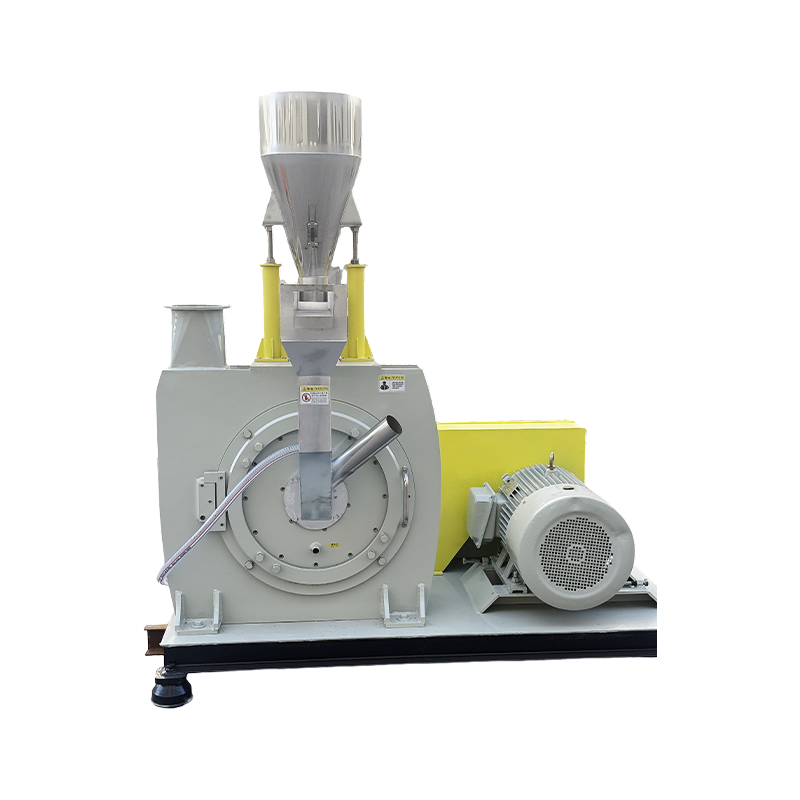
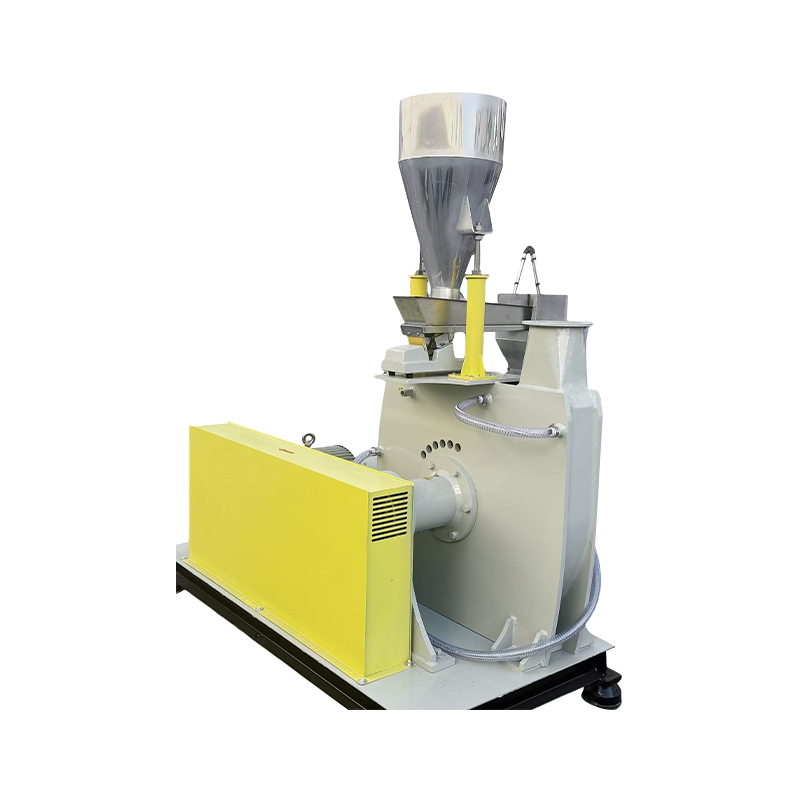
After coarse crushing, material is delivered to a disc mill, available in 500, 600, and 800 model configurations. The disc mill uses precision grinding discs manufactured from DC53 high-grade mold steel. These discs are designed for high wear resistance, controlled cutting geometry, and consistent pulverizing performance. The grinding process converts the pre-crushed material into powder with high uniformity. The resulting powder may be used in masterbatch remanufacturing, modified plastics, rotational molding powders, regenerated sheets, recycled fibers, extruded profiles, pipe compounds, and other applications where powder quality affects final product performance.
The line also includes a reinforced dual cooling system in the grinding section. With multi-point temperature sensors and PLC intelligent control, the grinding chamber temperature can be stabilized in a controlled range, typically between 50 and 80 degrees Celsius. This is especially important for heat-sensitive plastics such as PVC, PET, ABS, and certain blends. Excessive heat can cause yellowing, degradation, material adhesion, surface melting, reduced flowability, and unstable powder behavior. By managing temperature throughout the grinding process, the line protects polymer properties while maintaining output efficiency.
Negative-pressure pneumatic conveying integrates the process into a closed and cleaner system. Instead of allowing dust to escape around transfer points, the line draws material through enclosed ducts. Cyclone separation helps separate powder from conveying air, while the pulse-jet baghouse captures fine dust with high efficiency. This fully enclosed design reduces dust leakage, improves operator safety, supports workshop hygiene, and prevents valuable fine powder from being lost to the environment.
Why Blade Cutting Offers Advantages Over Hammer Crushing
Many traditional recycling systems use hammer-type crushers for pre-crushing. Hammer mills rely on impact force, repeatedly striking materials until they fracture. Although hammer systems can be useful in certain applications, they often create problems when processing plastic waste for precision powder production. Impact crushing tends to produce more dust, a wider particle size range, more fines, and more irregular particles. It can also generate unnecessary heat and may cause soft or flexible materials to wrap, entangle, or jam inside the chamber.
Blade-type cutting takes a different approach. It relies on controlled shearing action between rotary knives and fixed knives. Instead of randomly smashing plastic, it cuts the material into more predictable pieces. This controlled cutting method is especially suitable for brittle and medium-hardness plastics because it achieves high size reduction efficiency while limiting excessive dust generation. The result is a more uniform feedstock for the pulverizer, which improves the overall stability of the production line.
Compared with hammer crushing, blade cutting can reduce over-grinding during the first stage. Over-grinding at the coarse-crushing stage is undesirable because it produces uncontrolled fine dust before the material reaches the precision pulverizer. This dust is difficult to handle, increases filter load, creates workshop cleanliness issues, and reduces material value if not captured efficiently. A blade crusher cuts to the required coarse size and leaves the fine grinding task to the disc mill, where particle size can be controlled more accurately.
Blade cutting also reduces material entanglement. Film clumps, woven bag waste, mixed flexible scraps, and certain soft-rigid materials can wrap around hammer shafts or screens in conventional machines. This causes vibration, reduced throughput, overload, and downtime. A properly designed multi-blade cutting structure, combined with appropriate feeding and screen design, reduces these risks. It cuts the material progressively and discharges it once it reaches the required size.
Another important advantage is energy efficiency. When plastic is crushed by repeated impact, part of the energy is lost as noise, vibration, heat, and uncontrolled fracture. A cutting system applies energy more directly at the cutting edge. This can lower unnecessary power consumption and reduce mechanical stress. Over time, lower energy loss and reduced stress can contribute to lower operating cost, longer tool life, and more predictable maintenance schedules.
For production managers, fewer shutdowns and longer maintenance intervals are often as important as nominal capacity. A line that runs continuously with stable output is more valuable than a machine with high peak capacity but frequent blockages. The blade-type crushing and pulverizing production line is built to reduce jamming, avoid excessive dust, control heat, and maintain consistent feeding to the mill. These qualities directly support production continuity.
Core System Components
Heavy-Duty Blade Crusher
The blade crusher is the first major processing unit. It handles large and irregular waste materials, including sheets, injection-molded rejects, profiles, bottle waste, panels, casings, barrels, pallets, and clumped film. The crusher uses rotary knives and fixed knives to apply continuous shearing force. Depending on configuration, the line can use models with different knife quantities and motor power selections, enabling users to match capacity and material type.
The crusher is designed for industrial durability. Its cutting chamber, rotor structure, bearings, drive system, and blades must withstand repeated loads from high-impact plastics. The use of imported NSK bearings, star-delta or soft-start control, and high-strength blade material supports reliable operation. The 9CrSi blade material used in the crusher section provides a strong balance of hardness, toughness, and wear resistance for plastic cutting applications.
Precision Disc Pulverizer
The disc pulverizer is the heart of the fine grinding process. It converts pre-crushed flakes into powder with controlled particle size. Models such as 500, 600, and 800 can be selected based on throughput, material type, powder fineness, and plant layout. The grinding discs are made from DC53 high-grade mold steel, an important feature for customers who require long-term wear resistance and stable powder quality.
Disc quality directly influences powder quality. If grinding discs are poorly machined, unevenly balanced, or made from inferior steel, the pulverizer may produce unstable powder, generate excessive heat, vibrate during operation, or require frequent replacement. The production line uses precision-manufactured discs supported by advanced machining and dynamic balancing methods. This helps achieve a narrow particle size distribution, improved powder uniformity, and reduced excessive fines.
Cooling and Temperature Control
During high-speed pulverizing, friction generates heat. Without effective cooling, heat-sensitive plastics may soften, stick to the grinding discs, discolor, or degrade. The reinforced dual cooling system is designed to manage this risk. Temperature sensors monitor key areas, and PLC-based control helps stabilize process conditions. By maintaining the grinding chamber in an appropriate range, the system protects powder performance and reduces operator intervention.
Optional air cooling or localized water cooling can also be applied to the blade area of the crusher section. This is useful when processing materials that generate heat during cutting or when long continuous operating hours are required. By controlling temperature from the coarse-crushing stage through the fine-grinding stage, the line extends blade life and reduces quality variation.
Negative-Pressure Conveying, Cyclone Separation, and Dust Collection
Plastic pulverizing can create fine airborne particles. Dust control is therefore essential for safety, product recovery, and environmental compliance. The line uses a fully enclosed negative-pressure pneumatic conveying system. Since the conveying system operates under negative pressure, dust is drawn inward rather than escaping outward. This reduces leakage at transfer points and helps maintain a cleaner workshop.
Cyclone separation removes powder from the air stream, and the pulse-jet baghouse captures remaining fine dust. The dust capture efficiency can exceed 99.9 percent under suitable operating conditions and maintenance. This protects workers, reduces housekeeping labor, decreases material loss, and helps facilities comply with emission requirements. It also improves the economic value of recycling because fine powder that would otherwise be lost is retained in the process.
Vibrating Screening and Classification
The vibrating screen classifies the ground powder according to mesh requirements. Oversized particles can be separated and returned for further grinding, while qualified powder proceeds to packaging or downstream processing. This screening stage is important because different applications require different particle sizes. Masterbatch production may require excellent dispersion and uniformity, while rotational molding powders may require controlled flow and melt behavior. Screening allows the line to meet these varied needs.
Technical Specifications
The blade crusher section can be configured according to production capacity and material characteristics. The following table summarizes key model options provided in the product data. Actual line configuration may be customized according to feed material, target fineness, required output, cooling requirements, dust collection standards, and workshop layout.
Parameter |
Type 665 |
Type 1200 |
Type 1500 |
Knife quantity |
10 rotary knives, 4 fixed knives |
15 rotary knives, 6 fixed knives |
20 rotary knives, 8 fixed knives |
Capacity |
400-650 kg/h |
700-1000 kg/h |
800-1150 kg/h |
Screen mesh size |
16 mm |
16 mm |
16 mm |
Drive motor |
22/30/37/45 kW |
30/45/55 kW |
45/55/75 kW |
Speed control |
Star-delta or soft start |
Star-delta or soft start |
Star-delta or soft start |
Bearing standard |
Imported NSK bearings |
Imported NSK bearings |
Imported NSK bearings |
Blade material |
9CrSi |
9CrSi |
9CrSi |
Main shaft speed |
550 r/min |
550 r/min |
650 r/min |
Feeding size |
665 mm |
665 mm |
665 mm |
The type selection should not be based only on the maximum capacity number. Different plastics behave differently under cutting and grinding. PET bottle flakes, PVC flooring scraps, ABS appliance casings, PE pipe sections, PP woven bags, and EVA waste all have different densities, toughness, melting characteristics, and feeding behavior. A professional equipment supplier should evaluate material form, moisture, contamination level, required fineness, downstream application, and expected operating hours before recommending the final system.
Powder Quality and Downstream Value
The economic success of plastic recycling depends heavily on the value of the recycled output. Coarse regrind may be suitable for simple reuse, but fine powder opens additional application pathways. Powder can be mixed more evenly with virgin resin, additives, fillers, pigments, and functional modifiers. It can be used in masterbatch, rotomolding, extrusion, injection molding, coating-related applications, and composite formulations. To serve these markets, powder must have consistent particle size, stable flowability, low thermal damage, and minimal contamination.
The blade-type crushing and pulverizing production line improves powder quality by controlling each stage of size reduction. The blade crusher avoids random over-crushing and prepares uniform feed. The disc pulverizer performs the fine grinding with precision discs. Cooling protects material properties. Screening removes oversized particles. Dust collection recovers fine material and prevents uncontrolled contamination. As a result, the final powder can show improved dispersion, better flow, and more reliable performance in downstream processes.
In masterbatch production, particle uniformity affects pigment dispersion and color consistency. Uneven powder can create streaks, spots, agglomerates, or unstable feeding. By producing powder with a narrower distribution, the line supports more homogeneous mixing and improved product appearance. In functional masterbatch, where additives such as flame retardants, stabilizers, fillers, or processing aids must be evenly distributed, stable powder quality becomes even more important.
In rotational molding, powder flowability and particle size distribution affect mold filling, wall thickness uniformity, surface finish, and fusion behavior. Excessive fines can reduce flow, create dust, and affect processing behavior, while oversized particles may melt unevenly. A precision pulverizing system with screening is therefore an important tool for producing rotomolding-grade powders.
In SPC flooring and PVC profile applications, powder consistency supports stable extrusion and compound preparation. PVC is sensitive to overheating, so controlled grinding temperature is essential. If PVC powder is thermally damaged, it may discolor, release unwanted fumes, or show reduced processing stability. The reinforced cooling system helps reduce these risks and supports the reuse of PVC film, flooring offcuts, profiles, and mixed rigid/flexible scraps.
Application Areas
Injection Molding and Blow Molding Waste Recycling
Injection molding and blow molding plants generate a wide range of waste, including defective parts, runners, sprues, bottles, caps, containers, appliance components, and rejected molded goods. Many of these materials still have significant value if processed correctly. The blade-type production line rapidly cuts such waste into consistent flakes and then grinds it into reusable powder. This powder can be returned to injection molding, used in modified material production, or processed into masterbatch-related products.
For manufacturers, internal recycling can reduce raw material procurement costs and improve sustainability performance. Instead of selling scrap at low value, a factory can process its own waste into a controlled material stream. Because the line is automated and enclosed, it supports cleaner in-house recycling and reduces dependence on external processing.
PET Bottle Flakes, Sheets, and Packaging Straps
PET is widely recycled, but high-quality PET reuse requires careful processing. PET can be brittle, and improper crushing may create excessive dust or irregular particles. The blade crusher cuts bottle waste, flakes, sheets, and straps into manageable pieces, while the disc mill grinds them into powder for regenerated PET sheets, fibers, injection-molded products, and other applications. Temperature control is important because PET can degrade if exposed to excessive heat and moisture-related processing problems.
By producing more uniform PET powder, recyclers can expand the value of their output beyond low-grade flake sales. Powder may be used in compounding, sheet production, or specialty applications where particle consistency is required.
ABS and PS Engineering Plastic Recycling
ABS and PS are commonly found in appliance shells, keyboards, monitor housings, toys, consumer products, and electronic casings. These materials can be valuable when recovered in a clean and consistent form. The blade-type line crushes and pulverizes ABS and PS waste into uniform fine powder that can be reused in injection molding, modification, and composite material production.
For engineering plastics, recycled material stability is important. If powder is overheated or uneven, the final compound may show poor mechanical properties or inconsistent surface quality. The precision disc grinding and temperature management features of the line help preserve material performance and improve the reliability of recycled ABS and PS compounds.
PVC Film, Flooring Offcuts, Pipes, and Profiles
PVC recycling presents specific challenges because PVC is heat-sensitive and may degrade under excessive frictional heat. Waste PVC film, pipe scraps, profile cuttings, flooring offcuts, and mixed rigid/flexible compounds require a controlled process. The blade crusher reduces the material without excessive impact dust, and the disc pulverizer converts it into powder under controlled temperature. This powder can be reused in pipe extrusion, flooring substrates, profile regeneration, and compound preparation.
For PVC processors, powder quality affects extrusion stability, surface finish, and product color. The line’s cooling system, screening, and enclosed conveying structure support cleaner and more stable PVC recycling, helping manufacturers improve circular utilization while maintaining product standards.
Masterbatch and Functional Masterbatch Recycling
Masterbatch production often generates edge trims, off-spec pellets, lumps, color-change residues, and injection molding waste. These materials may contain valuable pigments, fillers, and additives. When properly pulverized, they can be reused in masterbatch remanufacturing or supplied to modified material producers. The blade-type crushing and pulverizing production line is well suited for this task because it produces powder with improved dispersion characteristics.
In pigment and additive systems, dispersion quality determines downstream color strength and functional performance. Uniform powder supports more effective mixing and reduces the risk of visible defects. For companies dealing with high-value color or functional materials, the ability to reclaim waste into usable powder can significantly improve profitability.
Manufacturing Strength Behind the Equipment
The quality of a pulverizing line depends not only on its design concept, but also on the manufacturing capability behind it. Changzhou Mao Yue Intelligent Equipment Co., Ltd. is a source manufacturer with 30 years of experience in plastic crushing and pulverizing equipment. Long-term specialization matters because pulverizing plastics is a practical engineering field where small details can strongly influence performance. Blade angle, rotor balance, grinding disc tooth geometry, cooling channel design, welding accuracy, bearing selection, and dust collection matching all affect reliability and powder quality.
The company operates six processing workshops, each averaging about 1,400 square meters. This production scale supports coordinated manufacturing of major machine structures, precision components, assembly, testing, and customization. A professional technical team continuously studies advanced machine technologies from countries such as Germany, applying relevant engineering concepts to equipment improvement. This combination of manufacturing depth and technical learning enables the company to provide systems that are not merely copied from standard designs, but adapted to real recycling conditions.
Advanced manufacturing equipment is another key strength. The factory is equipped with Taiwan-imported high-precision grinding machines built to German standards. These machines support the accurate machining of grinding discs and critical components. Precision machining helps reduce vibration, maintain consistent clearance, improve cutting efficiency, and extend service life. In pulverizing equipment, accuracy is not a luxury; it directly affects output quality and energy consumption.
German dynamic balancing equipment is used to calibrate rotating components. High-speed rotors and grinding discs must be balanced precisely. If rotating parts are unbalanced, the machine may vibrate, generate noise, wear bearings prematurely, damage knives or discs, and produce inconsistent powder. Dynamic balancing helps ensure stable operation, especially during long continuous production cycles.
Japanese welding systems contribute to structural strength and dimensional stability. Heavy-duty crushing and pulverizing equipment must resist vibration, impact, thermal changes, and operating stress. High-quality welding supports machine rigidity and reduces the likelihood of deformation or cracking. Strong machine frames also help maintain alignment between moving and fixed components, which is essential for stable cutting and grinding.
The company manufactures components according to European quality standards and has obtained CE mechanical certification and ISO 9001 quality management system certification. These certifications reflect attention to machine safety, quality management, and manufacturing consistency. For international customers, certification and quality systems provide confidence that the equipment is designed and produced with recognized standards in mind.
With long-term partnerships serving more than 5,000 enterprises in domestic and international markets, the company has accumulated practical experience across many materials and applications. This experience supports better project planning, because different customers may need different feeding systems, cooling options, disc configurations, screens, dust collection capacities, and automation layouts. A manufacturer with broad application history can better anticipate problems before installation.
Competitive Advantages for Recycling Plants
The blade-type crushing and pulverizing production line offers several competitive advantages when compared with conventional hammer milling plus separation grinding systems, basic crusher-pulverizer combinations, or low-cost machines without integrated dust collection and temperature control.
First, it offers better particle preparation. The blade crusher produces more uniform coarse particles, which allows the disc mill to operate with greater stability. This improves fine powder consistency and reduces unnecessary wear. In contrast, irregular feed from impact crushing can overload the mill, increase heat, and create uneven particle distribution.
Second, it reduces dust at the source. Because blade cutting avoids excessive impact shattering, it creates less uncontrolled dust during coarse size reduction. The fully enclosed conveying and pulse dust collection system then captures remaining dust effectively. This combination is superior to open transfer systems or standalone crushers that allow dust to escape into the workshop.
Third, it improves thermal control. Many competing systems focus only on mechanical size reduction and ignore the heat generated during grinding. For materials like PVC, PET, ABS, and EVA, heat can seriously affect material value. The reinforced cooling system and temperature monitoring give operators better control over product quality.
Fourth, it supports higher automation. The integrated system connects crushing, grinding, conveying, separation, screening, and dust collection into a continuous line. This reduces manual handling, lowers labor intensity, and improves production safety. Automation is especially valuable for facilities that operate multiple shifts or handle large volumes of recycled material.
Fifth, it improves long-term cost performance. Initial equipment price is only one part of total cost. Energy consumption, tool replacement, downtime, dust loss, labor, cleaning, maintenance, and rejected powder all influence profitability. By improving cutting precision, reducing jamming, extending maintenance intervals, and recovering fine powder, the line can shorten the investment payback period compared with less stable alternatives.
Sixth, it offers flexible configuration. Different plant sizes and production targets require different layouts. The modular design can be adapted to workshop footprint, capacity target, material type, dust control needs, and downstream powder requirements. Customers can choose different crusher models, disc mill sizes, cooling options, and conveying arrangements.
Environmental and Workplace Benefits
Plastic recycling equipment must meet rising expectations for environmental protection and worker safety. Dust is one of the most visible and important issues in pulverizing operations. Fine plastic powder can contaminate the workshop, affect electrical systems, increase cleaning requirements, and create health concerns. In some cases, combustible dust management may also be relevant depending on material and operating conditions.
The production line addresses these concerns through fully enclosed negative-pressure conveying and pulse-jet baghouse dust collection. By capturing dust at multiple points and preventing leakage, the system supports a cleaner production environment. A cleaner workshop improves employee comfort, reduces cleaning labor, and reflects positively on factory management standards.
Environmental compliance also has economic value. Facilities that fail to control dust may face production restrictions, complaints, or additional filtration expenses. A line designed with dust collection from the beginning is more reliable than a system retrofitted after dust problems appear. Integrated dust management also recovers valuable fine powder, improving material utilization.
Noise, vibration, and machine stability are also part of workplace quality. Precision-balanced rotating parts, strong frames, and controlled cutting action help reduce excessive vibration compared with poorly balanced impact systems. A more stable machine is easier to maintain and safer for operators.
Operational Considerations and Maintenance
To achieve the best performance from a blade-type crushing and pulverizing production line, operators should pay attention to material preparation, feeding consistency, blade condition, grinding disc clearance, cooling water quality, screen cleanliness, and dust collector maintenance. Even advanced equipment requires correct operation to maintain its advantages.
Feed material should be inspected for metals, stones, and other hard contaminants. Such contaminants can damage blades, grinding discs, screens, and conveying systems. Magnetic separation or manual inspection may be used depending on the recycling source. Moisture should also be controlled, especially for materials like PET where drying may be important for downstream processing.
Blades should be inspected and sharpened or replaced according to material abrasiveness and operating hours. Sharp blades cut efficiently and reduce motor load. Dull blades generate more heat, create irregular particles, and increase the risk of jamming. The use of 9CrSi knives supports durability, but maintenance remains essential for stable operation.
Grinding discs should be monitored for wear. Disc condition affects powder fineness, output, temperature, and energy consumption. Precision discs made from DC53 steel offer strong wear resistance, but all grinding components gradually wear during production. Scheduled inspection prevents sudden quality decline.
Cooling systems should be kept clean and functional. Temperature sensors, water channels, fans, and control systems should be checked regularly. Stable temperature control is one of the line’s major advantages, so cooling maintenance directly supports product quality.
Dust collector bags and pulse cleaning systems should be maintained according to operating conditions. If filter resistance becomes too high, conveying efficiency may decline and dust capture may be affected. Proper bag cleaning and timely replacement protect both workshop air quality and system performance.
Customization and Project Planning
No two recycling plants are exactly the same. Feed material form, target powder size, capacity requirement, workshop layout, labor arrangement, environmental standards, and budget can vary significantly. Therefore, a blade-type crushing and pulverizing production line should be planned as a project, not purchased only as a single machine.
Important project questions include: What materials will be processed most frequently? Are the materials rigid, flexible, brittle, fibrous, or mixed? What is the maximum feed size? What is the required powder mesh? Is the final powder used for masterbatch, extrusion, rotomolding, injection molding, or resale? What is the target hourly capacity? How many hours per day will the system operate? Are there special requirements for PVC, PET, ABS, or heat-sensitive compounds? What dust emission requirements apply to the workshop?
Changzhou Mao Yue Intelligent Equipment Co., Ltd. can provide customized solutions based on these factors. Customization may involve crusher model selection, motor power, cooling method, disc mill model, screen mesh, conveying distance, cyclone capacity, baghouse size, control system, platform layout, and packaging interface. This helps customers obtain a system that fits practical production needs rather than forcing the plant to adapt to a generic machine.
Q&A Section
What types of plastic waste can the blade-type crushing and pulverizing production line process?
It can process many medium-hardness, brittle, rigid, semi-rigid, and mixed plastic wastes, including PVC, PE, PP, PET, ABS, PS, EVA, pipes, profiles, sheets, barrels, pallets, woven bags, PET bottle flakes, appliance casings, toy scraps, flooring offcuts, film clumps, injection-molded rejects, and blow-molded waste.
What final powder size can the line produce?
The system is commonly used to produce powder in the range of 20 to 80 mesh or finer, depending on material properties, disc mill configuration, screen selection, cooling conditions, and production requirements.
Why is a blade crusher better than a hammer crusher for this application?
A blade crusher uses controlled shearing and cutting rather than random impact. This produces more uniform coarse particles, reduces dust, lowers the risk of material entanglement, avoids excessive over-grinding, and provides a more stable feed for the disc pulverizer.
Why is temperature control important during pulverizing?
High-speed grinding generates frictional heat. Materials such as PVC, PET, ABS, and EVA can discolor, soften, stick, or degrade if overheated. The reinforced cooling system and PLC temperature control help stabilize the grinding chamber and protect powder quality.
How does the dust collection system improve production?
The negative-pressure conveying system, cyclone separator, and pulse-jet baghouse work together to reduce dust leakage and recover fine powder. This improves workshop cleanliness, protects employees, reduces material loss, and supports environmental compliance.
What makes the grinding discs important?
Grinding discs determine pulverizing efficiency, particle size distribution, heat generation, and powder uniformity. DC53 high-grade mold steel discs, precision machining, and dynamic balancing help improve wear resistance, stability, and final powder quality.
Can the production line be customized?
Yes. The line can be configured according to material type, capacity, target fineness, cooling requirements, workshop layout, dust collection standards, and downstream application. Crusher model, pulverizer size, conveying system, screening method, and controls can be adapted to customer needs.
What industries can benefit from this system?
Industries include plastic recycling, masterbatch production, modified plastics, rotational molding, PVC pipe and profile production, SPC flooring, PET sheet and fiber recycling, injection molding, blow molding, and engineering plastic regeneration.
What company strengths support equipment reliability?
Changzhou Mao Yue Intelligent Equipment Co., Ltd. has 30 years of experience, six processing workshops, high-precision grinding machines, German dynamic balancing equipment, Japanese welding systems, CE certification, ISO 9001 certification, and long-term cooperation with thousands of enterprises.
How does the line improve return on investment?
It improves return on investment by reducing downtime, lowering dust loss, improving powder value, extending tool life, reducing labor intensity, supporting continuous automation, and producing higher-quality powder for value-added recycling applications.
Conclusion
The blade-type crushing and pulverizing production line is a comprehensive solution for turning plastic waste into valuable fine powder. Its main strength lies in the integration of controlled blade cutting, precision disc pulverizing, reinforced cooling, negative-pressure conveying, cyclone separation, vibrating screening, and pulse-jet dust collection. This complete process addresses the most common challenges in plastic pulverizing: irregular particle size, excessive dust, overheating, jamming, material entanglement, tool wear, and unstable powder quality.
For recyclers and manufacturers, the line provides a practical path toward higher-value resource utilization. Waste plastics that might otherwise be sold as low-value scrap can be converted into powder suitable for masterbatch, modified plastics, rotational molding, regenerated PET products, PVC extrusion, SPC flooring, injection molding, and composite production. The resulting powder can offer improved dispersion, better flowability, and more stable downstream performance.
The equipment also offers clear advantages over conventional hammer-based systems. Blade cutting improves precision and reduces dust at the coarse-crushing stage. The disc pulverizer provides controlled fine grinding. Cooling protects heat-sensitive polymers. Enclosed dust collection improves environmental performance and material recovery. Modular configuration supports different production capacities and plant layouts.
Behind the product is a manufacturer with extensive experience and strong processing capability. Changzhou Mao Yue Intelligent Equipment Co., Ltd. combines 30 years of specialization, precision manufacturing equipment, dynamic balancing technology, high-quality welding systems, CE certification, ISO 9001 quality management, and practical experience with thousands of customers. These strengths help ensure that the production line is not only mechanically capable, but also reliable, maintainable, and suitable for real industrial recycling conditions.
As plastic recycling continues to move from simple volume reduction toward high-quality regeneration, equipment performance will play a decisive role. A well-designed blade-type crushing and pulverizing production line helps producers meet stricter quality, efficiency, and environmental requirements while improving the economic value of recycled plastics. For operations seeking cleaner workshops, finer powder, better automation, and stronger competitiveness, this integrated line offers a technically mature and commercially practical solution.
References
1. Tadmor, Z., and Gogos, C. G. Principles of Polymer Processing. Wiley-Interscience.
2. Rauwendaal, C. Polymer Extrusion. Hanser Publishers.
3. Goodship, V. Introduction to Plastics Recycling. Smithers Rapra Technology.
4. ISO 9001 Quality Management Systems: Requirements. International Organization for Standardization.
5. European Committee for Standardization. Safety Requirements for Plastics and Rubber Machines.
6. Harper, C. A. Handbook of Plastics Technologies. McGraw-Hill.
7. Brandrup, J., Bittner, M., Michaeli, W., and Menges, G. Recycling and Recovery of Plastics. Hanser Publishers.