

 English
 русский
 Español
 عربى
 中文简体
 中文简体
Content
- 1 Why Large-Scale Plastic Pulverization Requires Specialized Equipment
- 2 Core Product Design and Performance
- 3 Room-Temperature Pulverization and Temperature Stability
- 4 Wear Resistance for Filled PA and PP
- 5 Industrial Construction and Low-Noise Operation
- 6 Manufacturing Strengths and Quality Control
- 7 Applications in PA Recycling
- 8 Applications in PP Powder Production
- 9 Functional Polymer and Specialty Powder Applications
- 10 Comparison with Smaller and Conventional Pulverizers
- 11 Energy Efficiency and Total Operating Cost
- 12 Integration into a Complete Pulverizing Line
- 13 Installation and Commissioning Considerations
- 14 Safety and Environmental Considerations
- 15 Technical Specification Overview
- 16 Who Should Choose This Pulverizer?
- 17 Company Capabilities and Customer Support
- 18 Recommended Purchasing Process
- 19 Frequently Asked Questions
- 19.1 What materials can the 800 mm pulverizer process?
- 19.2 What is the expected production capacity?
- 19.3 Can it process glass-filled PA?
- 19.4 How does the machine control temperature?
- 19.5 Is the machine suitable for continuous production?
- 19.6 What particle size can it produce?
- 19.7 Why is inverter speed control useful?
- 19.8 How long do the grinding discs last?
- 19.9 Does the machine require upstream equipment?
- 19.10 Can the pulverizer be integrated with a vibrating screen and dust collector?
- 19.11 What is the main advantage over a smaller pulverizer?
- 19.12 Is this machine suitable for every recycling facility?
- 20 Conclusion
- 21 References
- 22 Product: 800PA/PP Energy-Saving Room-Temperature Pulverizer
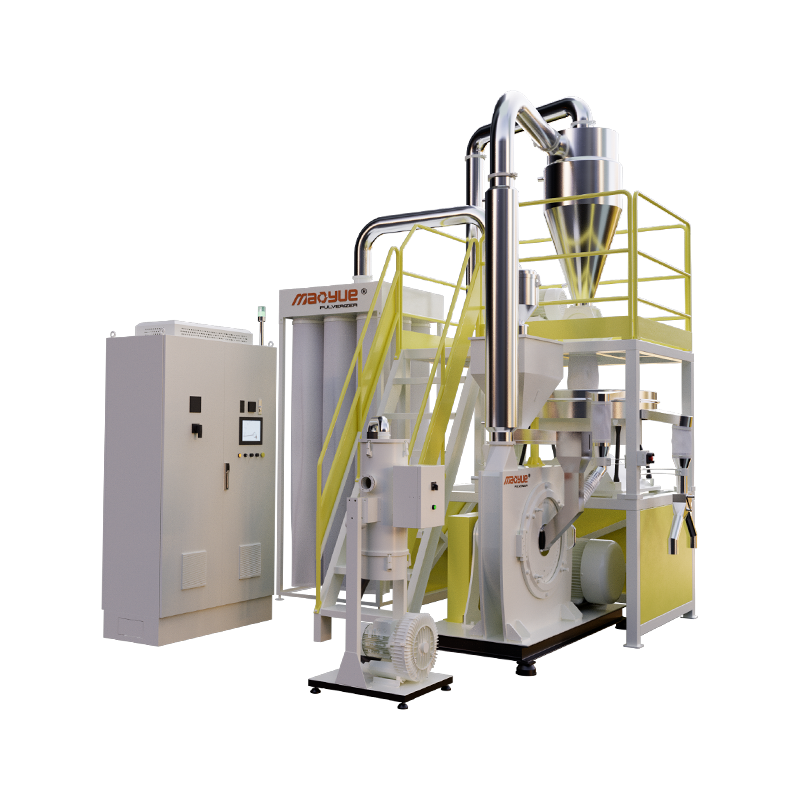
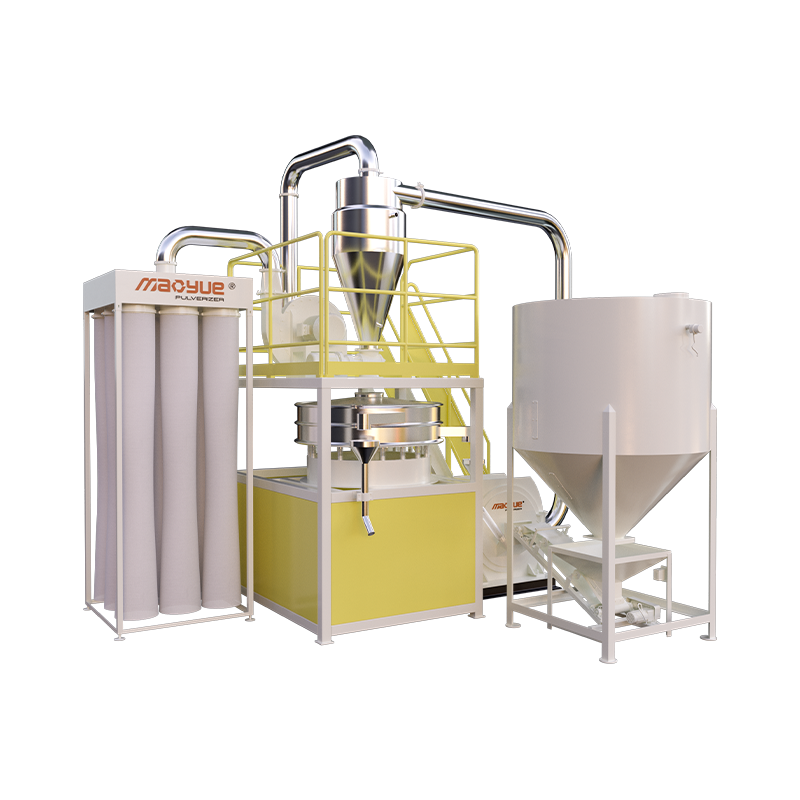
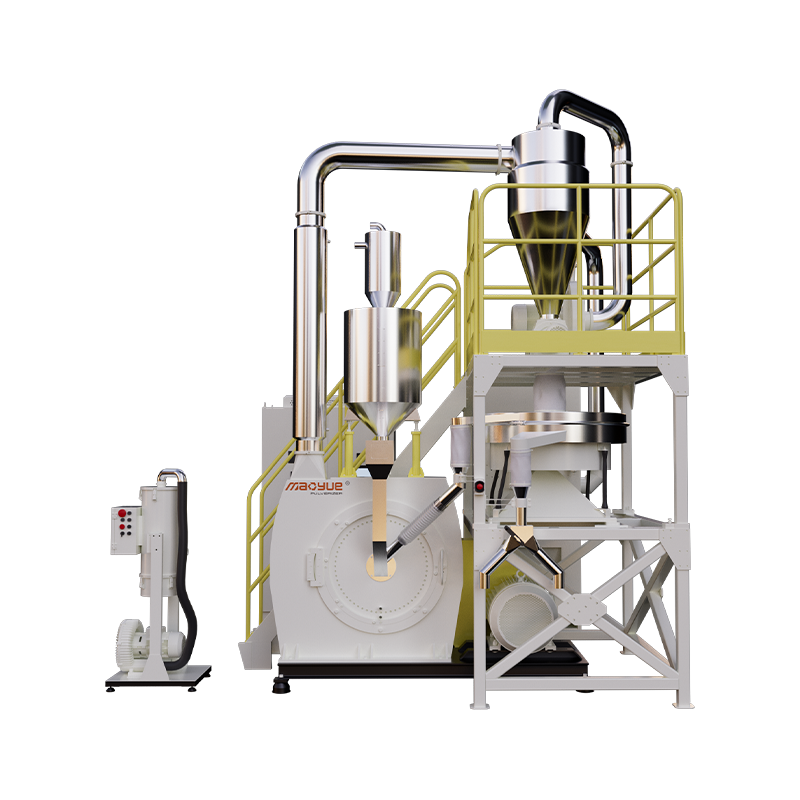
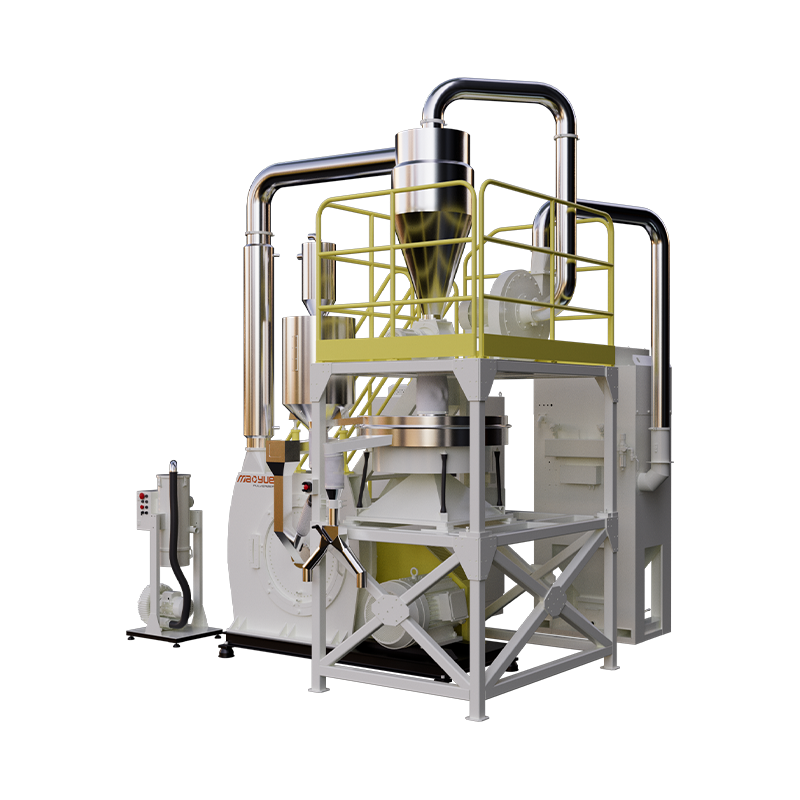
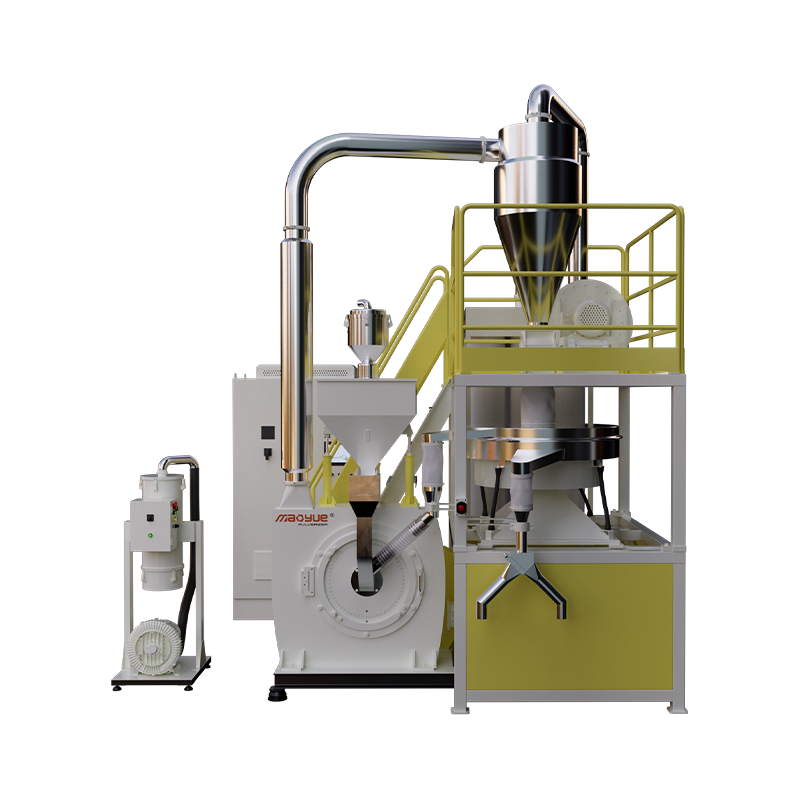
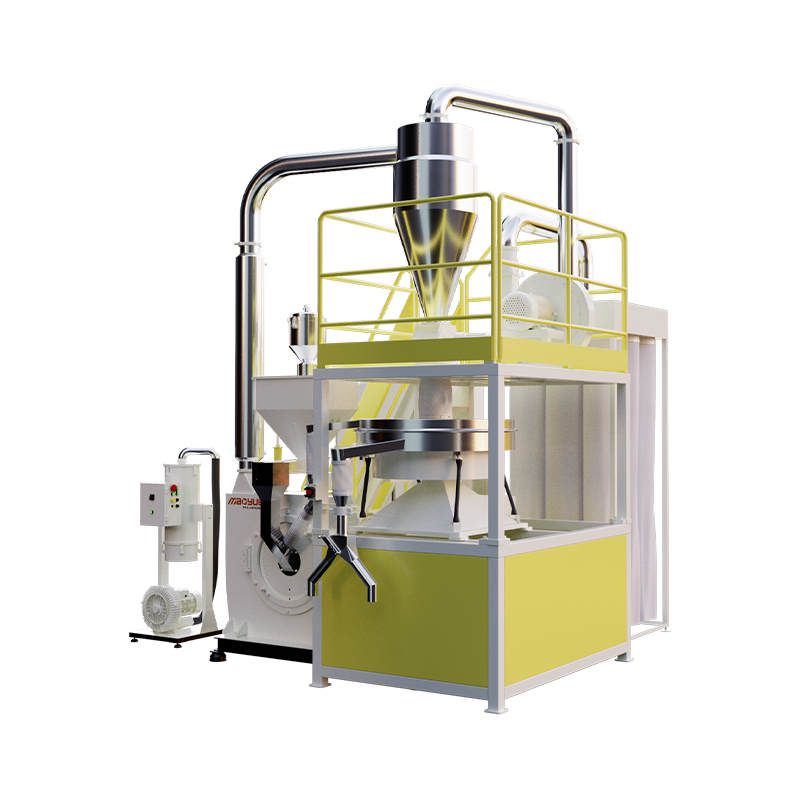
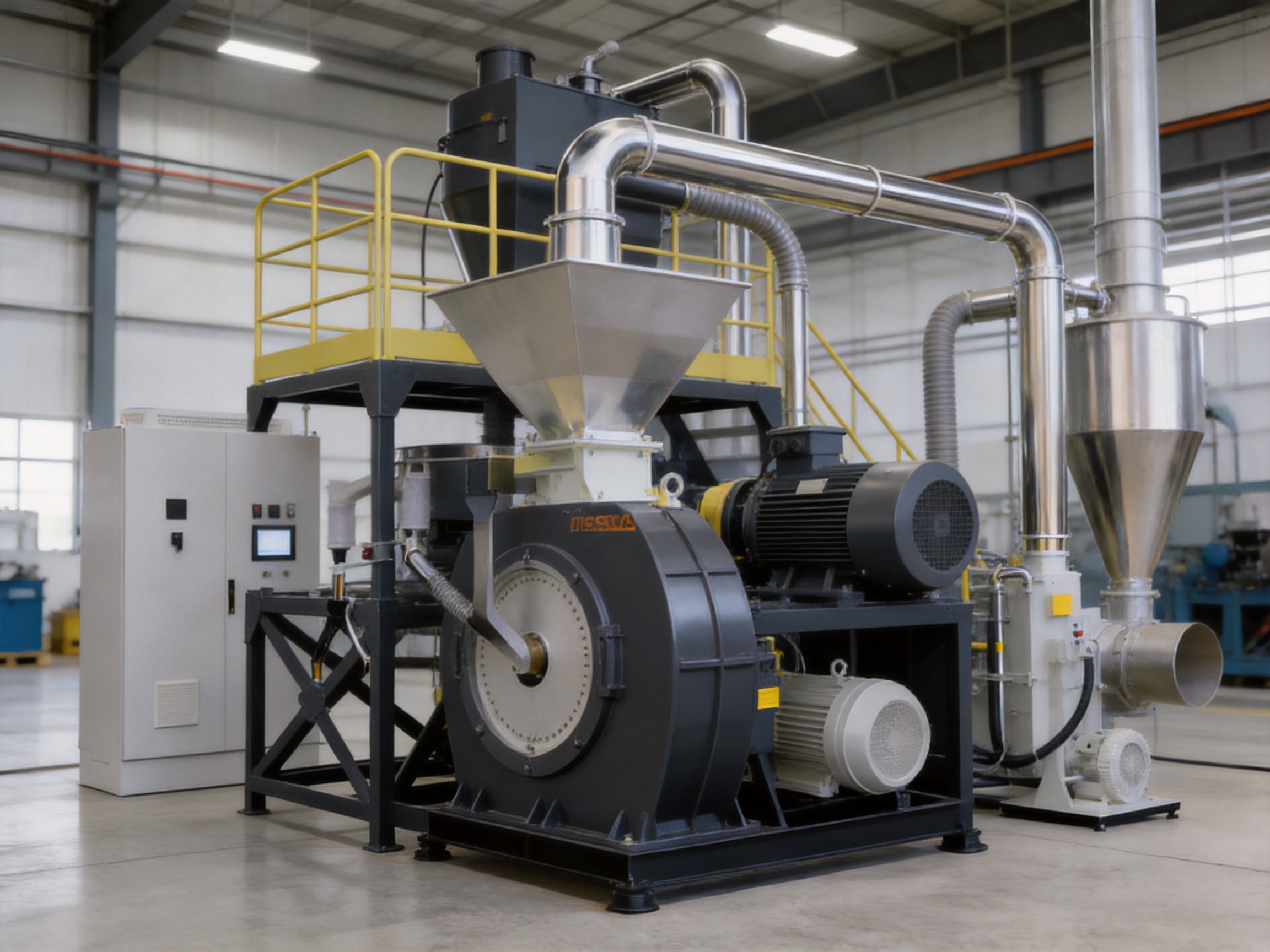
Modern plastic recycling and powder manufacturing require more than basic size reduction. Industrial users need equipment that can process large quantities of material continuously, maintain stable powder quality, control heat effectively, reduce wear, and remain dependable under demanding production schedules. The 800 mm energy-saving room-temperature pulverizer is designed for these requirements. With a large grinding disc, high-power drive system, advanced cooling, automatic temperature regulation, and heavy-duty construction, it is positioned as a production-scale solution for PA, PP, and other compatible thermoplastics.
This machine is developed for enterprises that have outgrown small and medium pulverizers and require stable, high-volume production. Its 800 mm disc diameter provides a substantially larger grinding area than 500 mm and 600 mm models. Combined with an oversized grinding chamber and a multi-stage shearing structure, the machine can deliver high throughput while producing controlled particle sizes for recycling, rotational molding, masterbatch, powder coating, and functional polymer applications.
The equipment is manufactured by Changzhou Mao Yue Intelligent Equipment Co., Ltd., a specialist producer with approximately 30 years of experience in plastic crushing and pulverizing machinery. The company combines high-precision machining, dynamic balancing, specialized welding, European-oriented component standards, and application-based technical support to create pulverizing systems for domestic and international customers.
Why Large-Scale Plastic Pulverization Requires Specialized Equipment
Plastic pulverization is not simply a matter of forcing material through a smaller opening. Thermoplastics respond strongly to friction, residence time, moisture, material composition, and heat. If the grinding chamber becomes too hot, PA and PP can soften, smear, agglomerate, or partially degrade. If the rotor and grinding disc are poorly balanced, vibration can increase rapidly at high speed. If the cutting surfaces wear unevenly, particle size distribution becomes inconsistent and the energy required per kilogram rises.
These problems become more serious when processing filled engineering plastics. PA6 and PA66 containing glass fiber, mineral powder, flame retardants, or other additives can be significantly more abrasive than unfilled resin. Recycled components may also contain contamination, mixed grades, surface coatings, or variations in moisture and geometry. A machine intended for large-scale industrial use must therefore provide more than a powerful motor. It must integrate structural rigidity, efficient airflow, cooling, wear resistance, controlled feeding, and convenient maintenance.
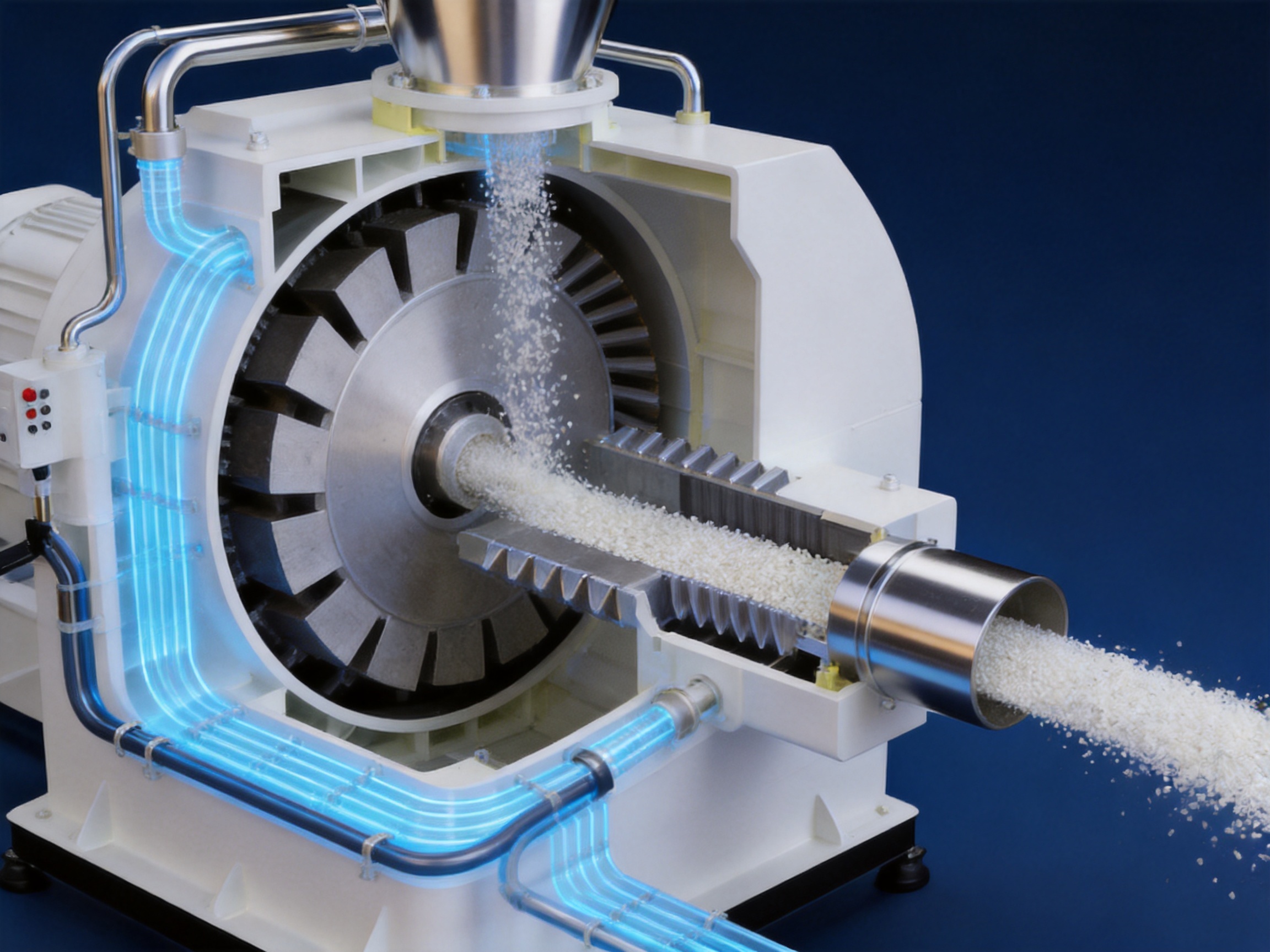
The 800 mm pulverizer addresses these requirements through a combination of high grinding capacity and process control. Its grinding system is designed for efficient shearing rather than relying only on impact. The large disc provides an expanded working surface, while the multi-stage grinding structure promotes repeated cutting and refining. This arrangement supports high throughput without requiring excessive residence time in the chamber.
For production managers, the result is a machine that can become the central grinding unit in a complete recycling or powder manufacturing line. It can be integrated with conveying, feeding, separation, screening, dust collection, packaging, and material storage systems. The machine is especially suitable when production continuity, powder uniformity, and predictable operating costs are more important than the lowest initial purchase price.
Core Product Design and Performance
The model uses an 800 mm grinding disc and is available with drive motor configurations of 75, 90, 110, or 132 kW. This range allows the machine to be selected according to material type, desired fineness, line layout, and production target. Variable speed control through an inverter helps operators adapt the operating conditions to different polymers and formulations.
Rated capacity is commonly specified in the range of 450 to 900 kg per hour, while actual output depends on the material, feed size, moisture, additive loading, target mesh, feeding stability, and selected motor configuration. Under suitable conditions and with appropriate upstream preparation, the machine can achieve the high production levels expected from an 800 mm class pulverizer. Some operating descriptions indicate higher peak capacities for selected materials and configurations; users should confirm final capacity through material testing and technical evaluation before ordering.
The standard particle-size range is approximately 10 to 50 mesh. This range can support many applications, including coarse-to-medium plastic powder for rotational molding, powder coating, masterbatch preparation, filler compounding, and selected recycled polymer applications. Final particle size is affected by the grinding gap, material properties, disc condition, feeding rate, and screening arrangement.
A vacuum feeding system provides controlled material transfer into the pulverizer. Stable feeding is important because sudden surges can overload the drive system, reduce powder consistency, and raise the temperature inside the chamber. Vacuum conveying also supports cleaner line design and can reduce manual handling in continuous production environments.
The material-contact pipeline is constructed from stainless steel, with pipe sizes of approximately 178 or 203 mm depending on the configuration. Stainless steel helps resist corrosion and contamination while providing a durable surface for conveying plastic powder. The system can be matched with dust collection and screening equipment to form a complete processing line.
Large Grinding Disc and Oversized Chamber
The 800 mm disc is one of the machine’s primary advantages over smaller pulverizers. A larger disc can provide a greater effective grinding area and support higher material flow when the grinding chamber, motor, air system, and feeding arrangement are correctly matched. The oversized chamber also gives the material sufficient space to move through the grinding zone without unnecessary compression or prolonged retention.
Compared with a smaller 500 mm unit, the 800 mm configuration is more appropriate for continuous industrial production. Compared with a 600 mm model, it offers greater production potential and a more substantial mechanical platform for large recycling lines. The larger structure is particularly useful where the customer processes several shifts per day or needs to handle large volumes of post-industrial and post-consumer material.
Multi-Stage Shearing Structure
The grinding system uses a multi-stage shearing structure to break down plastic through controlled mechanical cutting. Shearing can help produce more consistent particles than a process that depends primarily on random impact. It is suitable for materials that need to be reduced into a relatively uniform powder for downstream molding, coating, compounding, or blending.
The system is designed to support a stable balance between output and fineness. A narrower grinding clearance may improve fineness but can increase friction and heat. A wider clearance can increase throughput but may produce a coarser particle distribution. Inverter speed control and adjustable operating parameters allow the line to be configured according to the material and product specification.
High-Power Drive Options
The available 75, 90, 110, and 132 kW motor options give users room to select a suitable power level rather than applying one fixed specification to every project. Lower power configurations may be appropriate for less demanding materials or moderate production targets, while higher power options can support more difficult materials, higher feeding rates, or extended operating schedules.
Power selection should be based on more than nominal capacity. Engineering teams should consider material hardness, glass-fiber or mineral content, desired mesh size, starting conditions, operating hours, local electrical standards, and the required safety margin. Correct motor selection can improve energy efficiency because an appropriately sized machine avoids both excessive overload and unnecessary underutilization.
The inverter-based speed control system also supports smoother startup and process adjustment. Operators can gradually increase speed, adapt the machine to changing material conditions, and reduce mechanical shock during operation. This helps protect the motor, transmission system, grinding discs, and other high-wear components.
Room-Temperature Pulverization and Temperature Stability
Heat management is a decisive factor in thermoplastic pulverization. PA and PP can soften when exposed to excessive frictional heat. Softened material may stick to the disc, form lumps, block conveying lines, or alter the particle-size distribution. Heat can also affect the physical properties of recycled material and create color or odor problems in sensitive applications.
The 800 mm pulverizer uses a dual-circuit high-flow cooling system based on air and water circulation. The water-cooling arrangement is designed with separate inlet and outlet paths, allowing continuous heat transfer through the cooling circuit. High-flow air movement assists in carrying heat away from the grinding area and transporting processed powder through the line.
An automatic temperature-control system with PID regulation is used to maintain stable operating conditions. Under suitable installation and material conditions, the system is designed to maintain temperature fluctuation within approximately ±2°C. Actual performance will depend on cooling-water temperature, ambient conditions, feed rate, material moisture, particle size, and system maintenance.
Room-temperature processing does not mean that the grinding chamber produces no heat. Instead, it means that the machine is engineered to control generated heat so the material can be pulverized without unacceptable thermal degradation. This is particularly valuable for PA and PP powders that must remain free-flowing and consistent.
Stable temperature control provides several benefits. It can reduce agglomeration, minimize scorching, protect polymer properties, and improve the consistency of downstream processing. In powder coating or rotational molding, consistent thermal history can contribute to more predictable melting behavior. In recycled engineering plastics, effective heat management can help preserve the quality of the recovered material.
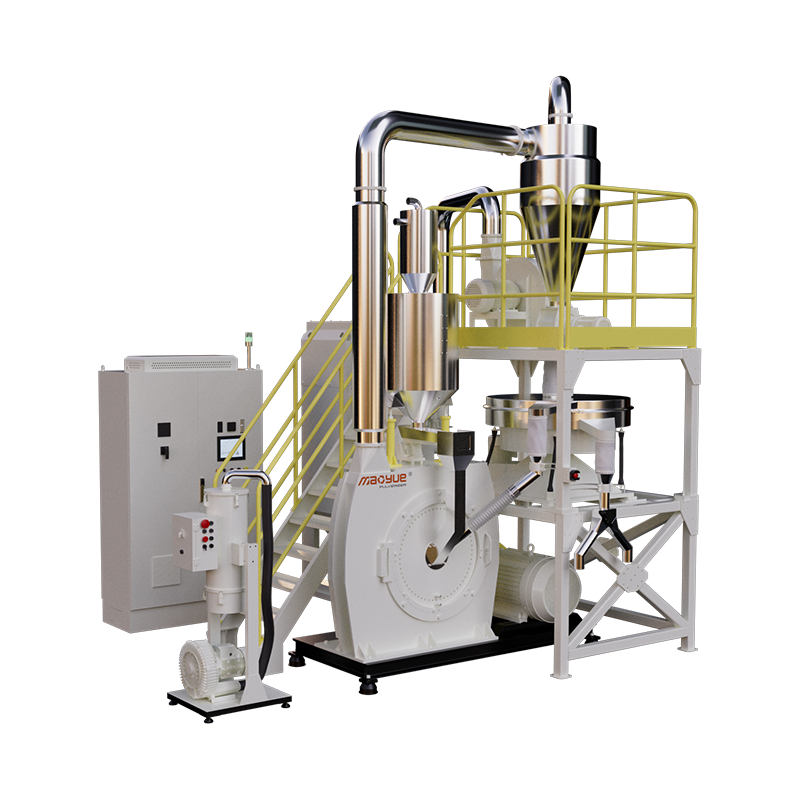
800PA/PP Energy-Saving Room-Temperature Pulverizer
Wear Resistance for Filled PA and PP
Engineering plastics reinforced with glass fiber, mineral powder, or other fillers can create severe wear on conventional grinding components. Materials containing approximately 30 to 50 percent glass fiber or mineral reinforcement may require much stronger grinding surfaces than unfilled plastics. Abrasive fillers can rapidly reduce cutting efficiency, increase clearances, and introduce metal contamination if the grinding system is not properly selected.
The 800 mm pulverizer uses heavy-duty, high-wear-resistant alloy grinding discs. The grinding blade material is specified as DC53 in a separated configuration. DC53 is a high-performance tool steel commonly selected for applications requiring hardness, strength, and resistance to repeated wear. The separated disc structure can also support practical replacement and maintenance because worn sections may be serviced without necessarily replacing the entire assembly.
Under suitable operating conditions, the expected service life of the grinding discs is approximately 1,200 to 2,000 hours. Actual life depends on the percentage and type of filler, contamination level, feed size, operating clearance, throughput, cooling effectiveness, and maintenance practices. Processing clean, correctly prepared material will generally produce a different wear pattern from processing contaminated or highly abrasive scrap.
Longer component life offers more than a reduction in spare-parts consumption. It can reduce maintenance frequency, shorten planned downtime, stabilize particle size, and improve production scheduling. For companies running multiple shifts or continuous operations, these factors can have a greater financial impact than the initial component price.
Maintenance Advantages of Separated Grinding Components
Grinding discs and blades are consumable components. Even a highly wear-resistant material eventually requires inspection, adjustment, sharpening, or replacement. A separated configuration helps maintenance teams isolate worn parts and manage replacement more efficiently. It can also simplify the stocking of spare components for sites that operate several machines.
Routine inspections should include disc condition, grinding clearance, bearing temperature, vibration, motor current, cooling-water flow, air volume, conveying pressure, and dust-collection performance. Operators should also monitor changes in sound and product appearance. An increase in noise, vibration, motor load, or coarse particles may indicate wear, imbalance, blockage, or improper feeding.
Using original or technically approved replacement parts is important. Grinding components must be matched for geometry, balance, hardness, and installation accuracy. Incorrectly manufactured or poorly balanced replacement parts can create vibration and reduce the service life of bearings and drive components.
Industrial Construction and Low-Noise Operation
Large pulverizers must withstand continuous mechanical loads. The machine is designed with heavy-duty industrial construction and vibration-damping measures to support stable operation. Structural rigidity is especially important for an 800 mm grinding system because the forces generated by a large rotating disc can become significant when processing dense or abrasive material.
Dynamic balance is also essential. Even a small imbalance at high rotational speed can produce considerable vibration. Changzhou Mao Yue Intelligent Equipment Co., Ltd. uses dynamic balancing equipment in its manufacturing process to improve rotor balance and component stability. Accurate balancing helps protect bearings, reduce structural stress, and maintain a more comfortable working environment.
The equipment includes a low-noise fan and is designed to operate below approximately 88 dB under specified conditions. The actual sound level depends on installation, material flow, ducting, foundation design, and surrounding equipment. Appropriate acoustic protection and workplace noise assessment should still be used in every installation.
Vibration damping and controlled noise are valuable in large factories. Excessive vibration can affect nearby equipment, loosen fasteners, damage duct connections, and increase maintenance requirements. Lower operating noise can improve communication and worker comfort, especially in facilities where several processing machines operate simultaneously.
Manufacturing Strengths and Quality Control
The performance of a large pulverizer depends heavily on manufacturing accuracy. A powerful motor cannot compensate for poor alignment, inaccurate machining, weak welding, inadequate balancing, or inconsistent assembly. For this reason, the production capability of the equipment manufacturer is an important part of the purchasing decision.
Changzhou Mao Yue Intelligent Equipment Co., Ltd. operates six processing workshops, each averaging approximately 1,400 square meters. These workshops support machining, welding, assembly, testing, and related production activities. The company maintains a technical team that studies advanced pulverizer technologies and manufacturing practices from Germany and other industrial markets.
The factory uses high-precision grinding machines imported from Taiwan and manufactured to German-oriented standards. Precision grinding is important for producing accurate disc surfaces, consistent clearances, and reliable contact geometry. Small dimensional deviations can affect output, energy use, product fineness, and wear distribution.
German dynamic balancing equipment is used to improve the balance of rotating components. This is particularly important for large discs, rotors, shafts, and other high-speed assemblies. Proper balance reduces vibration and helps maintain stable operation over long production cycles.
Japanese welding systems are used in the fabrication of structural and material-conveying components. High-quality welding contributes to frame strength, dimensional stability, and resistance to fatigue. Welding quality also affects the ability of the system to withstand vibration and repeated thermal changes.
The company manufactures components according to European quality-oriented practices and has obtained CE mechanical certification and ISO 9001 quality management system certification. These certifications do not replace application-specific engineering or local regulatory review, but they demonstrate a structured approach to product safety, manufacturing control, and documentation.
More than 5,000 enterprises in domestic and international markets have established partnerships with the company. This experience provides practical feedback across industries such as rotational molding, masterbatch production, polymers, PVC, PE, recycling, and powder coating. A wide application base can help the manufacturer understand different feedstocks and develop more appropriate configurations.
Applications in PA Recycling
Polyamide recycling is one of the most demanding applications for a high-capacity pulverizer. PA6 and PA66 components are widely used in automotive parts, electrical connectors, cable jackets, industrial components, textile materials, and engineering assemblies. These products can be valuable after use, but they often contain glass fiber, mineral reinforcement, coatings, inserts, or other contaminants.
The 800 mm machine can be used as a core grinding unit after suitable sorting, dismantling, and pre-crushing. Potential feedstocks include glass-filled PA components, automotive brackets, electrical housings, cable materials, industrial scrap, and textile tow waste. The exact feed preparation method depends on the shape and size of the incoming material.
When properly configured, the machine can produce PA powder in a broad range such as 10 to 100 mesh through grinding and screening arrangements. The standard machine specification identifies a 10 to 50 mesh range, while finer or broader distributions may require additional screening, multiple passes, or customized settings. Users should conduct trials when a narrow particle-size distribution is required.
Recovered PA powder may be used in recycled injection molding compounds, extrusion profiles, engineering material formulations, or further pelletizing processes. The suitability of the powder depends on polymer identification, contamination control, moisture management, additive content, and downstream formulation requirements.
For large automotive dismantling operations and centralized engineering-plastic recovery facilities, high throughput is a major advantage. A production-scale machine can reduce the need for multiple small pulverizers, simplify line management, and make better use of centralized dust collection and screening systems.
Applications in PP Powder Production
Polypropylene is used in containers, pallets, automotive components, household products, trash bins, playground equipment, tanks, and many other applications. PP powder is also used in rotational molding, powder coating, filler production, and selected masterbatch processes.
The 800 mm pulverizer is suitable for large PP powder production lines that require consistent flowability and controlled particle size. Its temperature-control system helps prevent excessive softening, agglomeration, and scorching during continuous operation. This is particularly important when the final powder must feed evenly into a rotational molding or coating process.
In rotational molding, uniform powder can support more consistent coverage, wall thickness, surface appearance, and melting behavior. In powder coating, particle-size control affects fluidization, electrostatic charging, transfer efficiency, and coating finish. In filler and masterbatch applications, stable powder characteristics support more predictable blending and dosing.
PP feedstock should be clean and appropriately prepared. Labels, metals, dirt, moisture, and incompatible polymers can affect product quality and increase wear. Upstream sorting, metal removal, shredding, and drying may be required depending on the source material and the final powder specification.
Functional Polymer and Specialty Powder Applications
Beyond conventional recycling, the pulverizer can support the preparation of specialty polymer powders. These may include PA-based powders containing flame-retardant, high-temperature-resistant, chemically resistant, or mineral-modified formulations. It can also be used for PP composite powder carriers and other engineered polymer blends.
Specialty powders require close control of contamination, temperature, particle size, and formulation consistency. A stable grinding environment is important because variation in thermal history or particle shape can affect downstream processing. The stainless-steel conveying path and controlled cooling system support cleaner and more repeatable processing.
Potential downstream uses include specialty injection molding, extrusion, powder coating, additive manufacturing feedstock development, and composite material preparation. The precise suitability of the powder for each application must be confirmed through laboratory testing, because requirements differ considerably between conventional recycling and high-performance engineering materials.
For applications requiring very low contamination, the complete line should be designed as a system. This may include dedicated material handling, enclosed transfer, effective dust filtration, magnetic separation, screen classification, cleaning procedures, and separate storage. A pulverizer alone cannot guarantee a final impurity level unless the entire process is controlled.
Comparison with Smaller and Conventional Pulverizers
The most direct advantage of the 800 mm model is its production scale. A 500 mm or 600 mm pulverizer may be appropriate for laboratory work, small factories, specialty batches, or moderate production. However, customers processing many tons per day may need several smaller machines to reach the same output. Multiple units can require more floor space, more operators, more electrical connections, and more maintenance points.
A single large pulverizer can simplify production management and concentrate cooling, dust collection, screening, and control functions. It can also reduce the number of transfer stages through which material must pass. This may improve line efficiency and make it easier to maintain a consistent process.
Compared with conventional machines that rely on basic air cooling, the 800 mm system provides a more comprehensive cooling arrangement with water circulation, high-flow air movement, and automatic temperature regulation. This is a significant advantage for thermoplastics that are sensitive to heat.
Compared with machines using standard low-wear steel, the use of DC53 grinding components provides improved resistance when processing abrasive, filled PA and PP. Longer wear life can reduce the frequency of disc replacement and help preserve product consistency over a longer operating period.
Compared with equipment designed primarily for intermittent operation, the industrial construction, vibration damping, cooling system, and serviceable components make this model more suitable for continuous production. It is intended for customers that value output stability and long-term operating cost rather than only the lowest purchase price.
Balanced Evaluation of the Investment
The 800 mm machine requires a higher initial investment than a small pulverizer. It also requires adequate electrical capacity, floor space, cooling infrastructure, dust collection, and trained operators. For a small business with limited throughput, the larger model may not be economically justified.
For a large recycling group, masterbatch producer, powder coating manufacturer, or OEM project, the investment can be evaluated through total cost of ownership. Relevant factors include output per hour, energy consumption per kilogram, disc life, downtime, labor requirements, product yield, maintenance cost, and the value of the finished powder.
A large machine is most economical when it operates near its intended production range with suitable material preparation. Buyers should therefore provide representative samples, target capacity, target mesh, operating hours, and final product requirements during the technical selection process.
Energy Efficiency and Total Operating Cost
Energy-saving performance should be evaluated across the complete process rather than by motor power alone. A larger motor may consume more electricity in absolute terms, but a larger machine can process substantially more material per hour. The relevant measure is often energy consumption per kilogram of acceptable powder.
The 800 mm pulverizer supports energy efficiency through several design factors. The multi-stage shearing structure can improve the effectiveness of mechanical size reduction. The large disc can process more material during each operating cycle. The inverter allows speed adjustment according to the feedstock. Effective cooling helps prevent inefficient operation caused by material softening or repeated recirculation.
Wear-resistant discs also contribute to long-term efficiency. As grinding surfaces wear, the machine may require more power to achieve the same result, and the product may become less uniform. Extending the useful life of the grinding components helps maintain process performance and reduces the material and labor costs associated with frequent replacement.
To control operating costs, users should maintain stable feeding, clean the cooling circuit, inspect the grinding clearance, replace clogged filters, remove metal contamination before grinding, and avoid feeding oversized or unsuitable materials. Preventive maintenance is usually less expensive than correcting a major failure after an overload or blockage.
Integration into a Complete Pulverizing Line
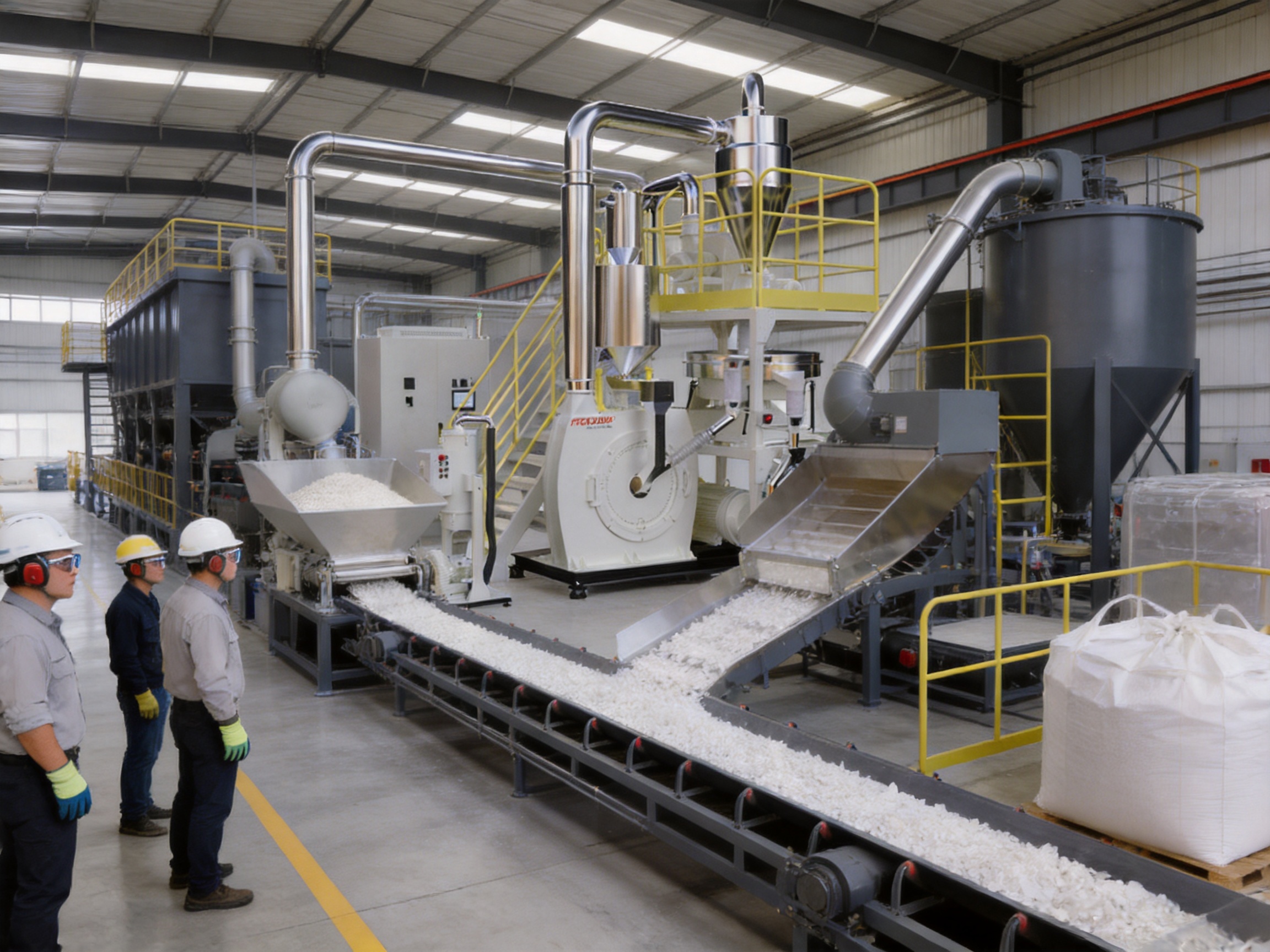
The pulverizer is most effective when integrated with equipment before and after the grinding chamber. A typical line may include raw-material storage, feeding, pre-crushing, metal separation, vacuum conveying, pulverization, cooling, screening, dust collection, finished-powder storage, and packaging.
Upstream shredding or crushing should reduce the feedstock to a size that the pulverizer can accept safely and consistently. Large molded parts may require a granulator or crusher before they enter the vacuum feeding system. Metal detection and magnetic separation can protect grinding components from bolts, inserts, wire, and other foreign objects.
Downstream screening can classify the powder and return oversize particles for additional processing. A swing vibrating screen with a diameter of approximately 1,200 or 1,500 mm and a motor power of approximately 1.1 or 1.5 kW can be included according to the required line configuration. Proper screening improves product consistency and allows different mesh fractions to be collected separately.
Dust collection is essential for product recovery, worker protection, and housekeeping. The system can be supplied with a dust collector using bags of approximately 300 mm diameter, subject to the final configuration. Dust collectors must be selected according to air volume, material density, powder characteristics, filtration efficiency, and local environmental requirements.
Pipe diameter, blower capacity, bends, vertical lifts, and conveying distance all affect system performance. The specified blower motor options are approximately 11 or 15 kW. Final selection should be based on the complete line layout rather than isolated machine data.
Installation and Commissioning Considerations
A high-capacity pulverizer should be installed on a stable foundation capable of supporting the equipment and absorbing operating vibration. The surrounding area must provide sufficient clearance for inspection, disc replacement, cleaning, electrical access, and dust-collector maintenance.
Electrical installation should follow the local code and the motor manufacturer’s requirements. The customer should confirm voltage, frequency, motor starting method, inverter compatibility, grounding, emergency-stop arrangements, overload protection, and control-panel location before shipment.
The cooling system requires a reliable water supply, suitable water quality, correct flow, and appropriate drainage. Water temperature should remain within the recommended range for the expected production environment. Filters, pumps, valves, and heat-transfer surfaces should be inspected regularly to prevent reduced cooling performance.
During commissioning, the machine should be tested first without material and then with a controlled quantity of representative feedstock. Operators should verify rotation direction, vibration, motor current, cooling-water flow, airflow, feeding stability, temperature response, and product particle size. Production should be increased gradually rather than immediately operating at maximum load.
Commissioning trials are also an opportunity to establish operating parameters for different materials. A production record should include feed rate, motor speed, grinding clearance, cooling conditions, product temperature, particle-size distribution, and energy consumption. This information can be used to create standard operating procedures for future shifts.
Safety and Environmental Considerations
Plastic pulverizing systems contain rotating components, high-speed grinding parts, electrical equipment, pneumatic or vacuum conveying, and fine powder. Guards, access interlocks, emergency stops, warning labels, and lockout procedures must be used. Operators should never open the grinding chamber while the rotor is moving or before stored energy has been safely isolated.
Fine plastic dust may create respiratory, housekeeping, and, depending on the material, combustible-dust risks. The dust-collection system should be designed and maintained according to the characteristics of the polymer and local safety regulations. Static-control measures, appropriate filtration, grounding, ventilation, and fire-prevention procedures may be necessary.
Personal protective equipment should include eye protection, hearing protection, suitable gloves for maintenance, and respiratory protection where required by the risk assessment. Operators should receive training in normal operation, blockage removal, emergency shutdown, cleaning, and maintenance.
Environmental performance also depends on proper dust capture, noise management, energy control, and responsible handling of waste streams. A well-designed line can improve material recovery while reducing the volume of plastic sent to disposal. When recycled powder is used to replace virgin resin, the overall environmental benefit may be further increased, provided that product quality and application requirements are satisfied.
Technical Specification Overview
Item |
Specification |
Operational Note |
Machine type |
800 mm plastic pulverizer |
Designed for high-volume PA and PP processing |
Grinding disc diameter |
800 mm |
Large working area for industrial production |
Typical capacity |
450 to 900 kg/h |
Actual output depends on material and target mesh |
Particle-size range |
Approximately 10 to 50 mesh |
Additional screening or customized settings may be required |
Drive motor options |
75, 90, 110, or 132 kW |
Selected according to feedstock and production target |
Speed control |
Inverter |
Supports gradual starting and process adjustment |
Grinding blade material |
DC53, separated configuration |
Suitable for demanding wear conditions |
Blower motor |
11 or 15 kW |
Final choice depends on conveying layout |
Pipe material |
Stainless steel |
Supports cleanliness and corrosion resistance |
Pipe diameter |
178 or 203 mm |
Configuration depends on system design |
Swing vibrating screen |
1,200 or 1,500 mm diameter |
Supports classification of finished powder |
Screen motor |
1.1 or 1.5 kW |
Selected according to screen size and material flow |
Feeding method |
Vacuum feeding |
Helps provide controlled and enclosed material transfer |
Dust-collector bag diameter |
Approximately 300 mm |
Final filtration design depends on air volume and dust type |
Cooling method |
Water cooling with separate inlet and outlet |
Used with high-flow air cooling and temperature control |
Operating noise target |
Below approximately 88 dB |
Actual level depends on installation and surrounding equipment |
Who Should Choose This Pulverizer?
The 800 mm model is best suited to customers with a clear need for industrial throughput. Large plastic recycling groups can use it as the main grinding unit in centralized recovery plants. Masterbatch producers can use it to prepare polymer and filler powders. Powder coating manufacturers can use it for controlled PP or PA powder production. Rotational molding companies can use it to manufacture uniform powder for tanks, pallets, containers, playground products, and other large molded articles.
It is also appropriate for OEM projects in which the pulverizer must be integrated into a customized, automated line. Export-oriented facilities may benefit from its enclosed conveying, temperature control, material-contact stainless steel piping, and compatibility with quality systems designed for international markets.
The machine may be excessive for occasional users, low-volume workshops, or applications involving only small quantities of unfilled plastic. In those cases, a smaller machine can provide a better balance between investment and capacity. The 800 mm model delivers the greatest value when it is used for long operating hours, high material throughput, abrasive feedstocks, and applications where stable powder quality directly affects product revenue.
Company Capabilities and Customer Support
Changzhou Mao Yue Intelligent Equipment Co., Ltd. focuses on plastic crushing and pulverizing equipment and provides machinery for recycling, rotational molding, masterbatch, polymer processing, PVC, PE, and powder coating applications. Its experience covers not only individual pulverizers but also components and complete processing-line concepts.
The company emphasizes quality, service, innovation, and customized solutions. Its technical team can assist with model selection, motor configuration, grinding-disc selection, cooling arrangements, conveying design, screening, dust collection, and line integration. This application-oriented approach is important because the same machine may perform differently when processing clean injection-molding scrap, glass-filled automotive parts, or post-consumer PP.
Customer support should begin before purchase. A professional evaluation should consider sample material, bulk density, moisture, contamination, additive content, feed size, expected capacity, target mesh, operating schedule, and local utilities. Material trials can help determine realistic output and verify the desired powder properties before final configuration.
After installation, training and technical documentation help operators achieve stable production more quickly. Recommended documentation may include installation drawings, electrical information, operating instructions, maintenance schedules, spare-parts lists, safety procedures, and troubleshooting guidance.
Recommended Purchasing Process
Businesses considering this machine should first define the product they intend to sell. “Plastic powder” can mean many different products, ranging from coarse rotational-molding powder to fine specialty material. The target application determines acceptable mesh, flowability, moisture, contamination, color, and bulk density.
The next step is to characterize the feedstock. The customer should identify polymer type, grade, filler content, average size, moisture, contamination, and whether the material is post-industrial or post-consumer. Mixed or unidentified plastics may require sorting and testing before pulverization.
Capacity should be calculated from actual operating hours rather than theoretical maximum output. A line operating 16 hours per day at a stable rate may be more productive and reliable than a line operated intermittently at an excessive rate. Planned cleaning, screen changes, maintenance, and material changes should be included in the production calculation.
Customers should also evaluate the complete infrastructure. Electrical service, cooling water, compressed air if required, dust collection, floor loading, building height, product storage, noise control, and worker access can all influence the final project cost.
Finally, the customer should request a technical proposal that clearly identifies the machine configuration, capacity basis, motor power, cooling arrangement, included accessories, spare parts, warranty terms, commissioning scope, and service responsibilities. Clear documentation reduces misunderstandings and supports long-term cooperation.
Frequently Asked Questions
What materials can the 800 mm pulverizer process?
The machine is primarily designed for PA and PP, including selected recycled, filled, and modified grades. It can be used for applications involving engineering plastics, masterbatch materials, rotational-molding powder, powder coating feedstock, and other compatible thermoplastics. Material testing is recommended for mixed, highly contaminated, or unusual feedstocks.
What is the expected production capacity?
The listed capacity is approximately 450 to 900 kg per hour. Actual output depends on polymer type, filler content, feed size, moisture, grinding clearance, motor configuration, target mesh, and the performance of the feeding and screening systems. Customers seeking a specific production rate should confirm it through a material trial.
Can it process glass-filled PA?
Yes, the machine is designed for demanding materials such as PA containing glass fiber or mineral reinforcement. The high-wear-resistant DC53 grinding components are intended to provide improved service life under abrasive conditions. However, contamination, filler percentage, and operating parameters will affect component life.
How does the machine control temperature?
It uses a dual-circuit cooling arrangement combining high-flow air and water cooling. The water system has separate inlet and outlet paths, while automatic PID temperature control adjusts operation to maintain stable conditions. Actual temperature stability depends on cooling-water conditions, ambient temperature, material flow, and maintenance.
Is the machine suitable for continuous production?
Yes. Its industrial construction, vibration damping, cooling system, high-power drive options, and wear-resistant grinding components make it suitable for extended and continuous operation. Proper feeding, scheduled inspection, and preventive maintenance remain essential for reliable 24-hour production.
What particle size can it produce?
The standard specification indicates approximately 10 to 50 mesh. The final distribution depends on disc clearance, speed, material characteristics, feed rate, and screening. Finer or narrower specifications may require customized settings, additional screening, or multiple processing stages.
Why is inverter speed control useful?
Inverter control allows operators to adjust the grinding speed for different materials and target products. It can support smoother startup, reduce mechanical shock, manage motor loading, and help balance throughput against fineness and temperature.
How long do the grinding discs last?
The expected service life is approximately 1,200 to 2,000 hours under suitable conditions. Abrasive fillers, metal contamination, improper clearance, excessive feed rate, and poor cooling can reduce service life. Regular inspection and correct maintenance are important.
Does the machine require upstream equipment?
Most installations benefit from upstream preparation. Large parts may need crushing or shredding, while metal separation and sorting can protect the grinding system. The required equipment depends on the shape, size, cleanliness, and composition of the incoming material.
Can the pulverizer be integrated with a vibrating screen and dust collector?
Yes. The configuration can include vacuum feeding, stainless-steel conveying pipes, a swing vibrating screen, blower equipment, and dust collection. The final arrangement should be engineered according to the required capacity, conveying distance, powder characteristics, and local environmental regulations.
What is the main advantage over a smaller pulverizer?
The principal advantage is production scale. The 800 mm disc and larger grinding chamber can support substantially higher throughput than smaller models when matched with the correct motor and auxiliary equipment. It can also reduce the need to operate multiple small units in parallel.
Is this machine suitable for every recycling facility?
No. It is most suitable for medium-to-large facilities that need high capacity, stable operation, and long-term industrial use. Smaller facilities with limited production may obtain better value from a smaller pulverizer. Selection should be based on material volume, target product, operating hours, and total cost of ownership.
Conclusion
The 800 mm energy-saving room-temperature pulverizer is designed for large-scale PA and PP processing where throughput, temperature stability, wear resistance, and continuous operation are essential. Its large disc, oversized grinding chamber, multi-stage shearing structure, inverter speed control, dual-circuit cooling, PID temperature regulation, stainless-steel conveying system, and heavy-duty construction provide a complete foundation for industrial powder production.
Its ability to process demanding filled materials, including glass-fiber- and mineral-reinforced PA and PP, makes it more suitable for advanced recycling and engineering-plastic applications than ordinary low-duty machines. The expected 1,200 to 2,000-hour grinding-disc service life, combined with industrial vibration control and practical maintenance features, can help reduce downtime and long-term operating costs.
The machine is not intended to be the lowest-cost solution for every customer. Its value is realized when it operates as the core of a high-volume production line handling substantial daily material quantities. For large recycling groups, masterbatch plants, powder coating companies, rotational molding producers, and export-oriented OEM projects, it offers a scalable route to reliable powder production.
Supported by high-precision machining, dynamic balancing, specialized welding, structured quality management, and decades of pulverizer experience, Changzhou Mao Yue Intelligent Equipment Co., Ltd. provides more than a standalone machine. It provides an industrial processing platform that can be configured around the customer’s material, output, powder specification, and future production goals.
References
1. Changzhou Mao Yue Intelligent Equipment Co., Ltd. Product information for the 800 mm PA and PP energy-saving room-temperature pulverizer.
2. Changzhou Mao Yue Intelligent Equipment Co., Ltd. Technical information concerning plastic crushing, pulverizing, cooling, screening, and dust-collection systems.
3. ISO 9001 quality management system principles for manufacturing and process control.
4. CE mechanical safety principles applicable to industrial machinery design and production.
5. General engineering guidance on thermoplastic processing, polymer temperature control, abrasive filler behavior, and particle-size classification.
6. Industrial maintenance practices for high-speed rotating equipment, dynamic balancing, wear-component inspection, and vibration monitoring.