

 English
 русский
 Español
 عربى
 中文简体
 中文简体
Content
- 1 1. A Complete Solution for Plastic Size Reduction
- 2 2. Working Principle of the Integrated Production Line
- 3 3. Separation, Screening, and Final Powder Collection
- 4 4. Key Technical Advantages
- 5 5. Comparison with Conventional Crushing and Grinding Systems
- 6 6. Manufacturing Quality and Engineering Strength
- 7 7. Automation and Electrical Control
- 8 8. Application Areas
- 9 9. Representative Technical Specifications
- 10 10. Installation, Operation, and Maintenance Considerations
- 11 11. Environmental and Workplace Benefits
- 12 12. Why Choose an Experienced Equipment Manufacturer?
- 13 13. Economic Value of the Production Line
- 14 14. Selecting the Correct Configuration
- 15 15. Frequently Asked Questions
- 15.1 15.1 What materials can this production line process?
- 15.2 15.2 What is the difference between the coarse crusher and the disc pulverizer?
- 15.3 15.3 Can the line produce powder for rotational molding?
- 15.4 15.4 How is overheating controlled?
- 15.5 15.5 Is the production line dusty?
- 15.6 15.6 What capacity can the coarse-crushing section achieve?
- 15.7 15.7 What knife material is used?
- 15.8 15.8 What grinding-disc material is used?
- 15.9 15.9 Can the system be customized?
- 15.10 15.10 What certifications does the manufacturer hold?
- 15.11 15.11 How can powder quality be maintained?
- 15.12 15.12 Is this line suitable for a centralized recycling facility?
- 16 16. Conclusion
- 17 References
- 18 Product: Hammer-impact swing-knife crushing and pulverizing production line
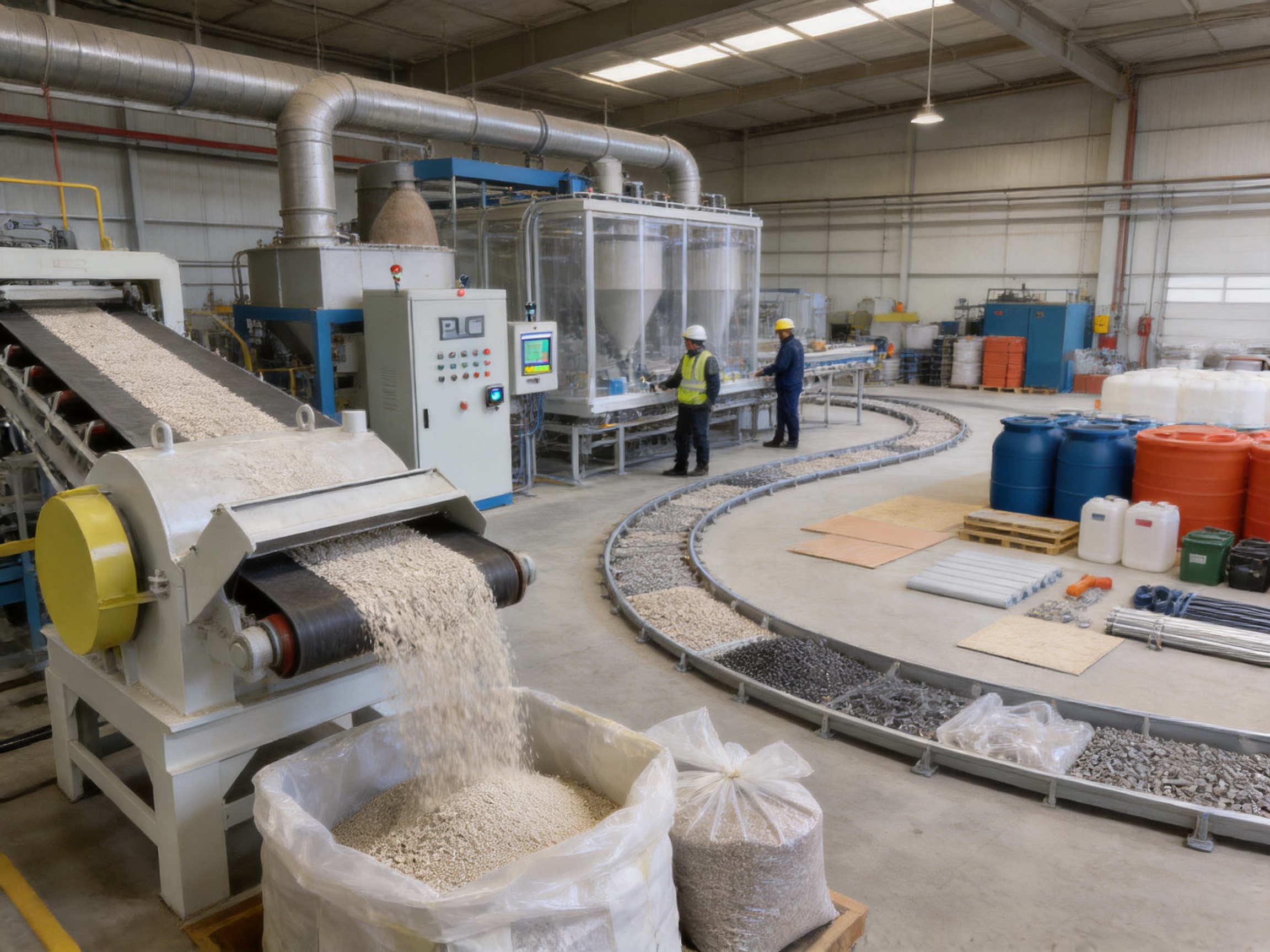
Plastic recycling is moving from a simple waste-reduction activity toward a high-value manufacturing process. Modern recyclers are expected to handle large and irregular plastic waste, produce consistent powder quality, control dust emissions, reduce energy consumption, and maintain stable production over long operating periods. A complete crushing and pulverizing production line must therefore do much more than reduce material size. It must coordinate feeding, coarse crushing, fine grinding, conveying, separation, screening, temperature control, dust collection, and automated operation as one integrated system.
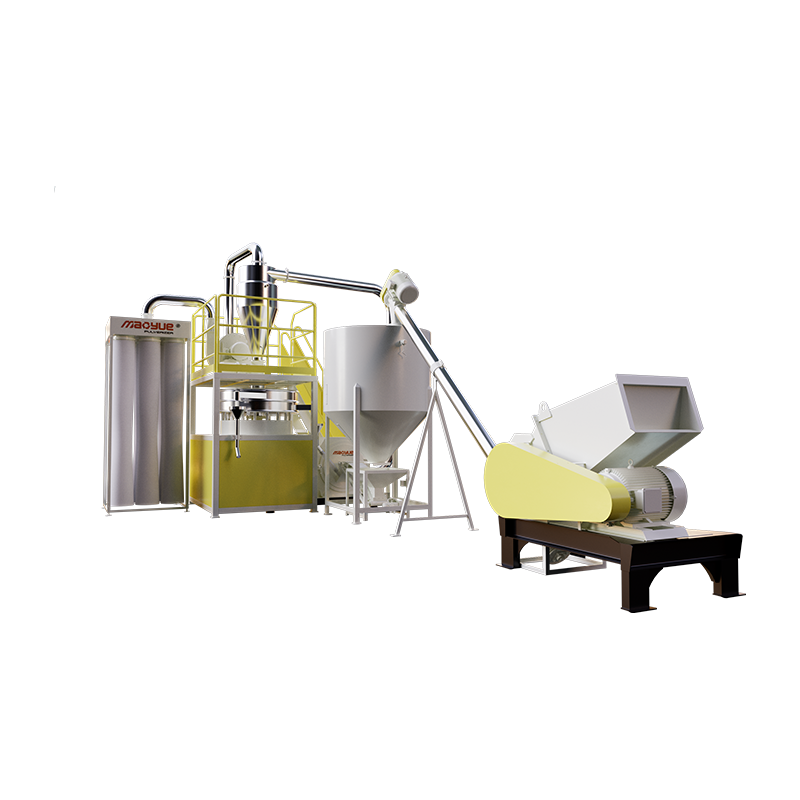
The hammer-impact swing-knife crushing and pulverizing production line is designed to meet these requirements. It combines a heavy-duty hammer-blade coarse crusher with a precision disc pulverizer, negative-pressure conveying, cyclone separation, vibrating screening, cooling equipment, and pulse dust collection. The result is a continuous processing solution capable of converting large plastic waste into uniform fine powder for reuse in rotational molding, pipe and profile extrusion, sheet production, SPC flooring, compounding, injection molding, and other plastic-processing applications.
Unlike conventional systems that depend on separate machines with manual transfer between stages, this production line uses coordinated equipment and centralized control. Large pipes, profiles, sheets, foam boards, pallets, woven bags, bottles, appliance housings, films, and other plastic waste can be reduced from bulky pieces to controlled powder sizes in a single production flow. Depending on the material, screen arrangement, machine configuration, and operating conditions, the final output can generally range from approximately 20 to 80 mesh or finer.
The system is especially suitable for PVC, PE, PP, PET, ABS, EVA, and other medium-hardness or impact-resistant plastics. Its design addresses common problems in plastic size reduction, including feeding blockage, blade entanglement, excessive heat, powder adhesion, yellowing, material degradation, inconsistent particle size, dust leakage, and high labor requirements.
1. A Complete Solution for Plastic Size Reduction
Plastic waste is rarely uniform. A recycling plant may receive long pipes, thick profiles, flat sheets, flexible bags, foam boards, molded products, production offcuts, and contaminated industrial scrap at the same time. Traditional knife crushers often perform well on selected materials but can struggle when the feedstock changes. Long and flexible pieces may wrap around the rotor, large pieces may bridge at the inlet, and tough products may require repeated feeding.
The hammer-impact swing-knife system uses a robust coarse-crushing structure to overcome these limitations. High-speed rotating knives and hammer-like impact elements apply a combination of impact, cutting, tearing, and shearing forces. This combination is more adaptable than a single cutting action. Large and irregular waste is broken into manageable pieces before entering the fine pulverizing stage.
The front-end crusher can be configured with a wide feed inlet to accommodate bulky materials. Its rotary knife arrangement supports continuous feeding and helps maintain a stable discharge size. The standard reference configuration includes 36 rotary knives, a nominal 1,000-type machine specification, a feed width of approximately 1,350 millimeters, and a discharge mesh or opening specification of approximately 16 millimeters for the coarse-crushing section.
Once the coarse crusher has reduced the material, the crushed plastic is transferred to the disc pulverizer. This two-stage arrangement is important because it prevents the fine grinder from receiving oversized or difficult-to-handle pieces. The coarse crusher absorbs the high-impact work, while the disc mill performs controlled fine grinding. Separating these duties improves capacity, reduces unnecessary stress on the grinding discs, and promotes a more stable final powder.
The production line is not limited to a single plastic recycling application. It can be configured for PVC pipe and profile recycling, PE and PP rotational molding powder, SPC flooring powder, engineering plastic recovery, plastic compounding, and centralized industrial waste treatment. Its modular structure also allows customers to adapt the process to local raw materials, required output, available floor space, and environmental regulations.
2. Working Principle of the Integrated Production Line
2.1 Feeding and Material Preparation
Material enters the line through a controlled feeding system. Depending on the nature of the waste, preliminary sorting, metal removal, manual inspection, or simple pre-cutting may be used. The feeding system can be combined with variable-frequency control so that the quantity of material entering the crusher matches the actual load of the equipment.
Controlled feeding is essential for stable production. If too much material enters at once, the crusher may experience overload, while insufficient feeding reduces capacity and may create unstable powder quality. Variable-frequency feeding allows operators to adjust the rate according to material thickness, hardness, moisture, and bulk density. It also helps coordinate the crusher with the pulverizer and conveying system.
2.2 Hammer-Impact Swing-Knife Coarse Crushing
In the coarse-crushing chamber, high-speed rotary knives and impact components break down large plastic waste. The material is exposed to repeated impact and shear forces until it reaches the required preliminary size. The knife and screen arrangement can be selected according to the intended application and feedstock characteristics.
The impact-based design is particularly useful for pipes, profiles, sheets, foam boards, woven bags, pallets, and molded products. These materials often vary in thickness and may have hollow, flexible, or irregular structures. A conventional cutting-only machine may require careful size control at the feed stage, whereas the hammer-impact configuration is designed to accept a wider range of large waste forms.
The coarse-crushing section can also be equipped with air cooling or water-mist assistance when material temperature must be controlled. This option is useful for heat-sensitive plastics and for applications in which frictional heat may affect subsequent grinding. The crushing chamber can be configured according to the material and production target.
2.3 Negative-Pressure Conveying
After coarse crushing, the material is transported through a fully enclosed negative-pressure conveying system. Airflow carries the crushed particles from one process stage to the next while reducing the need for manual handling. The negative-pressure arrangement helps prevent dust from escaping into the workshop because air is drawn into the system rather than forced outward through unsealed points.
Compared with open conveyors or manual transfer, pneumatic conveying provides a cleaner process and a more flexible equipment layout. The crusher, pulverizer, cyclone, screening unit, and dust collector can be positioned according to the factory floor plan. This is valuable for plants that need to use existing buildings or maximize production capacity within limited space.
2.4 Fine Pulverizing with a Disc Mill
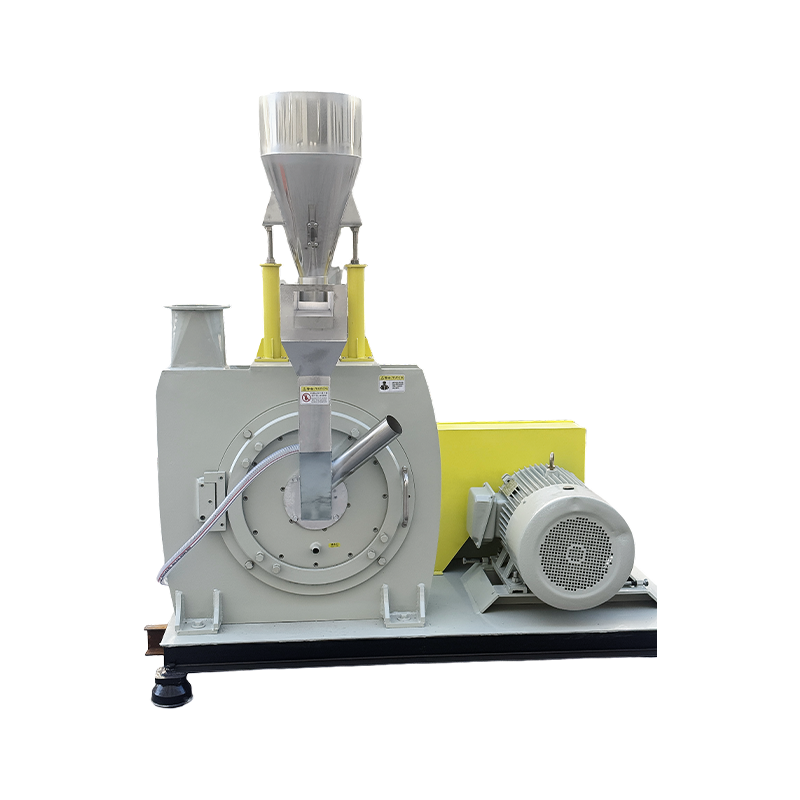
The fine-grinding stage uses a precision disc pulverizer available in different model ranges, including 500, 600, and 800 series configurations. The correct model depends on the material, required capacity, target mesh size, and operating conditions.
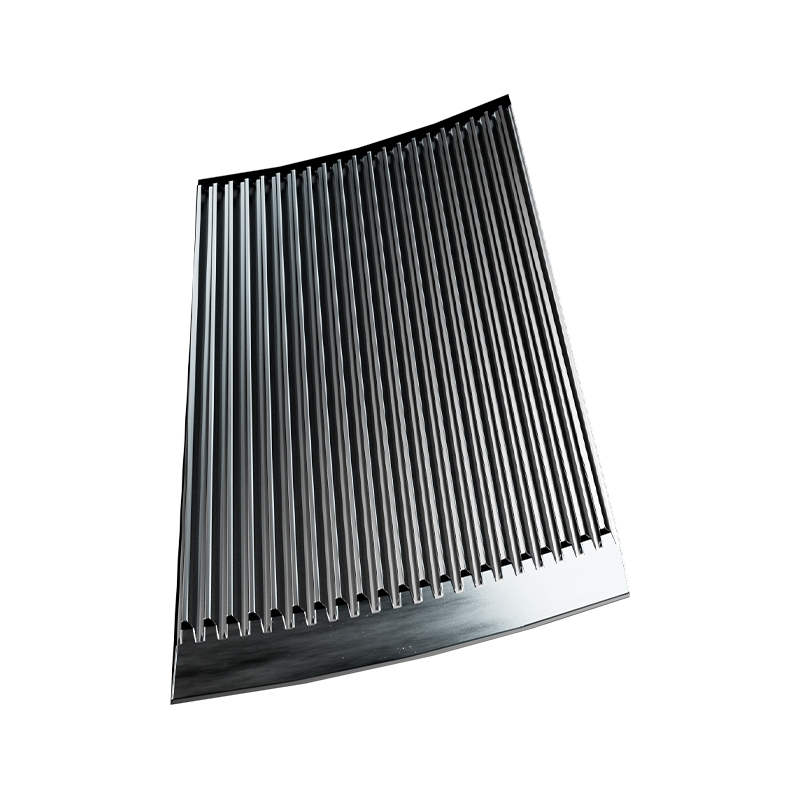
The grinding discs are manufactured from high-grade DC53 mold steel. This material offers a useful combination of hardness, wear resistance, toughness, and dimensional stability. Because plastic grinding places continuous stress on the working surfaces, disc material quality has a direct effect on service life, powder consistency, and maintenance frequency.
The tooth-by-tooth grinding profile is processed using high-precision CNC equipment. This manufacturing method supports accurate tooth geometry and consistent clearance between the grinding discs. German dynamic balancing calibration is used to help reduce vibration during high-speed operation. Accurate disc machining and rotor balancing are important because even small deviations can result in noise, vibration, uneven wear, or unstable powder output.
During operation, material passes through the grinding zone and is progressively reduced by controlled friction, impact, and shear. The fine-powder output can be adjusted through disc clearance, rotor speed, airflow, feed rate, and screening conditions. This makes the system suitable for different applications that require different powder sizes and flow properties.
2.5 Cooling and Temperature Management
Plastic pulverizing generates heat. If the grinding chamber becomes too hot, PVC and other sensitive materials may soften, stick to the discs, discolor, or degrade. Excessive heat can also reduce powder flowability and cause unstable operation.
The production line therefore uses a reinforced dual cooling system as a standard feature of the grinding section. Multiple temperature sensors monitor operating conditions, while a PLC control system coordinates cooling and machine operation. Under normal conditions, the grinding chamber temperature can be controlled within approximately 50 to 80 degrees Celsius, depending on the material, throughput, ambient environment, and configuration.
Temperature control provides several benefits. It helps prevent powder from adhering to the grinding discs, reduces the risk of yellowing, protects heat-sensitive plastics, and supports more consistent powder quality. It also improves production continuity because operators spend less time stopping the machine to remove deposits from the grinding chamber.
For PVC, PE, and similar materials, temperature stability is especially important. A well-controlled process helps preserve the characteristics needed for later extrusion, molding, compounding, or flooring production. Cooling is not merely an auxiliary function; it is a critical part of the product-quality system.
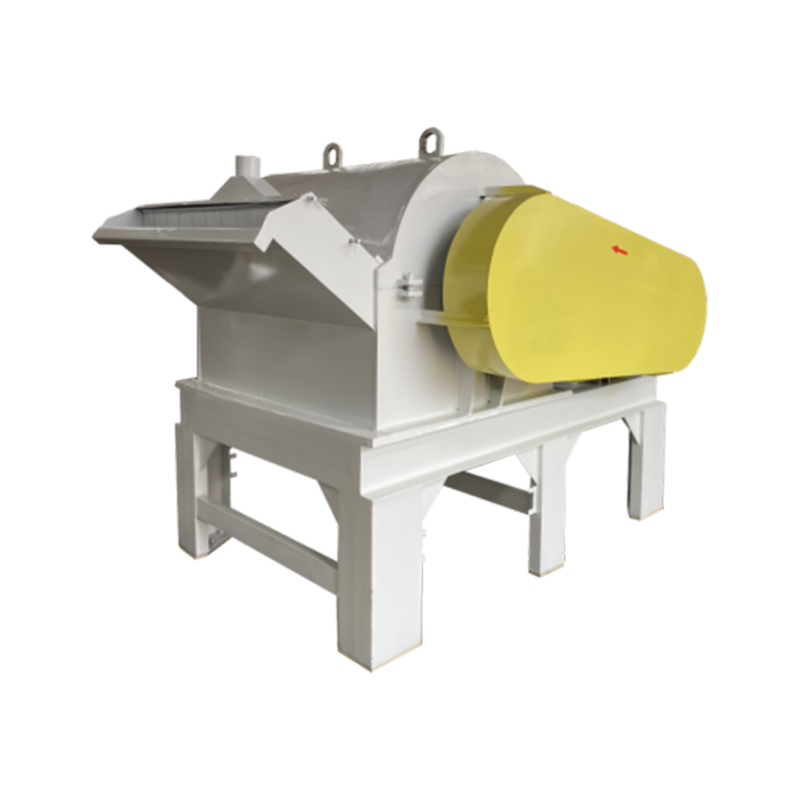
Hammer-impact swing-knife crushing and pulverizing production line
3. Separation, Screening, and Final Powder Collection
3.1 Cyclone Separation
After fine pulverizing, the air-material mixture enters the separation stage. The cyclone separator uses changes in airflow direction and centrifugal force to separate powder particles from the conveying air. Larger or denser particles move toward the collection area, while the air continues through the downstream filtration system.
Effective cyclone separation reduces the load on the pulse dust collector and helps recover valuable powder. It also promotes a more stable material flow through the line. When correctly matched to the pulverizer and fan, the cyclone can support continuous operation without excessive pressure loss.
3.2 Vibrating Screening
Vibrating screening is used to classify powder according to particle size. The screening unit can separate qualified powder from oversize particles that require further processing. This is important when the final product must meet a defined mesh range for rotational molding, SPC flooring, compounding, or other manufacturing applications.
Uniform particle size improves downstream processing. Powder with excessive coarse particles may feed unevenly, melt inconsistently, or create surface defects in finished products. Excessively fine powder may increase dust generation or affect bulk density. By screening the output, the production line provides greater control over the final material specification.
The screening process can be adjusted according to the customer’s application. For example, rotational molding powder may require a specific balance between flowability and particle size, while SPC flooring core-layer powder may require highly uniform dispersion and predictable feeding characteristics.
3.3 Pulse Dust Collection
The entire production line is designed around enclosed conveying and high-efficiency pulse bag dust collection. The dust collector captures fine particles generated during crushing, grinding, conveying, separation, and screening. Under suitable operating conditions, the collection efficiency can exceed 99.9 percent.
Pulse cleaning periodically removes accumulated dust from the filter bags. This maintains airflow and supports stable pressure conditions without requiring frequent manual cleaning. The collected powder can be returned to the process or handled as a recoverable product, depending on its quality and the plant’s process design.
Dust control provides both environmental and economic benefits. It protects workers from prolonged exposure to airborne plastic particles, reduces workshop contamination, improves housekeeping, and helps the plant comply with applicable emission requirements. At the same time, recovering fine powder prevents material waste and increases the utilization rate of the incoming plastic.
4. Key Technical Advantages
4.1 High Adaptability to Difficult Plastic Waste
The combination of impact, cutting, and shearing gives the coarse crusher strong adaptability. It can process bulky and irregular waste that may be difficult for ordinary knife crushers. Pipes, profiles, sheets, foam boards, woven bags, pallets, and molded products can be reduced into suitable pieces for the fine-grinding stage.
This adaptability is valuable for recycling companies that handle multiple material streams. Instead of purchasing separate equipment for every product type, a properly configured production line can process a broader range of materials with adjustments to feeding speed, cooling, screen size, and grinding settings.
4.2 Stable Fine Powder Quality
The disc pulverizer is manufactured for precision grinding rather than simple size reduction. CNC-processed grinding teeth, accurate disc clearance, and dynamic balancing help produce powder with stable particle distribution. This is particularly important when the powder will be used in products with strict appearance, dispersion, or feeding requirements.
Uniform powder quality can reduce downstream defects. In rotational molding, consistent powder supports even melting and more uniform wall thickness. In SPC flooring, controlled powder can improve distribution in the core layer. In extrusion and compounding, consistent particle size can support more predictable feeding and mixing.
4.3 Improved Thermal Stability
The dual cooling system, temperature sensors, and PLC control work together to reduce overheating. This is a major advantage over basic pulverizers that rely only on natural heat dissipation or manual intervention.
Better thermal management reduces the likelihood of disc adhesion, yellowing, material degradation, and sudden process interruptions. It also helps maintain product performance when processing materials with relatively low softening temperatures or high sensitivity to frictional heat.
4.4 High Material Recovery
Because the system is enclosed and the dust collector captures fine particles, less material is lost to the workshop environment. Recovered powder can be screened, inspected, and directed to the appropriate collection point. Higher recovery improves the economic value of waste plastic and supports a more efficient circular-material process.
4.5 Reduced Labor and Floor-Space Requirements
A traditional arrangement may require separate crushers, conveyors, grinders, screens, dust collectors, and manual transfer points. Each additional transfer increases labor requirements, dust leakage risk, and the amount of floor space needed.
The integrated production line reduces the number of manual interventions. PLC centralized control, variable-frequency feeding, automated conveying, temperature monitoring, and one-button start and stop functions simplify daily operation. The modular layout also allows the equipment to be arranged in a relatively compact footprint.
4.6 Lower Operating Risk
Stable feeding, overload protection, temperature monitoring, enclosed conveying, and automated control help reduce operating risks. Operators can monitor key conditions from the electrical control cabinet instead of repeatedly opening process equipment or manually transferring material between machines.
The production line is also easier to maintain because its major functions are organized into identifiable modules. Maintenance personnel can inspect the coarse crusher, disc mill, fan, cyclone, screen, dust collector, and control system according to a planned schedule.
5. Comparison with Conventional Crushing and Grinding Systems
Conventional plastic recycling systems often use a separate knife crusher followed by manual or open conveying to an independent pulverizer. This arrangement may be suitable for small operations with stable feedstock, but it can create several limitations as production capacity increases.
First, the front-end crusher may not be able to accept large or irregular materials efficiently. Operators may need to pre-cut pipes, profiles, sheets, or molded products, increasing labor costs. Flexible waste may wrap around the rotor, resulting in frequent stoppages.
Second, open transfer points can release dust into the workshop. Fine plastic particles may accumulate on equipment surfaces, affect housekeeping, and create potential occupational concerns. Manual handling also increases the possibility of material loss and cross-contamination between different plastic grades.
Third, separate machines may lack coordinated temperature control. The grinding section can become too hot before the operator notices the problem, leading to powder adhesion, discoloration, or reduced product quality.
Fourth, conventional systems may require more floor space and more operators. Each machine may have an independent switch, making startup and shutdown procedures more complicated. If the equipment is not correctly synchronized, the grinder may run empty, the crusher may overload the conveying system, or the screen may become blocked.
The integrated hammer-impact swing-knife production line addresses these weaknesses through coordinated design. Its heavy-duty coarse crusher accepts a wide range of large waste, while the disc pulverizer is reserved for controlled fine grinding. Negative-pressure conveying reduces dust leakage, the dust collection system protects the workshop, and PLC control coordinates the major process stages.
It is important to note that the most suitable system depends on the customer’s material and production objectives. A line should be selected after evaluating plastic type, moisture, contamination, feed size, bulk density, required mesh size, target capacity, and local environmental requirements. The advantage of an integrated system is not simply the number of machines included; it is the way the machines are engineered to work together.
6. Manufacturing Quality and Engineering Strength
The performance of a pulverizing line depends heavily on manufacturing accuracy. A machine with a strong motor but inaccurate grinding discs may produce vibration, unstable powder, and rapid wear. A crusher with poor welding quality may experience structural deformation. A dust collector with weak sealing may fail to control emissions. For this reason, manufacturing processes are central to equipment reliability.
6.1 Long-Term Industry Experience
Changzhou Mao Yue Intelligent Equipment Co., Ltd. has approximately 30 years of experience in plastic crushing and pulverizing equipment. The company focuses on disc pulverizers, plastic crushers, pulverizing components, and complete size-reduction systems for recycling and plastic-processing industries.
This long-term focus provides practical knowledge of different plastic materials, operating conditions, maintenance requirements, and application targets. Experience with rotational molding, masterbatch, polymers, PVC, PE, recycling, and powder coating enables the engineering team to recommend equipment configurations based on actual processing needs rather than relying only on standard specifications.
6.2 Multiple Specialized Workshops
The company operates six processing workshops, each averaging approximately 1,400 square meters. A multi-workshop manufacturing structure allows different production activities to be organized efficiently, including fabrication, machining, welding, assembly, inspection, and equipment testing.
Dedicated production areas can help reduce process interference and improve manufacturing control. Large equipment can be assembled and tested under suitable workshop conditions before shipment. This is particularly important for complete production lines, where the relationship between individual machines must be checked in addition to the quality of each machine itself.
6.3 Precision Machining Equipment
The factory uses high-precision grinding machines imported from Taiwan and built to German standards. Precision grinding equipment is important for the working surfaces of pulverizer discs, because the geometry of the grinding teeth directly influences material flow, powder consistency, energy consumption, and wear behavior.
Tooth-by-tooth CNC processing supports repeatable dimensions and accurate profiles. This helps maintain a consistent grinding gap and reduces the possibility of uneven contact between rotating and stationary discs. Better machining accuracy can also reduce vibration and extend the service life of critical components.
6.4 Dynamic Balancing
High-speed rotating components must be properly balanced. The company uses German dynamic balancing equipment to calibrate rotors and other rotating assemblies. Dynamic balancing helps reduce vibration, bearing stress, noise, and uneven wear.
Balanced rotating parts are especially important in disc pulverizers because the machine operates at high speed and processes abrasive material continuously. Proper balancing contributes to smoother operation and helps protect imported bearings and other drive components.
6.5 Japanese Welding Systems
Structural reliability begins with welding quality. The factory uses Japanese welding systems to support consistent fabrication of frames, housings, ducts, bins, and other structural components. Accurate welding helps maintain alignment, sealing performance, and mechanical strength.
Good welding practice also reduces the risk of deformation during assembly and operation. For dust-control equipment, properly fabricated housings and ducts are important because gaps or distortion can reduce negative-pressure performance and increase the possibility of leakage.
6.6 Quality Materials and Components
The grinding discs use DC53 high-grade mold steel, while the reference configuration includes imported NSK bearings. The use of wear-resistant steel and reliable bearings supports longer operating life in demanding recycling conditions.
Knife materials can be configured according to the application. The reference coarse-crusher specification lists SKD-11 for the knife blades. SKD-11 is widely used where high hardness, wear resistance, and dimensional stability are required. Correct heat treatment and sharpening are also important, so material selection must be combined with appropriate manufacturing and maintenance procedures.
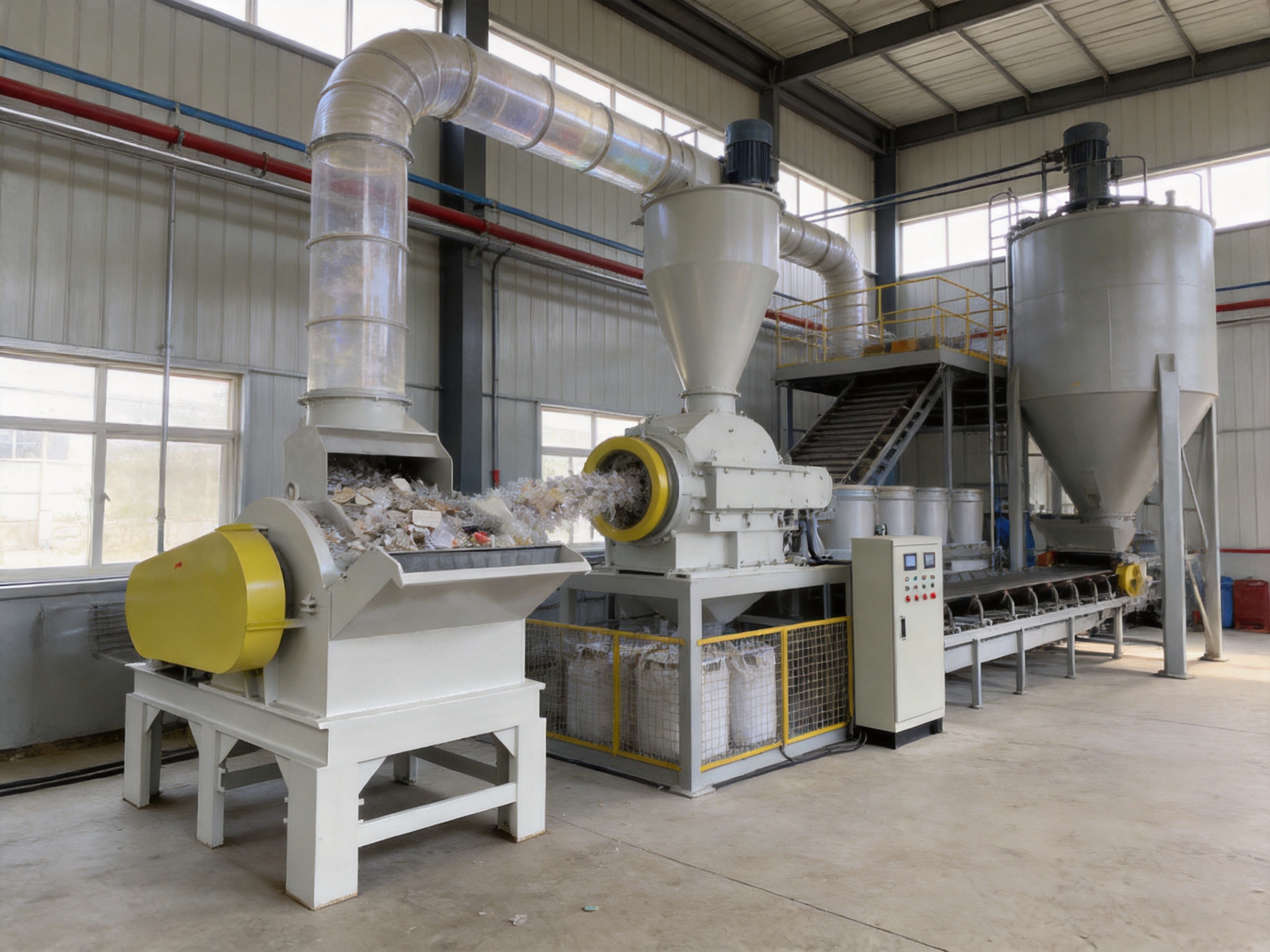
7. Automation and Electrical Control
The production line uses PLC centralized control to coordinate feeding, crushing, conveying, grinding, screening, cooling, and dust collection. Centralized control makes operation more straightforward and provides a clearer overview of system status.
Variable-frequency drives allow the operator to adjust feeding and motor speed according to the material. Different plastics require different operating conditions. A flexible film, a rigid PVC profile, and a thick engineering-plastic part should not necessarily be processed at the same feed rate or rotor speed. Frequency control allows the line to respond to these differences.
The electrical cabinet can be configured with star-delta starting or soft-start technology. These starting methods help reduce the immediate electrical impact of large motors and support smoother equipment startup. They can also reduce mechanical shock during acceleration.
One-button start and stop functions simplify the operating sequence. Interlocking controls can be used so that downstream equipment starts before upstream feeding and stops in the correct order. This helps prevent material accumulation in conveying ducts, screens, and collection bins.
Temperature sensors provide continuous information about the grinding chamber and other monitored areas. If the temperature approaches a preset limit, the control system can increase cooling, reduce feeding, issue an alarm, or stop the equipment according to the selected safety logic.
Automation does not eliminate the need for trained operators. Instead, it allows operators to focus on material inspection, quality control, routine maintenance, and production planning rather than repetitive manual switching and material transfer.
8. Application Areas
8.1 PVC Pipe, Profile, and Sheet Recycling
Waste PVC pipes, window and door profiles, flooring sheets, foam boards, and extrusion offcuts can be difficult to process because they are often long, thick, hollow, or rigid. The hammer-impact coarse crusher reduces these materials into suitable pieces, after which the disc pulverizer produces reusable powder.
The recovered PVC powder can be used in SPC flooring core layers, pipe extrusion, profile regeneration, sheet production, and other applications, subject to material sorting and quality requirements. Recycling production scrap in this way can reduce the need for virgin raw materials and lower disposal costs.
8.2 PE and PP Rotational Molding Waste
Rotational molding and blow molding operations generate waste such as barrels, tanks, containers, trash bins, toys, playground products, pallets, and production trim. PE and PP waste can be processed into powder for new rotational molding products or modified material production.
Rotational molding applications typically require powder with good flowability, predictable particle size, and reliable melting behavior. The fine-grinding, screening, and temperature-control functions of the line support these requirements. Depending on the feedstock and configuration, the final powder may be produced in ranges such as 30 to 80 mesh.
8.3 Engineering Plastics
PET, ABS, EVA, and other engineering or specialty plastics can be processed when the line is configured for their hardness, thermal behavior, and required powder size. Potential feedstocks include bottle flakes, appliance housings, automotive components, films, foamed materials, and industrial production scrap.
Engineering-plastic powder may be reused in extrusion, injection molding, compounding, modification, or other material-processing operations. Proper sorting is essential because different polymers, additives, colors, and contaminants may affect the value of the final powder.
8.4 SPC Flooring Production
SPC flooring manufacturers often require consistent mineral-polymer core-layer materials and controlled powder dispersion. Recycled PVC powder produced from suitable pipe, profile, sheet, or flooring waste can serve as a secondary raw material when it meets the required formulation and cleanliness standards.
Uniform powder size helps improve feeding and mixing. Controlled temperature during pulverizing also reduces the risk of thermal degradation that could affect color, odor, or processing performance.
8.5 Centralized Industrial Recycling Centers
Recycling centers and environmental-service companies often receive mixed industrial plastic waste from several sources. A modular crushing and pulverizing line can provide a centralized solution for preparing material for reuse, resale, or further compounding.
The enclosed conveying and dust collection systems are valuable in centralized facilities because they support cleaner workshops and help operators manage large volumes of fine material. The line can also be integrated with sorting, metal separation, storage silos, packaging, and quality-control systems.
9. Representative Technical Specifications
The following table summarizes a representative configuration for the hammer-impact swing-knife coarse-crushing section. Actual specifications may vary according to the customer’s material, capacity target, final powder requirements, and selected equipment combination.
Item |
Specification |
Remarks |
Type |
1000 |
Representative machine type |
Knife quantity |
36 rotary knives |
Configuration for coarse crushing |
Capacity |
1–2.5 tonnes per hour |
Depends on material and operating conditions |
Coarse discharge specification |
Approximately 16 millimeters |
Screen and material dependent |
Drive motor options |
55, 75, 90, or 110 kilowatts |
Selected according to workload |
Speed control |
Inverter |
Supports adjustable operating speed |
Bearing arrangement |
Imported bearings |
Reference brand: NSK |
Knife-blade material |
SKD-11 |
Wear-resistant tool steel |
Host speed |
Approximately 860 revolutions per minute |
Reference operating speed |
Feeding size |
Approximately 1,350 millimeters |
Feed-in width or applicable dimension |
Electrical cabinet |
Star-delta or soft start |
Starting method selected by configuration |
The final powder specification is determined by the disc pulverizer model, grinding-disc clearance, air volume, screening system, feed rate, and material characteristics. A technical evaluation should be completed before confirming the final equipment selection.
10. Installation, Operation, and Maintenance Considerations
Correct installation is necessary to obtain the expected performance from an integrated production line. The foundation must support the machine weight and dynamic loads. The layout should provide sufficient room for inspection, blade replacement, disc maintenance, filter-bag service, electrical access, and safe material handling.
The conveying ducts should be installed with attention to sealing, airflow direction, bends, and support points. Poorly designed ducts can increase pressure loss, reduce conveying capacity, and cause powder accumulation. The fan, cyclone, screen, and dust collector must be matched to the pulverizer so that the entire airflow system remains balanced.
Before commissioning, the operator should verify motor rotation, bearing lubrication, belt tension, knife clearance, grinding-disc clearance, electrical connections, temperature sensors, emergency stops, and dust-collection seals. The system should initially run without material to confirm that there is no abnormal vibration, noise, or overheating.
During operation, feedstock should be inspected for metal, stones, excessive moisture, and other contaminants. Metal contamination can damage knives, grinding discs, bearings, and screens. Material sorting is therefore an important part of equipment protection and final powder quality.
Routine maintenance should include inspection of knives, grinding discs, bearings, belts, screens, filter bags, duct connections, cooling lines, sensors, and electrical components. Wear parts should be replaced or sharpened according to their actual condition. Continuing to operate with severely worn knives or grinding discs can increase energy consumption and reduce powder quality.
Operators should also record production data, including throughput, motor current, temperature, vibration, powder size, and dust-collector pressure. These records make it easier to identify changes in performance before they develop into major failures.
11. Environmental and Workplace Benefits
Plastic recycling equipment must be evaluated not only by capacity but also by its environmental performance. Dust emissions, material loss, noise, energy consumption, and worker exposure can all affect the long-term sustainability of a recycling operation.
The enclosed negative-pressure conveying system helps contain airborne particles. The pulse dust collector captures fine powder generated throughout the process, while the cyclone and screening stages support material recovery. Together, these features help create a cleaner workshop and reduce the amount of plastic dust released into the surrounding environment.
Improved dust control also reduces the amount of powder settling on motors, control cabinets, bearings, and other equipment. Cleaner equipment can be easier to inspect and maintain. In addition, a cleaner working environment improves visibility and reduces the time spent on housekeeping.
Energy efficiency depends on many factors, including feedstock, motor selection, throughput, powder specification, airflow, and operating discipline. The integrated design can reduce unnecessary conveying and manual handling, while variable-frequency control allows power consumption to be matched more closely to the actual production load.
By converting waste plastic into reusable powder, the line supports resource conservation. Recovered material can replace part of the virgin resin used in suitable applications, reducing the need for new raw material and lowering the volume of plastic sent to landfill or incineration.
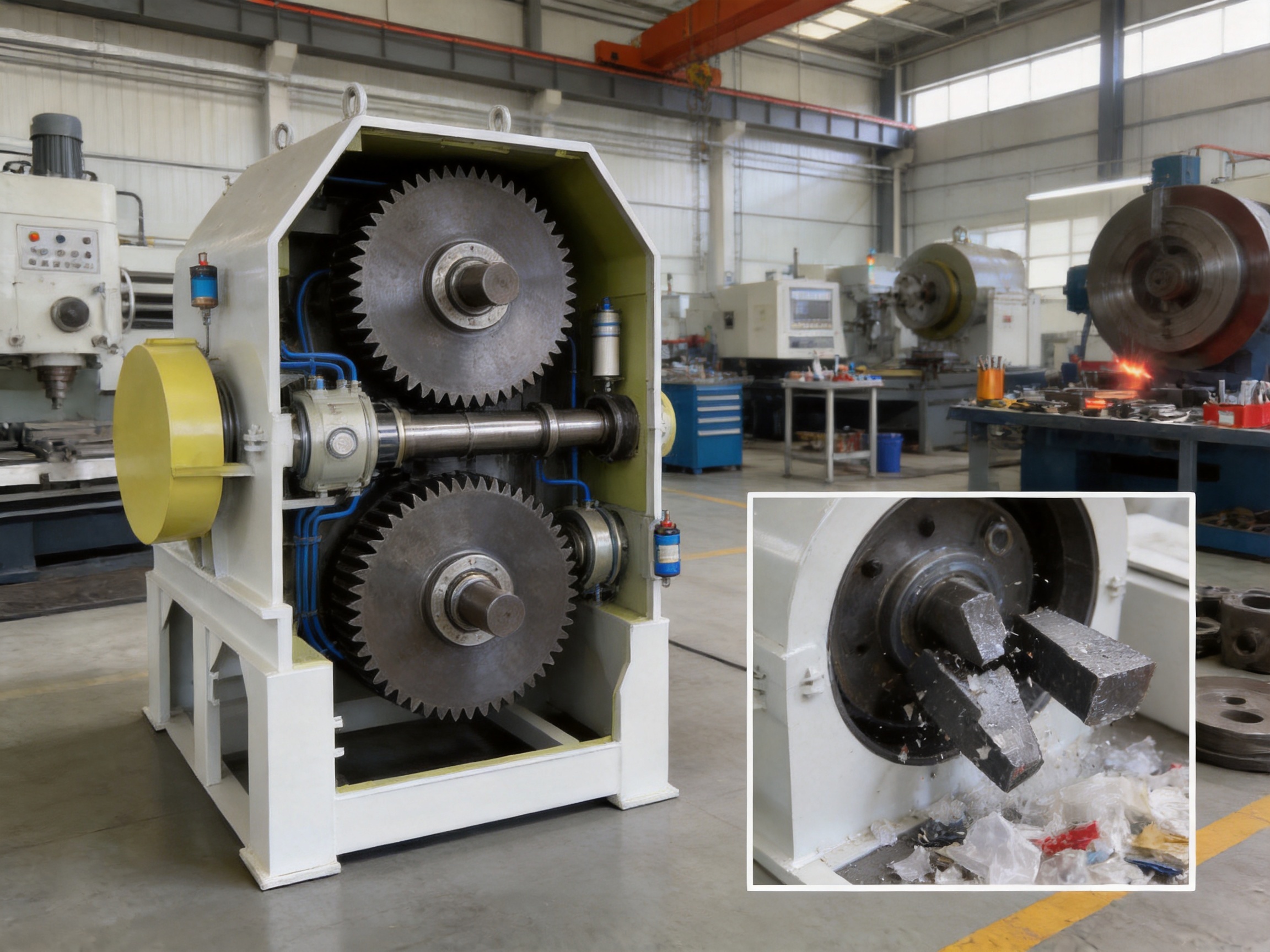
12. Why Choose an Experienced Equipment Manufacturer?
Purchasing a pulverizing line is a long-term investment. The equipment must continue to operate reliably after installation, and the supplier must be able to provide technical support, replacement parts, process recommendations, and service guidance.
An experienced manufacturer understands that a machine’s published capacity does not automatically apply to every material. Capacity is influenced by density, thickness, moisture, hardness, feed size, contamination, required mesh size, cooling conditions, and operator settings. A responsible equipment supplier therefore evaluates the customer’s material and application before confirming the design.
Changzhou Mao Yue Intelligent Equipment Co., Ltd. provides equipment for plastic crushing and pulverizing applications and has established partnerships with more than 5,000 enterprises in domestic and international markets. Its product development and manufacturing activities are focused on improving production efficiency, reducing labor intensity, and delivering stable powder quality.
The company has obtained CE mechanical certification and ISO 9001 quality management system certification. These certifications support the company’s emphasis on equipment safety, process control, documentation, and manufacturing consistency.
Its technical team studies advanced machine technologies from countries such as Germany and applies precision machining, dynamic balancing, and modern welding methods to equipment production. This combination of application knowledge and manufacturing capability helps the company develop customized solutions rather than offering only one fixed machine configuration.
Customization may include feed-in dimensions, motor power, knife quantity, cooling method, disc mill model, screen specification, dust-collection capacity, electrical control arrangement, powder packaging, and line layout. The appropriate design should always be selected according to the customer’s actual production objectives.
13. Economic Value of the Production Line
The economic value of a plastic pulverizing line comes from more than its hourly output. A complete evaluation should include raw-material recovery, labor savings, energy use, maintenance costs, downtime, powder quality, and the selling or reuse value of the final product.
By integrating coarse crushing and fine grinding, the line can reduce manual transfer and improve production continuity. Enclosed conveying helps reduce material loss, while dust collection allows more fine powder to be recovered. Stable powder quality can improve the value of the recycled material and increase its suitability for demanding applications.
Automated feeding and centralized control can reduce the number of operators required for routine production. The line also reduces the need for large open storage areas between individual process stages. These factors may lower factory-space costs and improve overall workflow.
Temperature control can provide economic benefits by reducing rejected powder, cleaning stoppages, and damage caused by overheating. Precision grinding discs and balanced rotating parts can reduce vibration and uneven wear, helping extend maintenance intervals when the equipment is operated correctly.
The actual payback period depends on the purchase price, raw-material cost, local labor rates, electricity prices, annual operating hours, material recovery rate, and final powder value. Customers should prepare a detailed project calculation before investment, using realistic production and market assumptions.
14. Selecting the Correct Configuration
The first step in selecting a production line is to define the feedstock. Customers should identify the polymer type, product form, maximum dimensions, average thickness, moisture content, contamination level, color range, and presence of metal or other foreign materials.
The second step is to determine the desired output. Important questions include the required capacity per hour, final mesh size, acceptable particle-size distribution, powder temperature, bulk density, packaging method, and whether oversize material will be returned for regrinding.
The third step is to evaluate the factory environment. Available floor space, ceiling height, foundation conditions, power supply, ventilation, cooling-water availability, dust-emission requirements, and local safety standards all affect the final layout.
The fourth step is to consider future expansion. A line may initially be designed for a modest capacity but later need to process additional materials or operate for longer hours. Selecting modular equipment and sufficient control capacity can make future expansion easier.
Material testing is recommended before final confirmation. Test samples can be used to verify coarse-crusher performance, grinding temperature, final powder size, throughput, dust collection, and energy consumption. Testing also helps identify whether additional sorting, drying, metal separation, or pre-treatment is necessary.
15. Frequently Asked Questions
15.1 What materials can this production line process?
The line is designed for many medium-hardness and impact-resistant plastics, including PVC, PE, PP, PET, ABS, and EVA. Typical feedstocks include pipes, profiles, sheets, foam boards, woven bags, pallets, barrels, containers, appliance housings, films, and molded industrial scrap. Material testing is recommended for mixed or highly contaminated waste.
15.2 What is the difference between the coarse crusher and the disc pulverizer?
The coarse crusher reduces large and irregular waste into manageable pieces, generally around the required preliminary size. The disc pulverizer then performs precision fine grinding to produce the final powder. Separating these functions improves adaptability, protects the fine grinder, and supports better powder quality.
15.3 Can the line produce powder for rotational molding?
Yes. When configured for suitable PE or PP feedstock, the line can produce uniform, free-flowing powder for rotational molding. The final particle size depends on the material, disc mill settings, screening system, and customer requirements. Clean and correctly sorted feedstock is essential.
15.4 How is overheating controlled?
The grinding section uses a reinforced dual cooling system, multiple temperature sensors, and PLC control. The system can regulate cooling and operating conditions to keep the grinding chamber within a suitable temperature range, commonly approximately 50 to 80 degrees Celsius depending on the application.
15.5 Is the production line dusty?
The line is designed with enclosed negative-pressure conveying and pulse bag dust collection. Under suitable installation and operating conditions, dust collection efficiency can exceed 99.9 percent. Proper sealing, filter maintenance, airflow adjustment, and regular inspection are necessary to maintain performance.
15.6 What capacity can the coarse-crushing section achieve?
A representative 1000-type coarse crusher configuration is rated at approximately 1 to 2.5 tonnes per hour. Actual capacity depends on polymer type, feed size, product thickness, moisture, contamination, knife condition, motor power, and the required discharge size.
15.7 What knife material is used?
The reference specification lists SKD-11 for the coarse-crusher knife blades. This tool steel is selected for hardness and wear resistance. The final knife material and heat-treatment requirement may be adjusted according to the specific plastic and operating conditions.
15.8 What grinding-disc material is used?
The disc pulverizer uses DC53 high-grade mold steel for the grinding discs. The discs are processed with high-precision CNC equipment, and rotating assemblies are dynamically balanced to support stable operation and consistent powder output.
15.9 Can the system be customized?
Yes. Customization may involve the feed inlet, motor power, knife arrangement, cooling method, disc mill model, screening system, dust collector, conveying route, control cabinet, powder collection, and overall layout. Configuration should be based on tested material and production requirements.
15.10 What certifications does the manufacturer hold?
Changzhou Mao Yue Intelligent Equipment Co., Ltd. has obtained CE mechanical certification and ISO 9001 quality management system certification. These certifications support its focus on product safety, manufacturing quality, and standardized management.
15.11 How can powder quality be maintained?
Powder quality depends on clean feedstock, stable feeding, correct grinding-disc clearance, suitable temperature, proper airflow, effective screening, and regular maintenance. Operators should monitor particle size, color, temperature, bulk density, and the presence of oversized particles.
15.12 Is this line suitable for a centralized recycling facility?
Yes. Its modular structure, enclosed conveying, dust collection, automated control, and broad material adaptability make it suitable for industrial plastic recycling centers, environmental enterprises, recycling stations, and plastic-processing plants.
16. Conclusion
The hammer-impact swing-knife crushing and pulverizing production line provides an integrated approach to plastic size reduction. Its heavy-duty coarse crusher handles large and irregular waste, while the precision disc pulverizer produces controlled fine powder. Negative-pressure conveying, cyclone separation, vibrating screening, dual cooling, PLC automation, and pulse dust collection work together to create a stable and efficient production process.
The line offers important advantages over conventional separate crushing and grinding systems, including broader material adaptability, reduced manual handling, improved dust control, more consistent powder quality, better temperature management, flexible layout, and lower overall operating complexity.
Its performance is supported by the manufacturing strengths of Changzhou Mao Yue Intelligent Equipment Co., Ltd., including long-term industry experience, six specialized workshops, Taiwan-imported precision grinding equipment, CNC tooth-by-tooth processing, German dynamic balancing technology, Japanese welding systems, wear-resistant materials, imported bearings, and certified quality-management practices.
For plastic recyclers and manufacturers seeking to convert bulky waste into useful powder, the system provides a practical route toward higher material recovery and improved production efficiency. The best results are achieved when the equipment is selected through material testing, application analysis, and a complete evaluation of capacity, powder size, cooling, dust control, layout, and future expansion requirements.
References
1. Technical information supplied for the hammer-impact swing-knife crushing and pulverizing production line.
2. Technical information supplied for the 1000-type hammer-blade coarse crusher configuration.
3. Technical information supplied for disc pulverizer grinding-disc materials, CNC processing, and dynamic balancing.
4. Technical information supplied for negative-pressure conveying, cyclone separation, vibrating screening, and pulse dust collection.
5. Technical information supplied for plastic recycling applications, including PVC, PE, PP, PET, ABS, EVA, rotational molding, SPC flooring, and engineering-plastic recovery.
6. General principles of polymer size reduction, industrial dust collection, particle classification, and recycling process design.
7. General principles of PLC automation, variable-frequency motor control, industrial cooling, and preventive maintenance for plastic-processing equipment.